

Security News
Risky Biz Podcast: AI Agents Are Raising the Stakes for Software Supply Chain Security
Open source attacks are accelerating as AI coding agents pull in dependencies faster, with less human review.
By Sarah Gooding - Jun 30, 2026
@fluojs/notifications
Advanced tools
Channel-agnostic notification orchestration with optional queue and lifecycle event seams for Fluo.
English 한국어
Channel-agnostic notification orchestration for fluo. It freezes the shared contract for notification channels, provides a Nest-like module API, and exposes optional queue-backed delivery and lifecycle event publication seams.
npm install @fluojs/notifications
NotificationsService instead of provider-specific SDKs or transport details.Register notifications with NotificationsModule.forRoot(...) or NotificationsModule.forRootAsync(...).
import { Module } from '@fluojs/core';
import {
  NotificationsModule,
  type NotificationChannel,
} from '@fluojs/notifications';

const emailChannel: NotificationChannel = {
  channel: 'email',
  async send(notification) {
    console.log('sending email', notification.subject, notification.payload);

    return {
      externalId: 'email-123',
      metadata: { provider: 'demo-email' },
    };
  },
};

@Module({
  imports: [
    NotificationsModule.forRoot({
      channels: [emailChannel],
    }),
  ],
})
export class AppModule {}
NotificationsServiceimport { Inject } from '@fluojs/core';
import { NotificationsService } from '@fluojs/notifications';
@Inject(NotificationsService)
export class WelcomeService {
constructor(private readonly notifications: NotificationsService) {}
async sendWelcomeEmail(userId: string, email: string) {
await this.notifications.dispatch({
channel: 'email',
recipients: [email],
subject: 'Welcome to fluo',
payload: {
template: 'welcome-email',
userId,
},
});
}
}
NotificationsModule.forRoot(...) and NotificationsModule.forRootAsync(...) export NotificationsService, NOTIFICATIONS, and NOTIFICATION_CHANNELS as global providers. Application services should declare dependencies with fluo's class-level @Inject(...) decorator so the standard-decorator DI container can resolve the service without parameter decorators.
Use the optional queue seam when many notifications should be deferred to background workers.
NotificationsModule.forRoot({
  channels: [emailChannel],
  queue: {
    adapter: {
      async enqueue(job) {
        return queue.enqueue(job);
      },
      async enqueueMany(jobs) {
        return Promise.all(jobs.map((job) => queue.enqueue(job)));
      },
    },
    bulkThreshold: 50,
  },
});
Behavioral contract notes:
bulkThreshold.dispatch() stays direct by default even when a queue adapter is configured. Use dispatch(..., { queue: true }) to opt one single notification into queue-backed delivery.dispatch(..., { queue: false }) to force direct delivery even when a queue adapter exists.dispatchMany(...).dispatchMany(..., { continueOnError: true }) collects failures instead of throwing on the first failed direct delivery.notification.dispatch.failed lifecycle events before rethrowing the enqueue error to the caller.enqueueMany(...) is unavailable, bulk queue delivery falls back to enqueueing each job individually.Publish caller-visible lifecycle events without coupling the foundation package to @fluojs/event-bus directly.
NotificationsModule.forRoot({
  channels: [emailChannel],
  events: {
    publishLifecycleEvents: true,
    publisher: {
      async publish(event) {
        await eventBus.publish(event);
      },
    },
  },
});
Published event names:
notification.dispatch.requestednotification.dispatch.queuednotification.dispatch.deliverednotification.dispatch.failedIf events.publisher is configured, lifecycle event publication defaults to on unless publishLifecycleEvents: false is set. Channel deliveries that omit externalId receive a deterministic fallback delivery id so dispatch results remain stable for callers.
The foundation package intentionally does not:
process.env directly@fluojs/queue or @fluojs/event-bus concrete runtime typesThese limitations are part of the package contract so leaf packages can evolve independently while sharing one stable orchestration layer.
NotificationsModule.forRoot(options) / NotificationsModule.forRootAsync(options)NotificationsServiceNotificationsService.createPlatformStatusSnapshot()NOTIFICATIONSNOTIFICATION_CHANNELSNotificationDispatchRequestNotificationDispatchOptionsNotificationDispatchManyOptionsNotificationDispatchResultNotificationDispatchFailureNotificationDispatchStatusNotificationChannelNotificationChannelContextNotificationChannelDeliveryNotificationPayloadNotificationsQueueAdapterNotificationsQueueJobNotificationsAsyncModuleOptionsNotificationsEventsOptionsNotificationsEventPublisherNotificationLifecycleEventNotificationLifecycleEventNamecreateNotificationsPlatformStatusSnapshot(...)NotificationsPlatformStatusSnapshotNotificationsStatusAdapterInputNotificationsConfigurationErrorNotificationChannelNotFoundErrorNotificationQueueNotConfiguredErrorStatus snapshots include operationMode, dependency diagnostics, ownership, readiness, and health fields for platform diagnostics.
@fluojs/queue: Recommended when bulk notification delivery should run in the background.@fluojs/event-bus: Recommended when notification lifecycle events should be published to the wider app.@fluojs/config: Recommended for passing provider configuration into forRootAsync() without direct environment access.packages/notifications/src/module.test.ts: Module registration, async wiring, queue seam, and tolerant bulk dispatch examples.packages/notifications/src/public-surface.test.ts: Public contract verification for root exports and TypeScript-only types.packages/notifications/src/status.test.ts: Health/readiness contract examples.FAQs
Channel-agnostic notification orchestration with optional queue and lifecycle event seams for Fluo.
The npm package @fluojs/notifications receives a total of 33 weekly downloads. As such, @fluojs/notifications popularity was classified as not popular.
We found that @fluojs/notifications demonstrated a healthy version release cadence and project activity because the last version was released less than a year ago. It has 1 open source maintainer collaborating on the project.
Did you know?

Socket for GitHub automatically highlights issues in each pull request and monitors the health of all your open source dependencies. Discover the contents of your packages and block harmful activity before you install or update your dependencies.
Security News
Open source attacks are accelerating as AI coding agents pull in dependencies faster, with less human review.

Research
/Security News
Malicious Chrome and Firefox extensions posed as free VPNs while stealing clipboard data through later extension updates.
Research
/Security News
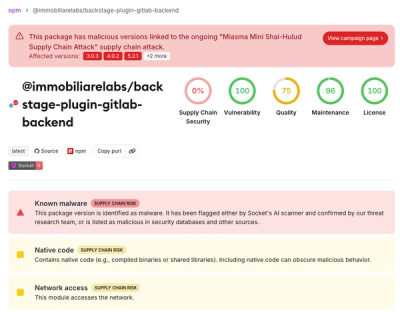
Miasma Mini Shai-Hulud hits @immobiliarelabs Backstage plugins, targeting GitLab and LDAP auth packages on npm.