

Product
PHP and Composer Support Is Now in Beta
Socket’s PHP and Composer support is now in Beta for all customers, with PHP reachability analysis generally available.
By Trevor Norris, Benjamin Barslev - Aug 21, 2026
@foldkit/devtools-mcp
Advanced tools
MCP server exposing Foldkit DevTools to AI agents (Claude Code, Cursor, etc.)
A Model Context Protocol server that exposes a running Foldkit app to AI agents (Claude Code, Codex, Cursor, Windsurf, anything that speaks MCP).
With it attached, agents can:
Message SchemaProjects scaffolded with create-foldkit-app ship with the MCP server pre-wired. Open the project in your AI agent and the tools appear under the foldkit-devtools prefix.
For existing projects, run the init command in your project root:
npx @foldkit/devtools-mcp init
This writes a .mcp.json (or merges into an existing one) so any MCP-aware agent picks up the server.
For faster startup, install the MCP server as a devDependency. Otherwise npx fetches it on each AI agent restart:
npm install -D @foldkit/devtools-mcp
# or
pnpm add -D @foldkit/devtools-mcp
# or
yarn add -D @foldkit/devtools-mcp
Then make two edits to your project.
In vite.config.ts, pass devToolsMcpPort to the Foldkit plugin so it opens the relay:
import { foldkit } from '@foldkit/vite-plugin'
import { defineConfig } from 'vite'

export default defineConfig({
  plugins: [foldkit({ devToolsMcpPort: 9988 })],
})
In your Runtime.makeProgram call, pass your Message Schema. The runtime decodes every dispatched payload against it, returning a clean error if the shape does not match before it reaches your update function:
Runtime.makeProgram({
  devTools: {
    // Rest of your DevTools config
    Message,
  },
})
Restart your dev server, then restart your AI agent. The MCP server will appear with the foldkit_* tools attached.
The browser bridge runs inside your app, so the MCP server only sees a runtime while the app is open in a browser tab. Close the tab and the runtime disappears from foldkit_list_runtimes.
Each tool accepts an optional runtime_id. When omitted, the most recently connected runtime is used.
| Tool | Description |
|---|---|
foldkit_list_runtimes | Returns metadata for every connected browser tab. Agents call this first to discover which runtime to target. |
foldkit_get_model | Snapshots the current Model. Accepts an optional path to narrow to a subtree and expand to control summarization. |
foldkit_get_model_at | Snapshots a historical Model after a given history entry. Pass index: N - 1 to read the Model just before message N. Same path/expand semantics as foldkit_get_model. For the initial Model (and init Command names), use foldkit_get_init. |
foldkit_get_init | Reads the recorded initial Model and the names of Commands returned from the application's init function. Equivalent to selecting the synthetic "init" row in the DevTools panel. |
foldkit_get_runtime_state | Snapshots the runtime's DevTools state: history bounds, current paused/live status, and whether init is recorded. Useful for understanding what foldkit_list_messages and foldkit_get_message will see and detecting whether the runtime is paused. |
foldkit_list_messages | Lists recent Message history entries with pagination. Each entry carries the Message body, Command names triggered, timestamp, an isModelChanged flag, the diff path lists (changedPaths / affectedPaths), and any extracted Submodel chain. |
foldkit_get_message | Reads one entry at a given index. The response carries the SerializedEntry only; to inspect the Model around the entry, call foldkit_get_model_at with index - 1 (before) and index (after). Use foldkit_get_init for the synthetic init entry. |
foldkit_list_keyframes | Returns the indices Foldkit can replay back to. Index -1 is the initial Model. |
foldkit_replay_to_keyframe | Time-travels the runtime to a previous state. The runtime is paused at that snapshot until foldkit_resume is called. |
foldkit_resume | Resumes normal execution after a replay. |
foldkit_dispatch_message | Enqueues a Message into the runtime as if your application produced it. The runtime decodes the payload against your Schema and returns a clean error if it does not match. |
foldkit_get_model and foldkit_get_model_at are designed for AI agents reading state into a token-bounded context. Two parameters control the payload size:
path is a dot-string anchored at root that narrows the response to a subtree. The alphabet matches the changedPaths array on each SerializedEntry, so a path observed in foldkit_list_messages can be passed straight back. Examples: 'root' (the whole Model), 'root.route', 'root.session.user', 'root.cards.0'. When the path doesn't resolve, the response is an error listing the keys available at the deepest segment that did resolve, so the agent can refine in one follow-up call.expand controls summarization. By default (false), large arrays collapse to { _summary: 'array', length, sample: [head, last] }, deeply nested records collapse to { _summary: 'record', keys }, and long strings collapse to { _summary: 'string', length, head }. Tagged-union variants ({ _tag, ... }) keep their tag and recursively summarize children. With expand: true, the literal value at the path is returned with no summarization. Pair a narrow path with expand: true to read a specific subtree at full fidelity without paying for the rest of the Model.Three components cooperate:
foldkit): runs alongside DevTools, subscribes to the DevTools store, and exchanges typed frames over Vite's HMR WebSocket.@foldkit/vite-plugin): opens a separate WebSocket server on devToolsMcpPort and forwards traffic between browsers and MCP clients.Multiple browser tabs can be connected at once and each is addressable by its connection id. Tabs that close (gracefully or not) are pruned from the live runtime list automatically.
| Environment variable | Default | Description |
|---|---|---|
FOLDKIT_DEVTOOLS_MCP_HOST | localhost | Hostname of the Vite plugin relay. |
FOLDKIT_DEVTOOLS_MCP_PORT | 9988 | Port the Vite plugin relay listens on. Must match devToolsMcpPort in your Vite config. |
devTools: false in your program config, the bridge does not start and the runtime is invisible to MCP. The default enables the bridge in dev.Message in your DevToolsConfig, dispatch is rejected. The other (read-only) tools still work.show setting.See foldkit.dev/ai/mcp for the full guide.
MIT
FAQs
MCP server exposing Foldkit DevTools to AI agents (Claude Code, Cursor, etc.)
The npm package @foldkit/devtools-mcp receives a total of 5,057 weekly downloads. As such, @foldkit/devtools-mcp popularity was classified as popular.
We found that @foldkit/devtools-mcp demonstrated a healthy version release cadence and project activity because the last version was released less than a year ago. It has 1 open source maintainer collaborating on the project.
Product
Socket’s PHP and Composer support is now in Beta for all customers, with PHP reachability analysis generally available.
Product
Socket is bringing experimental protection to Firefox, scanning 97,000+ extensions in Mozilla's official directory for malware and risky updates.
Research
/Security News
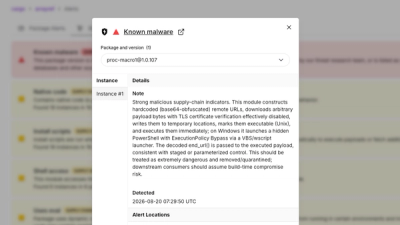
Three compromised Rust crates pulled in a malicious dependency that downloaded and executed cross-platform malware during Cargo builds.