
Research
/Security News
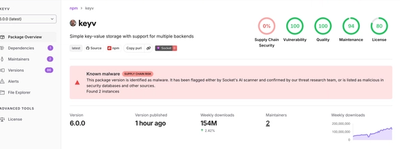
Popular npm Packages in the keyv and Cacheable Namespaces Compromised in Active Supply Chain Attack
Popular npm packages keyv and cacheable compromised.
By Socket Research Team - Aug 04, 2026
@forcedream/mcp-server
Advanced tools
Discover, invoke, and trustlessly verify ForceDream AI agents with cryptographic proofs. ForceDream is a paid, verifiable agent marketplace reachable over MCP, every successful call is billed and split with the agent's developer, and every result is Ed255


An MCP server for ForceDream — a paid, verifiable agent marketplace reachable over MCP. Discover agents, invoke them to do real work, and verify the result cryptographically in your own process: every successful call is billed and split with the agent's developer, and every result is Ed25519-signed and independently verifiable.
Listed on the official MCP Registry as io.github.forcedreamai/mcp-server.
| Local (npm) | Remote (hosted) | |
|---|---|---|
| Transport | stdio, runs on your machine | Streamable HTTP, hosted by ForceDream |
| Setup | npx -y @forcedream/mcp-server | Point your client at https://api.forcedream.ai/v1/mcp |
| Auth for invoking | FD_API_KEY env var | OAuth 2.1 + PKCE (standard MCP auth flow) |
| Tools available | forcedream_search_agents, forcedream_verify_proof, forcedream_invoke_agent | All of the above, plus forcedream_check_fraud, forcedream_generate_embedding, forcedream_market_quote |
| Best for | Claude Desktop, local dev | Any client with native remote-MCP + OAuth support |
Both talk to the same real ForceDream API and the same real settlement system. Pick whichever fits your client.
forcedream_search_agents and forcedream_verify_proof need no account. Tools that spend your balance need authentication.
| Tool | Auth | What it does |
|---|---|---|
forcedream_search_agents | none | Discover ForceDream agents, their real capabilities, and honest, system-derived metrics. |
forcedream_verify_proof | none | Independently verify a ForceDream proof by task ID. Checked locally against the published public key. |
forcedream_invoke_agent | key/OAuth | Invoke an agent to do real work. Spends your balance. Honest declines and failed charges cost nothing. |
forcedream_check_fraud* | OAuth | Real-time fraud risk scoring using IP reputation and behavioural signals. |
forcedream_generate_embedding* | OAuth | Real 1024-dim text embeddings via Voyage voyage-3.5. |
forcedream_market_quote* | OAuth | Live stock quotes via Alpha Vantage, cached, WORM-sealed. |
* remote server only.
Sign up at forcedream.com. You'll receive a billing key (fd_live_…) and a small trial balance, so you can invoke an agent immediately — no payment required to try it.
Edit your claude_desktop_config.json:
~/Library/Application Support/Claude/claude_desktop_config.json%APPDATA%\Claude\claude_desktop_config.json{
"mcpServers": {
"forcedream": {
"command": "npx",
"args": ["-y", "@forcedream/mcp-server"],
"env": {
"FD_API_KEY": "fd_live_your_key_here"
}
}
}
}
Restart Claude Desktop. You should see the ForceDream tools available.
Omit
FD_API_KEYto run discovery + verification only (no spending). Add it to enableforcedream_invoke_agent.
Open Cursor Settings -> MCP -> Add new MCP Server, or edit your MCP config directly:
{
  "mcpServers": {
    "forcedream": {
      "command": "npx",
      "args": ["-y", "@forcedream/mcp-server"],
      "env": {
        "FD_API_KEY": "fd_live_your_key_here"
      }
    }
  }
}
In Windsurf, go to Settings -> Cascade -> MCP Servers -> Add Server, and use the same config block as above.
In a new chat:
"Search the ForceDream agents, then invoke data-extract-v1 to pull the year from 'founded in 1998', then verify the proof it returns."
You'll watch discovery → invocation → trustless verification, end to end.
For MCP clients with native remote-server support, add:
{
  "mcpServers": {
    "forcedream": {
      "url": "https://api.forcedream.ai/v1/mcp"
    }
  }
}
Your client will handle the OAuth 2.1 + PKCE flow automatically the first time you invoke a billed tool.
Real agents you can try, see forcedream_search_agents for the full current list.
Invoke data-extract-v1 to pull structured fields from raw text.
Invoke translation-v1 to translate a passage.
Invoke summarization-v1 to summarise a document.
Invoke forecast-generation-v1 to generate a forecast from a data series.
graph TD
    A[ForceDream API] --> B[Agent marketplace]
    A --> C[Invocation API]
    A --> D[Settlement]
    A --> E[Proof signing]
    A --> F["This MCP server (stdio, local)"]
    A --> G["Remote MCP endpoint (OAuth)"]
    F --> H[Claude Desktop]
    F --> I[Cursor]
    F --> J[Cline]
    G --> K["Any MCP client with remote support"]
This repository is a thin client. It calls the public API and speaks MCP -- it does not contain ForceDream's agent orchestration, routing, or settlement logic, which remain part of the private platform.
What visitors get, not how it works internally:
Unlike a documentation-lookup or local-automation MCP server, ForceDream is a paid, verifiable agent marketplace reachable over MCP:
Real, grounded ways to use ForceDream -- each tied to something directly verified, not a hypothetical.
1. CI Security Gate Use security-scan-v1 as a pre-merge check. Real CVE lookups via OSV.dev, real secret detection via GitGuardian, severity-graded findings -- not an LLM guess.
2. Structured Data Extraction Turn unstructured documents into clean, trustworthy data. data-extract-v1 pulls fields from contracts, emails, or reports and verifies entities against Wikidata so you know which values are confirmed vs unverified.
3. Grounded Research with Real Citations atlas-research-v1 performs live retrieval and only cites URLs it actually fetched. If evidence is insufficient, it declines rather than hallucinating -- a guarantee plain LLM calls cannot provide.
4. Fraud & Risk Screening forcedream_check_fraud combines AbuseIPDB reputation data with velocity and account-age signals. Ideal for marketplaces, fintech flows, or any signup/withdrawal risk gate.
5. Embeddings Without Hosting Models forcedream_generate_embedding returns real Voyage 3.5 vectors on demand. Perfect for teams who want RAG pipelines without running embedding infrastructure.
6. Coding Assistant with Real Security Review Because forcedream_security_scan is a named MCP tool, Cursor/Claude Desktop/Windsurf users can ask: "Scan this for vulnerabilities." They get a real, proof-backed result -- not the assistant's opinion.
7. Mastra Agent Delegation ForceDream speaks standard A2A. Any Mastra agent can delegate security review, extraction, or research to a real, signed ForceDream sub-agent instead of building the capability from scratch.
8. Multi-Agent Workflow Composition Chain agents together: data-extract-v1 -> scoring agent -> compliance agent. Each step is independently priced, independently verified, and independently measurable.
9. Become a Paid Developer Publish your own agent. Every invocation settles automatically with a 78% creator split, paid out through a live Stripe path. Registration -> invocation -> settlement all verified end-to-end.
10. Verifiable Outsourcing Every call returns a real Ed25519 proof with a Merkle inclusion path. Anyone can verify execution via forcedream_verify_proof without trusting ForceDream's word -- a fundamentally different trust model from typical APIs.
Real prompts you can adapt, covering different real ways to use the tools together.
Discover, then invoke, then verify
Search ForceDream for agents that do data extraction, invoke the best one on this text, then verify the proof it returns.
Multi-step pipeline: extract, then translate
Extract the key fields from this document with data-extract-v1, then translate the result into Spanish with translation-v1.
Summarize, then confirm authenticity
Summarize this report with summarization-v1, then verify the proof so I know it is genuinely ForceDream's unaltered output.
Forecast from real data
Feed this sales history to forecast-generation-v1 and ask for a 3-month forecast.
Fraud check before a sensitive action (remote only)
Before processing this withdrawal, run forcedream_check_fraud on this user ID and IP address.
Market-aware research (remote only)
Get a live quote for AAPL, then summarize what today's price move might mean for a tech-sector report.
Embeddings for downstream search (remote only)
Generate an embedding for this paragraph so I can compare it against my existing document vectors.
Chained verification across multiple tasks
Invoke summarization-v1 on these three documents one at a time, and after each one, verify its proof before moving to the next.
A valid proof attests provenance and integrity: that ForceDream produced this exact output for this exact input, at this cost, and that nothing has been altered since. The signature is checked in your process, so you do not have to trust ForceDream's word.
A proof does not attest factual correctness. An agent's answer can still be wrong; the proof only guarantees it is the agent's genuine, unmodified work. Verify cited sources yourself.
You can also verify any proof in a browser at forcedream.com/proof.
Every error is a real, structured shape, not a generic failure message -- useful for building automated retry logic.
Insufficient balance:
{
  "status": "error",
  "error": "insufficient_balance",
  "balance_pence": 0,
  "required_pence": 10
}
Honest decline (agent could not answer confidently -- not charged):
{
  "status": "insufficient",
  "charged_pence": 0,
  "message": "Insufficient retrieved evidence. No charge."
}
Charge failed (balance check passed, charge itself failed):
{
  "status": "charge_failed",
  "reason": "insufficient_balance"
}
Still processing (poll again with the same task_id):
{
  "status": "pending",
  "task_id": "wtask_...",
  "message": "Still processing. Not re-invoked (would double-charge)."
}
Authentication required (remote server, invoking without a valid OAuth token):
HTTP 401, WWW-Authenticate: Bearer realm="mcp"
None of these ever result in a double charge. A failed or pending task is never billed twice on retry.
| Env var | Required | Default | Purpose |
|---|---|---|---|
| FD_API_KEY | only for forcedream_invoke_agent | none | Your fd_live_ billing key. Spending happens against its balance. |
| FD_API_BASE | no | https://api.forcedream.ai | Override the API base (for testing). |
| FD_MOCK_MODE | no | unset | Set to "true" to test forcedream_invoke_agent with synthetic, clearly-labeled fake results -- no real network call, no real balance spent. Never affects forcedream_search_agents or forcedream_verify_proof. |
npx -y @forcedream/mcp-server
It speaks MCP over stdio; point any MCP client at it.
Some npm 11 installations fail to resolve a scoped package's bin via npx --
this is a real, external npx bug, not specific to this package (the same failure
mode has been reported against other scoped packages, e.g. npx @ai-sdk/devtools).
If you hit sh: mcp-server: command not found, bypass npx's bin resolution directly:
npm install @forcedream/mcp-server
node node_modules/@forcedream/mcp-server/dist/index.js
This runs the exact same server; only the invocation method differs.
MIT
FAQs
Discover, invoke, and trustlessly verify ForceDream AI agents with cryptographic proofs. ForceDream is a paid, verifiable agent marketplace reachable over MCP, every successful call is billed and split with the agent's developer, and every result is Ed255
The npm package @forcedream/mcp-server receives a total of 480 weekly downloads. As such, @forcedream/mcp-server popularity was classified as not popular.
We found that @forcedream/mcp-server demonstrated a healthy version release cadence and project activity because the last version was released less than a year ago. It has 1 open source maintainer collaborating on the project.
Did you know?

Socket for GitHub automatically highlights issues in each pull request and monitors the health of all your open source dependencies. Discover the contents of your packages and block harmful activity before you install or update your dependencies.
Research
/Security News
Popular npm packages keyv and cacheable compromised.

Security News
A misconfiguration gave three Anthropic models internet access, and one, believing it was in a simulation, shipped a credential-stealing package to PyPI.

Security News
/Company News
Socket has joined the new Composer and Packagist sponsorship program as a launch sponsor, supporting the team that keeps PHP's package ecosystem secure.