
Product
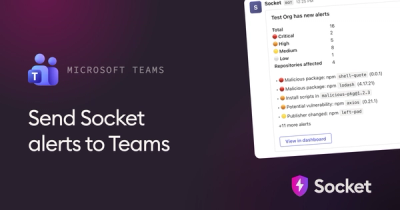
Microsoft Teams Notifications Are Now Available in Socket
Socket can now send alerts and supply chain attack notifications to Microsoft Teams, with filters that route the right updates to each channel.
By Jeppe Hasseriis - Sep 01, 2026
@formatika/sdk
Advanced tools
JavaScript SDK for formatika.app — convert, compress and clean up files from your own code
JavaScript and TypeScript client for formatika.app — convert, compress and clean up files from your own code.
One call does the whole round trip: upload, queue the job, follow it, hand you the result. No key is needed to start: without one you get the same free daily allowance a person gets in the browser.
npm install @formatika/sdk
import { readFile, writeFile } from 'node:fs/promises'
import { Formatika } from '@formatika/sdk'

const formatika = new Formatika()

const result = await formatika.run({
  tool: 'image.convert',
  files: { filename: 'photo.heic', data: await readFile('photo.heic') },
  params: { format: 'webp', quality: 82 },
})

for (const file of result.files) {
  await writeFile(file.filename, await file.download())
}
Works anywhere fetch does — Node 20+, Bun, Deno, edge runtimes. Nothing from
node: is imported, so bundlers have nothing to shim.
const formatika = new Formatika({ apiKey: process.env.FORMATIKA_API_KEY })
FORMATIKA_API_KEY is picked up from the environment on its own, so passing
apiKey is only needed when you keep the key somewhere else. Create keys in
your account.
Without a key the client is an anonymous caller with the free daily allowance. With a key the allowance is larger, and work beyond it is paid with credits.
const tools = await formatika.tools()
// → { id: 'image.convert', title, description, accept, maxFiles, params: <JSON Schema> }
params is the very schema the service validates against, so it can be fed to
a form generator, a validator or an agent without being copied by hand. The
list is live: tools added to formatika show up here without a new release of
this package.
const controller = new AbortController()
setTimeout(() => controller.abort(), 30_000)

const result = await formatika.run({
  tool: 'video.compress',
  files: bigVideo,
  params: { targetMB: 24 },
  onProgress: (percent) => console.log(percent),
  signal: controller.signal,
})
Aborting stops the work on the server too, not just the waiting: a running
encode is cancelled within a second. The same happens when the wait runs out
(timeoutMs, three minutes by default) — nothing is left burning CPU for a
result nobody is waiting for.
import { FormatikaError } from '@formatika/sdk'

try {
  await formatika.run({ tool: 'image.convert', files, params: { format: 'webp' } })
} catch (error) {
  if (error instanceof FormatikaError) {
    error.code // 'RATE_LIMITED' | 'QUOTA_EXCEEDED' | 'UNSUPPORTED_FORMAT' | …
    error.retryable // whether repeating the same call makes sense
    error.retryAfterSeconds // when the service told us how long to wait
  }
}
Retries are yours to make, deliberately. Repeating a job means a second job and a second charge, so the client never does it behind your back — it tells you whether repeating is sensible and, when the service said so, how long to wait.
A failed job raises the job's own code (ENGINE_FAILED, CORRUPT_INPUT, …),
not the HTTP status: the request went fine, the work did not.
run is the whole path; the steps are public too, when you need to hold the
pieces yourself — a queue of your own, progress in a database, a job outliving
the process:
const upload = await formatika.upload('pdf.merge', file)
const job = await formatika.createJob({ tool: 'pdf.merge', uploadIds: [upload.id] })

const done = await formatika.wait(job.id) // or poll formatika.job(job.id) yourself
const bytes = await formatika.download(done.files[0])

await formatika.cancel(job.id) // while it is queued or running
Result links are signed and short-lived: they are made to be downloaded now, not stored.
Files are processed and deleted; results live for a limited time and then go. Nothing is kept for training, analysis or resale — that is the point of the service, not a footnote.
@formatika/mcpMIT
FAQs
JavaScript SDK for formatika.app — convert, compress and clean up files from your own code
The npm package @formatika/sdk receives a total of 5 weekly downloads. As such, @formatika/sdk popularity was classified as not popular.
We found that @formatika/sdk demonstrated a healthy version release cadence and project activity because the last version was released less than a year ago. It has 1 open source maintainer collaborating on the project.
Product
Socket can now send alerts and supply chain attack notifications to Microsoft Teams, with filters that route the right updates to each channel.

Security News
pnpm 12 rewrites the package manager in Rust, cutting install times by up to 90% while preserving pnpm 11 workflows and lockfiles.
Security News
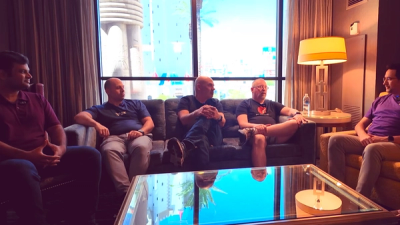
Socket CTO Ahmad Nassri joins AppSec leaders at Black Hat to discuss active malware, package manager risks, and software supply chain defense.