

Company News
AWS Security Hub Adds Socket for Supply Chain Security
Socket is now in the AWS Security Hub Extended plan. Adopt it through AWS, apply committed spend, and block malicious open source packages.
By Feross Aboukhadijeh - Aug 04, 2026
@formio/mcp
Advanced tools
The MCP server (@formio/mcp) is independently usable from any MCP-aware client. It speaks stdio: the client spawns it and owns stdin/stdout. There is no port to open and nothing to start by hand.
From a clone of this repo, the entry point is src/stdio.ts:
pnpm install
pnpm --filter @formio/mcp exec tsx src/stdio.ts
Run that way it waits for MCP traffic on stdin, which only tells you it starts cleanly — point a client at the command instead. A built package exposes the same entry point as the formio-mcp bin and as dist/stdio.js.
| Transport | Command | Compatible with |
|---|---|---|
| stdio | npx -y @formio/mcp (or node dist/stdio.js) | Claude Code, Claude Desktop, Cursor, VS Code, Windsurf, Cline — anything that speaks MCP over stdio |
There is no HTTP or SSE transport. The server's only HTTP listener is the temporary browser-login page described under Authentication, which carries no MCP traffic.
The same stdio entry works everywhere; only the file the config goes in changes — .mcp.json in a project for Claude Code, claude_desktop_config.json for Claude Desktop, and each editor's own MCP settings elsewhere:
{
  "mcpServers": {
    "formio-mcp": {
      "command": "npx",
      "args": ["-y", "@formio/mcp"],
      "env": {
        "FORMIO_PROJECT_URL": "https://your-project.form.io"
      }
    }
  }
}
Standalone (non-plugin) mode needs FORMIO_PROJECT_URL before any tool that reaches Form.io will work; FORMIO_BASE_URL is optional and defaults to https://api.form.io, so set it when self-hosting. In plugin mode the plugin manages both, via Claude Code's user-config plus the per-cwd ~/.formio/projects.json mapping.
The server starts without either one, so a client can connect and list the tools before anything is configured — the project URL is only demanded at the point a tool needs it, and hello works regardless.
The server ships a Dockerfile and is published to Docker Hub as formio/mcp for linux/amd64 and linux/arm64. The image speaks stdio, so the MCP client owns stdin/stdout and the container must be run with -i:
docker run -i --rm \
  -e FORMIO_PROJECT_URL=https://your-project.form.io \
  -e FORMIO_API_KEY=your-api-key \
  formio/mcp
Wired into a client — the same mcpServers entry as Connect a client, with command and args pointed at Docker — that becomes:
{
  "mcpServers": {
    "formio-mcp": {
      "command": "docker",
      "args": [
        "run", "-i", "--rm",
        "-e", "FORMIO_PROJECT_URL",
        "-e", "FORMIO_API_KEY",
        "formio/mcp"
      ],
      "env": {
        "FORMIO_PROJECT_URL": "https://your-project.form.io",
        "FORMIO_API_KEY": "your-api-key"
      }
    }
  }
}
FORMIO_API_KEY is the recommended path — no browser, nothing interactive. Browser login also works if you publish the auth port; see Headless environments for both.
Two container-specific notes regardless of auth mode. Prefer FORMIO_PROJECT_URL over the project_set tool: project_set persists its per-directory mapping to ~/.formio/projects.json, which lives inside the container and is discarded when it exits. And the cwd argument every tool takes refers to a path inside the container, not on your host.
To reuse a token across container runs, mount the cache directory — it must be writable, since the server rewrites the file when a token is refreshed or cleared:
-v "$HOME/.formio:/root/.formio"
Two things commonly bite when the deployment is not public:
Hostname resolution. A private hostname won't resolve inside the container. Map it explicitly:
docker run -i --rm --add-host forms.internal:10.0.0.5 \
  -e FORMIO_BASE_URL=https://forms.internal \
  -e FORMIO_PROJECT_URL=https://forms.internal/my-project \
  -e FORMIO_API_KEY=your-api-key \
  formio/mcp
Private or self-signed certificates. The image trusts only the standard CA bundle. A certificate your host trusts — via the macOS keychain, say — will still fail inside the container, surfacing as a bare fetch failed from the tool. There are two cases, and they behave differently:
Issued by a private CA. Mount the CA certificate and point Node at it:
-v /path/to/rootCA.pem:/certs/rootCA.pem:ro -e NODE_EXTRA_CA_CERTS=/certs/rootCA.pem
A fully self-signed server certificate — one where subject and issuer are identical and there is no CA:TRUE basic constraint. NODE_EXTRA_CA_CERTS cannot fix this, even if you mount the server's own certificate: Node requires a trust anchor to be a CA, and rejects the chain with DEPTH_ZERO_SELF_SIGNED_CERT. Confirm which case you have with:
echo | openssl s_client -connect your-host:443 -servername your-host 2>/dev/null \
  | openssl x509 -noout -subject -issuer
If subject and issuer match, your only option is FORMIO_INSECURE_TLS=1, which skips verification entirely. Use it for local development only — never against a production deployment.
The build context is this directory, not the repo root — the package compiles standalone because its tsconfig extends nothing above it and none of its dependencies are workspace packages:
docker build -t formio-mcp packages/mcp-server
The MCP Inspector connects to the server and lets you browse and call its tools by hand — useful for confirming a config works before wiring it into an agent. Start the web portal:
npx @modelcontextprotocol/inspector
It prints a URL carrying an auth token and opens a browser. The default port is 6274; if something already holds it, move both with CLIENT_PORT=6284 SERVER_PORT=6285.

Copy inspector-config.example.json to inspector-config.json, fill in your project URL and API key, and you have the file the next step asks for. That name is gitignored, so a filled-in copy cannot be committed by accident.
The same run, step by step:
1. Choose Add Servers → Import from client config.
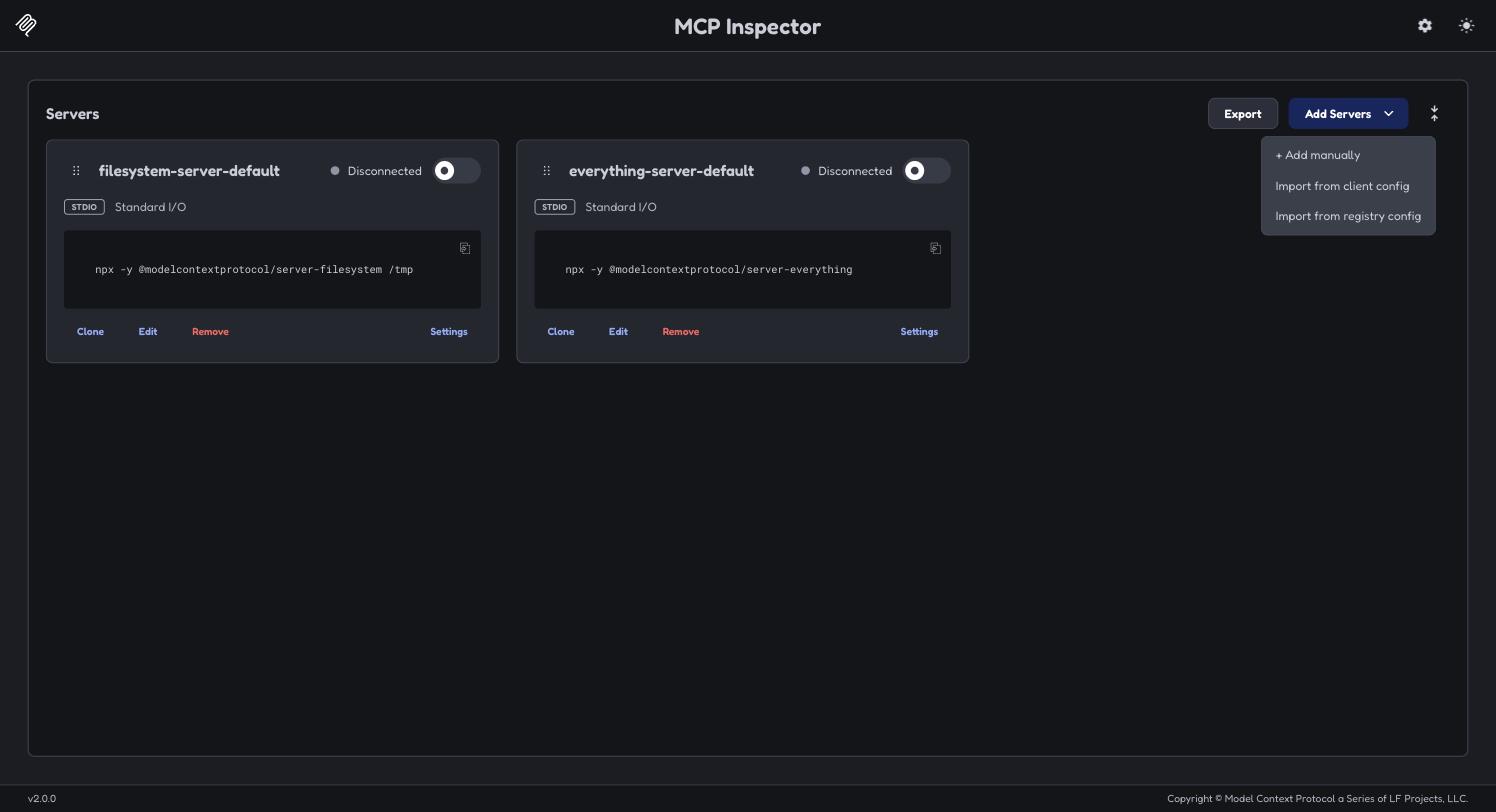
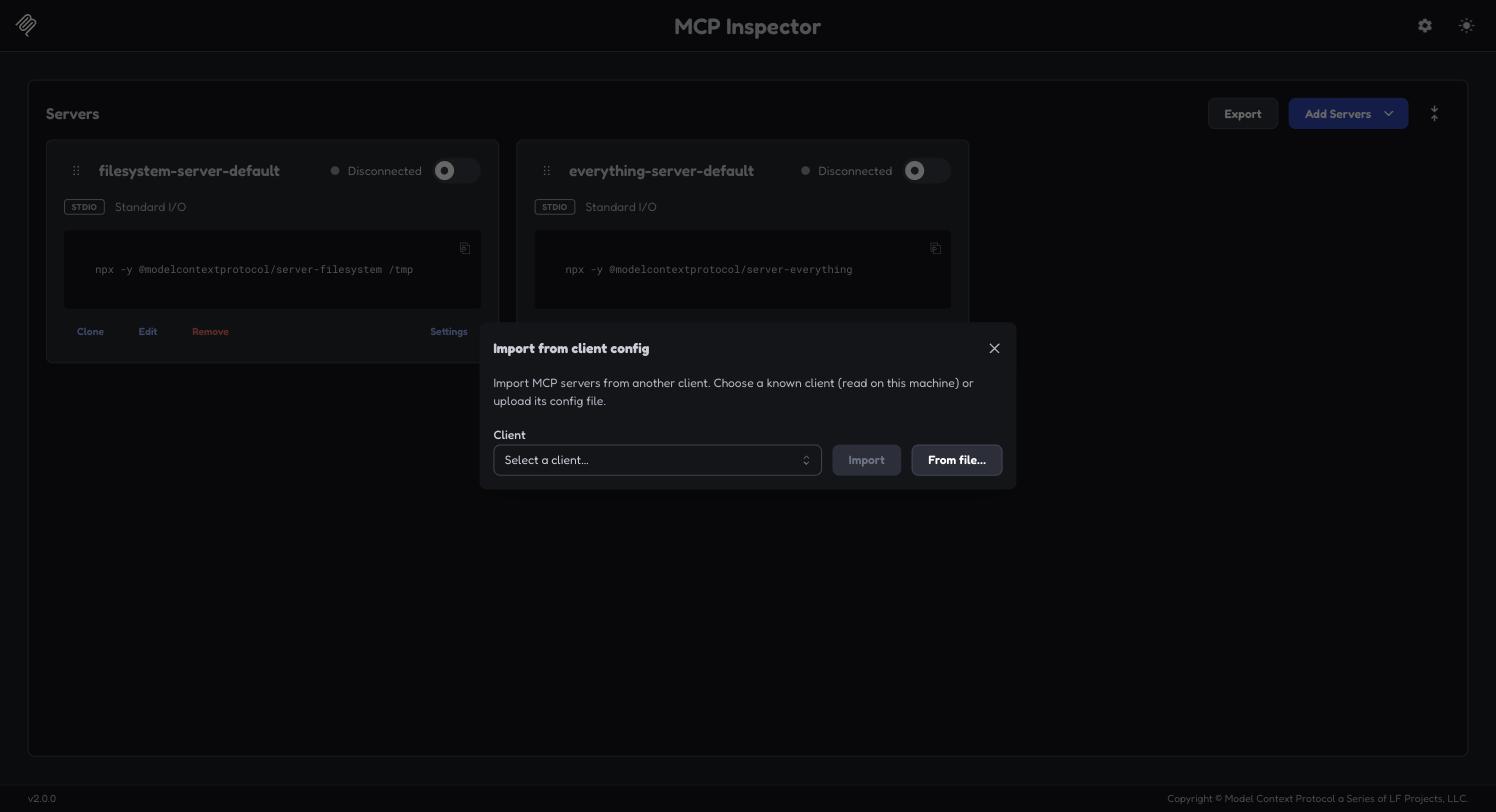
2. Click "From file…". The dialog takes a client config file or a client installed on this machine — there is nowhere to paste JSON.
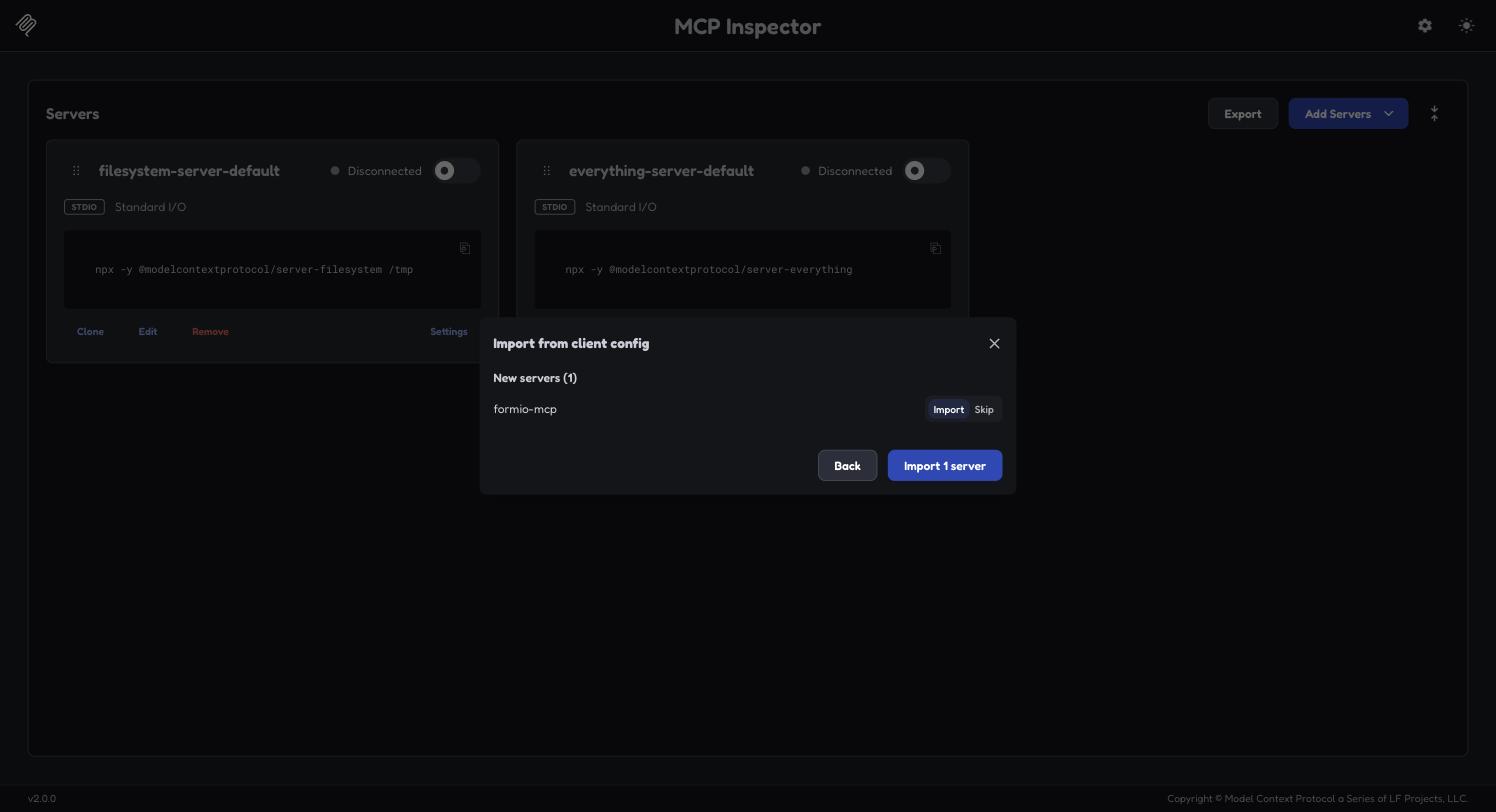
3. Select your inspector-config.json, and the server it defines is listed as new. Confirm with "Import 1 server".
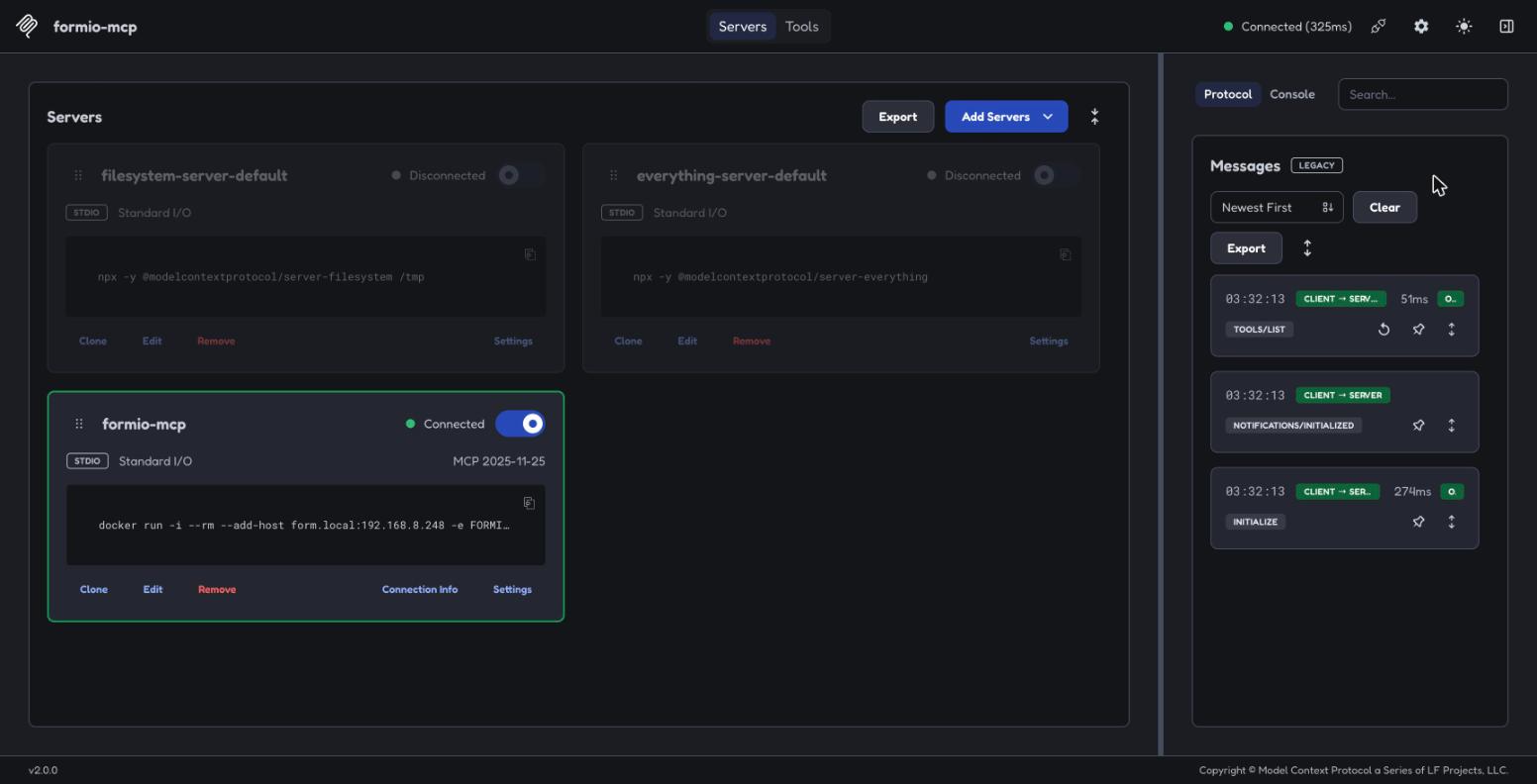
4. Enable the server with the toggle on its card. It turns green and reports the negotiated protocol version once the container is up; the first connection is slower because Docker has to start it.
5. Open the Tools tab for the tools this server exposes. A standalone server lists 19 — every tool below except project_set, which only registers in plugin context.
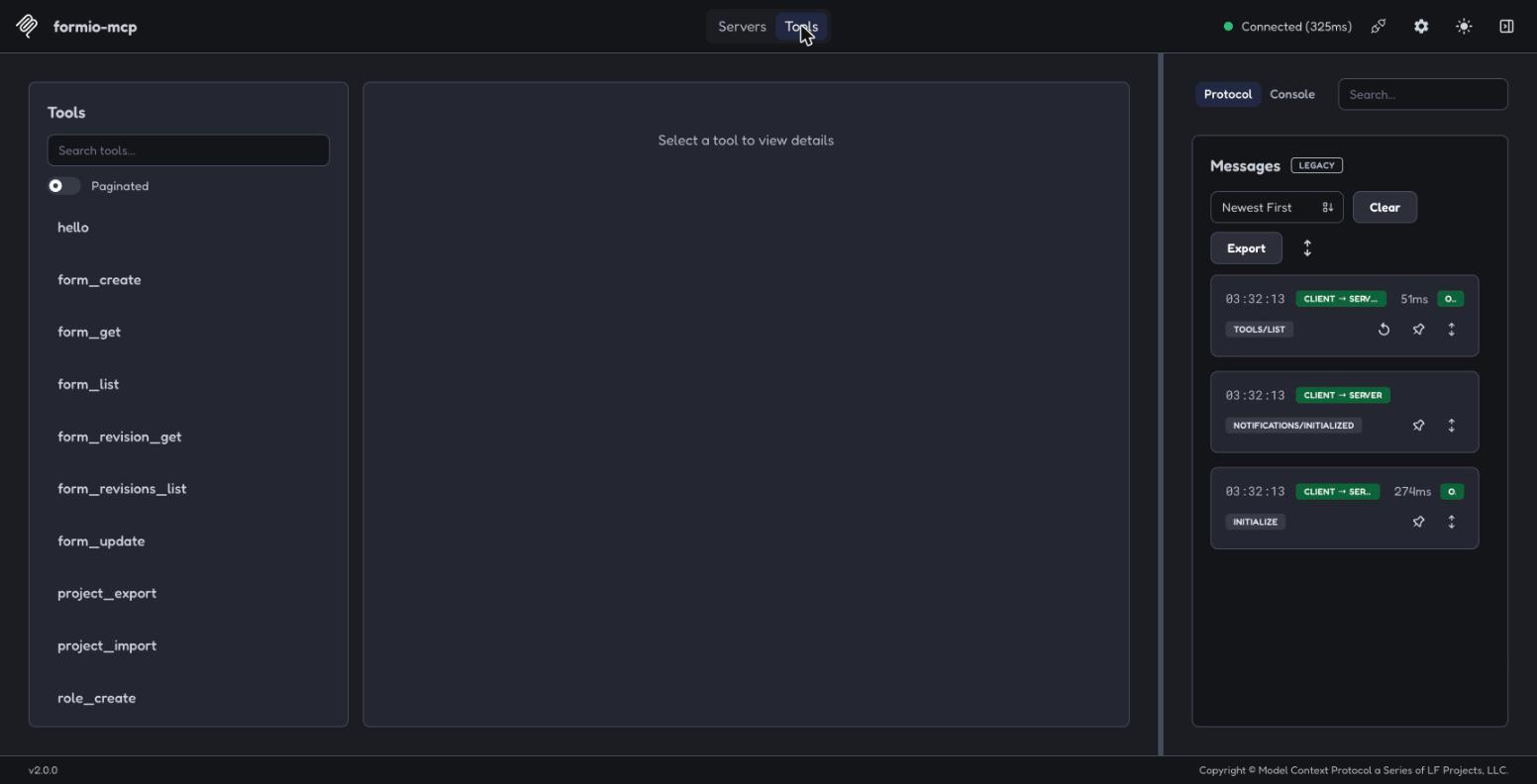
6. Pick a tool, fill in its arguments, and press "Execute Tool". The result appears in the middle pane and the JSON-RPC exchange in the right-hand Protocol panel. hello is the one tool that touches no credentials, so it isolates transport problems from auth problems; form_list below is a real call against a project.
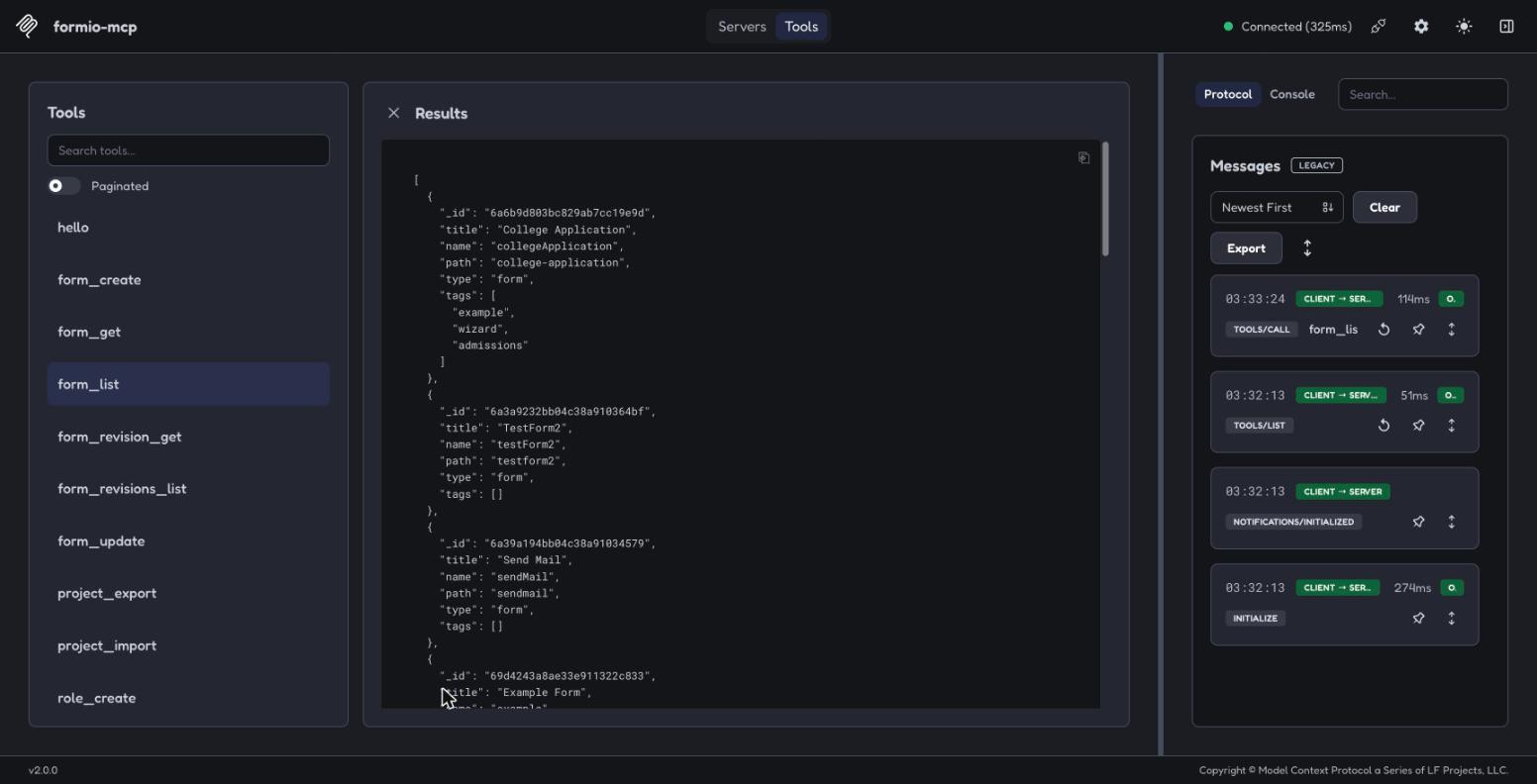
Importing writes the server into the inspector's own catalog at ~/.mcp-inspector/mcp.json, so it is still there next time — remove it from the card when you are done. A tool that fails with a bare fetch failed is usually the deployment, not the server: see Self-hosted deployments for hostname resolution and certificate trust inside a container.
The bundled @formio/mcp server exposes these tools. Skills prefer these over raw HTTP whenever an operation is covered.
| Tool | Purpose |
|---|---|
form_create | Create a new form. Use the formio-form skill first to build the JSON definition. |
form_get | Fetch a single form definition by ID or path. |
form_list | List forms with optional filtering and pagination. |
form_update | Update an existing form. Call form_get first, edit with formio-form, then update. |
form_revisions_list | List a form's saved revisions. |
form_revision_get | Fetch one revision of a form by revision id. |
| Tool | Purpose |
|---|---|
role_create | Create a new project role. |
role_list | List all project roles. |
role_update | Full-replacement update of a role. Include all fields you want preserved. |
| Tool | Purpose |
|---|---|
action_types_list | List all action types available on the server. |
action_type_get | Get an action type's settings schema. |
action_create | Attach a new action to a form. |
action_list | List actions on a form. |
action_get | Get a single action by ID. |
action_update | Update an action. |
action_delete | Detach an action from a form. |
| Tool | Purpose |
|---|---|
project_export | Export the project's complete template (roles, resources, forms, actions) as a portable JSON document. Use before project_import to snapshot. |
project_import | Import a template JSON — additively merges roles, resources, forms, and actions in one call. Same-machine-name items are overwritten in place; everything else is preserved. |
project_set | Plugin-mode only — persist a per-cwd Project URL mapping in ~/.formio/projects.json. Never exposed standalone (the standalone server binds to FORMIO_PROJECT_URL via env instead). |
| Tool | Purpose |
|---|---|
hello | Smoke-test tool. Returns a static greeting; useful for verifying MCP wiring before any authenticated call. |
The MCP server supports two authentication modes:
/callback endpoint, and formioFetch attaches x-jwt-token on every subsequent request. The flow is implicit — the first authenticated tool call triggers it on a cache miss. No explicit authenticate tool exists.FORMIO_API_KEY. All requests attach x-token; the browser flow is skipped entirely.The JWT is cached in ~/.formio/mcp-tokens.json (mode 0600), keyed by FORMIO_BASE_URL — one token covers every project on the same deployment. Tokens are valid for roughly seven days; on a cache hit the server checks expiry locally, then revalidates against the server, and falls back to a fresh login if either check fails.
What the agent is granted. JWT mode hands the agent the JWT of whoever logs in, so the agent acts with that person's permissions for the token's lifetime — sign in as an administrator and the agent inherits administrator access to the deployment. An API key is scoped to its project instead. Prefer API-key mode for unattended or shared environments, and sign in as a least-privileged user when using JWT mode.
By default the login page is served on an ephemeral port bound to 127.0.0.1 and the server shells out to open/start/xdg-open, which assumes a desktop browser on the same machine.
Where that assumption doesn't hold — a container, an SSH session, CI — you have three options:
Set FORMIO_API_KEY and skip the browser entirely. Simplest for unattended use.
Complete the login manually. The login URL is written to stderr on every login attempt, before any browser launch is tried — not only when something fails. If the launch does fail, that is reported as an additional line rather than swallowed. The URL also appears in the timeout error, which the client surfaces as tool output, so it reaches you even if you never see the server's logs.
stderr is used because with stdio transport stdout carries the MCP protocol itself — writing anything else there corrupts the stream.
Bind somewhere reachable. Set FORMIO_AUTH_HOST=0.0.0.0 and FORMIO_AUTH_PORT to a fixed, published port, then open the URL from your own machine:
docker run -i --rm -p 43117:43117 \
  -e FORMIO_PROJECT_URL=https://your-project.form.io \
  -e FORMIO_AUTH_HOST=0.0.0.0 -e FORMIO_AUTH_PORT=43117 \
  formio/mcp
FORMIO_AUTH_HOST=0.0.0.0 exposes the login page on every interface for the duration of the login. Only use it where that is acceptable.
If no login arrives within FORMIO_AUTH_TIMEOUT seconds (default 900) the call fails with an error naming these options, rather than hanging until the client gives up.
When FORMIO_LOGIN_FORM is unset, the server probes these candidates on the first login attempt and caches the first one that responds (1.5-second timeout per candidate):
${FORMIO_BASE_URL}/formio/user/login (portal-base)${FORMIO_PROJECT_URL}/admin/login (project admin)${FORMIO_PROJECT_URL}/user/login (project user)The probe runs lazily — only when the local auth page is actually served.
| Name | Required | Default | Purpose | Hosted SaaS example | Self-hosted example |
|---|---|---|---|---|---|
FORMIO_PROJECT_URL | yes* | — | Full URL of your Form.io project. In plugin mode, only used as the pre-filled default offered when prompting for an unmapped cwd. | https://myproject.form.io | https://forms.example.com/myproject |
FORMIO_BASE_URL | no** | https://api.form.io | Full base URL of your Form.io deployment. Set it when self-hosting. | https://api.form.io | https://forms.example.com |
FORMIO_API_KEY | no | undefined | Long-lived project API key. When set, the server skips the browser login flow. | CHANGEME | CHANGEME |
FORMIO_LOGIN_FORM | no | Auto-resolved | Override the portal login form URL used by the JWT login flow. | https://formio.form.io/user/login | https://forms.example.com/formio/user/login |
FORMIO_AUTH_HOST | no | 127.0.0.1 | Bind address for the browser-login page. 0.0.0.0 makes it reachable from outside a container. | ||
FORMIO_AUTH_PORT | no | ephemeral | Fixed port for the browser-login page, so a container can publish it. | 43117 | 43117 |
FORMIO_AUTH_TIMEOUT | no | 900 | Seconds to wait for a browser login before failing the call. | ||
FORMIO_INSECURE_TLS | no | undefined | Set to 1 to skip TLS verification. Local development only — never against production. | ||
FORMIO_PLUGIN_CONTEXT | no | 0 | Set by the plugin manifest. When 1, the server enables project_set and reads FORMIO_PROJECT_URL from ~/.formio/projects.json per cwd instead of env. |
* Standalone only, where the server refuses to start without it. In plugin context, FORMIO_PROJECT_URL is captured per-cwd by the project_set tool and persisted to ~/.formio/projects.json. The verify-project-url SessionStart/PreToolUse hook offers formio_default_project_url (from plugin user-config) as the default the first time you enter a workspace.
** Reversed in plugin context: the plugin always collects FORMIO_BASE_URL through user-config, so it is required there and the hosted-cloud default does not apply.
FAQs
Form.io MCP Server
We found that @formio/mcp demonstrated a healthy version release cadence and project activity because the last version was released less than a year ago. It has 7 open source maintainers collaborating on the project.
Did you know?

Socket for GitHub automatically highlights issues in each pull request and monitors the health of all your open source dependencies. Discover the contents of your packages and block harmful activity before you install or update your dependencies.
Company News
Socket is now in the AWS Security Hub Extended plan. Adopt it through AWS, apply committed spend, and block malicious open source packages.

Research
/Security News
Popular npm packages keyv and cacheable compromised.

Security News
A misconfiguration gave three Anthropic models internet access, and one, believing it was in a simulation, shipped a credential-stealing package to PyPI.