
Product
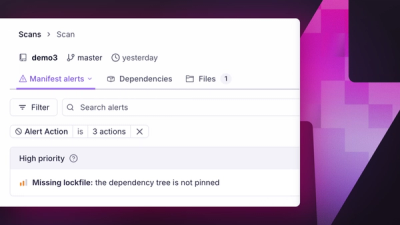
Introducing Manifest Alerts
Socket now detects supply chain risks in project manifests, starting with missing lockfiles that can make dependency installs non-reproducible.
By André Staltz, Trevor Norris - Jun 16, 2026
@fractalshq/auth-react
Advanced tools
Adapter-agnostic React helpers for cookie-based SIWS auth. No tokens in localStorage; session lives in HTTP-only cookies.
Adapter-agnostic React helpers for cookie-based SIWS auth. No tokens in localStorage; session lives in HTTP-only cookies.
import { AuthProvider, useAuth } from "@fractalshq/auth-react";
export default function App() {
return (
<AuthProvider baseURL="/api">
<Login />
</AuthProvider>
);
}
function Login() {
const { user, status, loginWithWallet, logout } = useAuth();
const connect = async () => {
const publicKey = await getPubkey();
const sign = (m: string) => wallet.signMessage(m);
await loginWithWallet({ publicKey, sign, provider: "phantom" });
};
return (
<div>
{status !== "authenticated" ? (
<button onClick={connect}>Sign in</button>
) : (
<>
<pre>{JSON.stringify(user, null, 2)}</pre>
<button onClick={logout}>Sign out</button>
</>
)}
</div>
);
}
@fractalshq/auth-react now ships an opinionated wallet wrapper that wires @solana/wallet-adapter-react, default adapters (Phantom, Solflare, Trust, Coinbase, Safe Ledger), and Ledger derivation state.
import {
  FractalsWalletProvider,
  useFractalsWallet,
  useLedgerDerivation,
  LedgerDerivationToggle,
} from "@fractalshq/auth-react";

export default function App() {
  return (
    <FractalsWalletProvider network="mainnet-beta">
      <AuthProvider baseURL="/api">{/* ... */}</AuthProvider>
    </FractalsWalletProvider>
  );
}

function WalletSummary() {
  const { publicKey, isLedgerWallet } = useFractalsWallet();
  const { mode } = useLedgerDerivation();
  return (
    <div>
      <p>Connected wallet: {publicKey?.toBase58() ?? "—"}</p>
      {isLedgerWallet && <LedgerDerivationToggle showDescription />}
    </div>
  );
}
Reminder: import
@solana/wallet-adapter-react-ui/styles.cssonce in your app if you use the provided modal.
import { useActiveOrg, useHasOrgRole, useHasPlatformRole, FRACTALS_PLATFORM_ID } from "@fractalshq/auth-react";

const { id: activeOrgId, role } = useActiveOrg();
const canManageOrg = useHasOrgRole(activeOrgId!, ["admin", "distributor"]);
const isPlatformAdmin = useHasPlatformRole(FRACTALS_PLATFORM_ID, ["admin"]);
import { createClient } from "@fractalshq/auth-react";

const client = createClient({ baseURL: "/api" });
const { message } = await client.createNonce(pubkey);
const sig = await sign(message);
await client.signInSiws({ publicKey: pubkey, signature: sig, message });
const me = await client.getMe();
Ledger devices are supported via transaction-based authentication that works with hardware wallets. We never access private keys; users must verify transactions on-device.
@solana/web3.js installed (see Web3 Adapter Setup below)# Required for web3 operations
npm install @solana/web3.js
# Choose one Ledger integration:
# Option A — Ledger Wallet API Client (via Ledger Live / Connect Kit):
npm install @ledgerhq/wallet-api-client @ledgerhq/connect-kit-loader
# Option B — Direct device transport (advanced):
npm install @ledgerhq/hw-transport-webhid @ledgerhq/hw-app-solana
Ledger authentication requires a web3 adapter. Add this to your app's providers:
import { Transaction, PublicKey, TransactionInstruction, SystemProgram } from '@solana/web3.js';
import { AuthProvider, Web3Adapter } from '@fractalshq/auth-react';

const web3Adapter: Web3Adapter = {
  Transaction,
  PublicKey,
  TransactionInstruction,
  SystemProgram,
};

export default function App() {
  return (
    <AuthProvider baseURL="/api" web3Adapter={web3Adapter}>
      {/* Your app */}
    </AuthProvider>
  );
}
See Ledger docs for setup and security notes: https://developers.ledger.com.
import { AuthProvider, useAuth } from "@fractalshq/auth-react";
import { Connection } from "@solana/web3.js";

export default function App() {
  return (
    <AuthProvider baseURL="/api" web3Adapter={web3Adapter}>
      <LedgerLogin />
    </AuthProvider>
  );
}

function LedgerLogin() {
  const { loginWithLedger } = useAuth();

  const connectLedger = async () => {
    // Implement using your chosen Ledger integration:
    const signer = await getLedgerSolanaSigner(); // Returns a WalletSigner
    const connection = new Connection("https://api.mainnet-beta.solana.com");

    await loginWithLedger({
      signer,
      connection,
      provider: "ledger"
    });
  };

  return <button onClick={connectLedger}>Sign in with Ledger</button>;
}
The getLedgerSolanaSigner() should encapsulate your chosen Ledger integration. For example:
{ publicKey, sign }.@ledgerhq/hw-transport-webhid + @ledgerhq/hw-app-solana to derive { publicKey, sign }.import { createClient } from "@fractalshq/auth-react";
import { Connection } from "@solana/web3.js";
const client = createClient({
baseURL: "/api",
web3Adapter: { Transaction, PublicKey, TransactionInstruction, SystemProgram }
});
const signer = await getLedgerSolanaSigner(); // Returns a WalletSigner
const connection = new Connection("https://api.mainnet-beta.solana.com");
await client.loginWithLedgerSigner({
signer,
connection,
provider: "ledger"
});
FAQs
Adapter-agnostic React helpers for cookie-based SIWS auth. No tokens in localStorage; session lives in HTTP-only cookies.
We found that @fractalshq/auth-react demonstrated a healthy version release cadence and project activity because the last version was released less than a year ago. It has 2 open source maintainers collaborating on the project.
Did you know?

Socket for GitHub automatically highlights issues in each pull request and monitors the health of all your open source dependencies. Discover the contents of your packages and block harmful activity before you install or update your dependencies.
Product
Socket now detects supply chain risks in project manifests, starting with missing lockfiles that can make dependency installs non-reproducible.

Research
/Security News
The trojanized extensions use TinyGo-compiled WebAssembly and Solana transaction memos to resolve command-and-control infrastructure.

Security News
Anthropic says the directive cited national security concerns over a narrow jailbreak, but offered no specific technical details.