@ghostpaw/affinity







Agent contacts: people, promises and yearly dates, with a radar for who is drifting.
A local social CRM: contacts, identities, relationships, journal events,
commitments and recurring dates in one SQLite file. One self-contained binary
per platform, an MCP server, and a zero-dependency TypeScript library.
Install
Each line downloads the latest release for one platform, checks it against
SHA256SUMS, puts ghostpaw-affinity on your PATH and prints the version.
Linux x64
cd "$(mktemp -d)" && T=linux-x64 && V=$(curl -fsSLI -o /dev/null -w '%{url_effective}' https://github.com/GhostPawJS/affinity/releases/latest | sed 's|.*/v||') && F=ghostpaw-affinity-$V-$T.tar.gz && U=https://github.com/GhostPawJS/affinity/releases/download/v$V && curl -fsSL -O "$U/$F" -O "$U/SHA256SUMS" && grep " $F\$" SHA256SUMS | sha256sum -c - && tar -xzf "$F" ghostpaw-affinity && mkdir -p ~/.local/bin && mv ghostpaw-affinity ~/.local/bin/ && { case ":$PATH:" in *":$HOME/.local/bin:"*) ;; *) echo 'export PATH="$HOME/.local/bin:$PATH"' >> ~/.profile; export PATH="$HOME/.local/bin:$PATH";; esac; } && ghostpaw-affinity --version
Linux arm64
cd "$(mktemp -d)" && T=linux-arm64 && V=$(curl -fsSLI -o /dev/null -w '%{url_effective}' https://github.com/GhostPawJS/affinity/releases/latest | sed 's|.*/v||') && F=ghostpaw-affinity-$V-$T.tar.gz && U=https://github.com/GhostPawJS/affinity/releases/download/v$V && curl -fsSL -O "$U/$F" -O "$U/SHA256SUMS" && grep " $F\$" SHA256SUMS | sha256sum -c - && tar -xzf "$F" ghostpaw-affinity && mkdir -p ~/.local/bin && mv ghostpaw-affinity ~/.local/bin/ && { case ":$PATH:" in *":$HOME/.local/bin:"*) ;; *) echo 'export PATH="$HOME/.local/bin:$PATH"' >> ~/.profile; export PATH="$HOME/.local/bin:$PATH";; esac; } && ghostpaw-affinity --version
macOS Apple silicon
cd "$(mktemp -d)" && T=darwin-arm64 && V=$(curl -fsSLI -o /dev/null -w '%{url_effective}' https://github.com/GhostPawJS/affinity/releases/latest | sed 's|.*/v||') && F=ghostpaw-affinity-$V-$T.tar.gz && U=https://github.com/GhostPawJS/affinity/releases/download/v$V && curl -fsSL -O "$U/$F" -O "$U/SHA256SUMS" && grep " $F\$" SHA256SUMS | shasum -a 256 -c - && tar -xzf "$F" ghostpaw-affinity && sudo mkdir -p /usr/local/bin && sudo mv ghostpaw-affinity /usr/local/bin/ && ghostpaw-affinity --version
macOS Intel
cd "$(mktemp -d)" && T=darwin-x64 && V=$(curl -fsSLI -o /dev/null -w '%{url_effective}' https://github.com/GhostPawJS/affinity/releases/latest | sed 's|.*/v||') && F=ghostpaw-affinity-$V-$T.tar.gz && U=https://github.com/GhostPawJS/affinity/releases/download/v$V && curl -fsSL -O "$U/$F" -O "$U/SHA256SUMS" && grep " $F\$" SHA256SUMS | shasum -a 256 -c - && tar -xzf "$F" ghostpaw-affinity && sudo mkdir -p /usr/local/bin && sudo mv ghostpaw-affinity /usr/local/bin/ && ghostpaw-affinity --version
Windows x64 (PowerShell)
$r='GhostPawJS/affinity'; $v=(irm "https://api.github.com/repos/$r/releases/latest").tag_name; $f="ghostpaw-affinity-$($v.TrimStart('v'))-windows-x64.zip"; $u="https://github.com/$r/releases/download/$v"; $t=(New-Item -ItemType Directory (Join-Path $env:TEMP ([guid]::NewGuid()))).FullName; iwr "$u/$f" -OutFile "$t\$f" -UseBasicParsing; iwr "$u/SHA256SUMS" -OutFile "$t\SHA256SUMS" -UseBasicParsing; $want=((Get-Content "$t\SHA256SUMS" | Where-Object { $_ -like "* $f" }) -split '\s+')[0]; if (-not $want -or (Get-FileHash "$t\$f" -Algorithm SHA256).Hash -ne $want) { throw "checksum mismatch for $f" }; $d=Join-Path $env:LOCALAPPDATA 'Programs\ghostpaw\bin'; Expand-Archive "$t\$f" $t -Force; New-Item -ItemType Directory -Force $d | Out-Null; Copy-Item "$t\ghostpaw-affinity.exe" $d -Force; $p=[Environment]::GetEnvironmentVariable('Path','User'); if (";$p;" -notlike "*;$d;*") { [Environment]::SetEnvironmentVariable('Path',"$p;$d",'User') }; $env:Path="$d;$env:Path"; ghostpaw-affinity --version
Linux installs to ~/.local/bin (added to ~/.profile if missing), macOS to
/usr/local/bin (asks for sudo), Windows to %LOCALAPPDATA%\Programs\ghostpaw\bin
(added to the user PATH; open a new terminal afterwards).
Then:
ghostpaw-affinity contact create '{"name":"Sam","kind":"human"}'
ghostpaw-affinity search sam
ghostpaw-affinity skill
Contacts live in ~/.ghostpaw/affinity.db unless --db <path> or the
GHOSTPAW_AFFINITY_DB environment variable says otherwise; relative paths
resolve against the current directory.
A session with the linux-x64 binary against a fresh database:
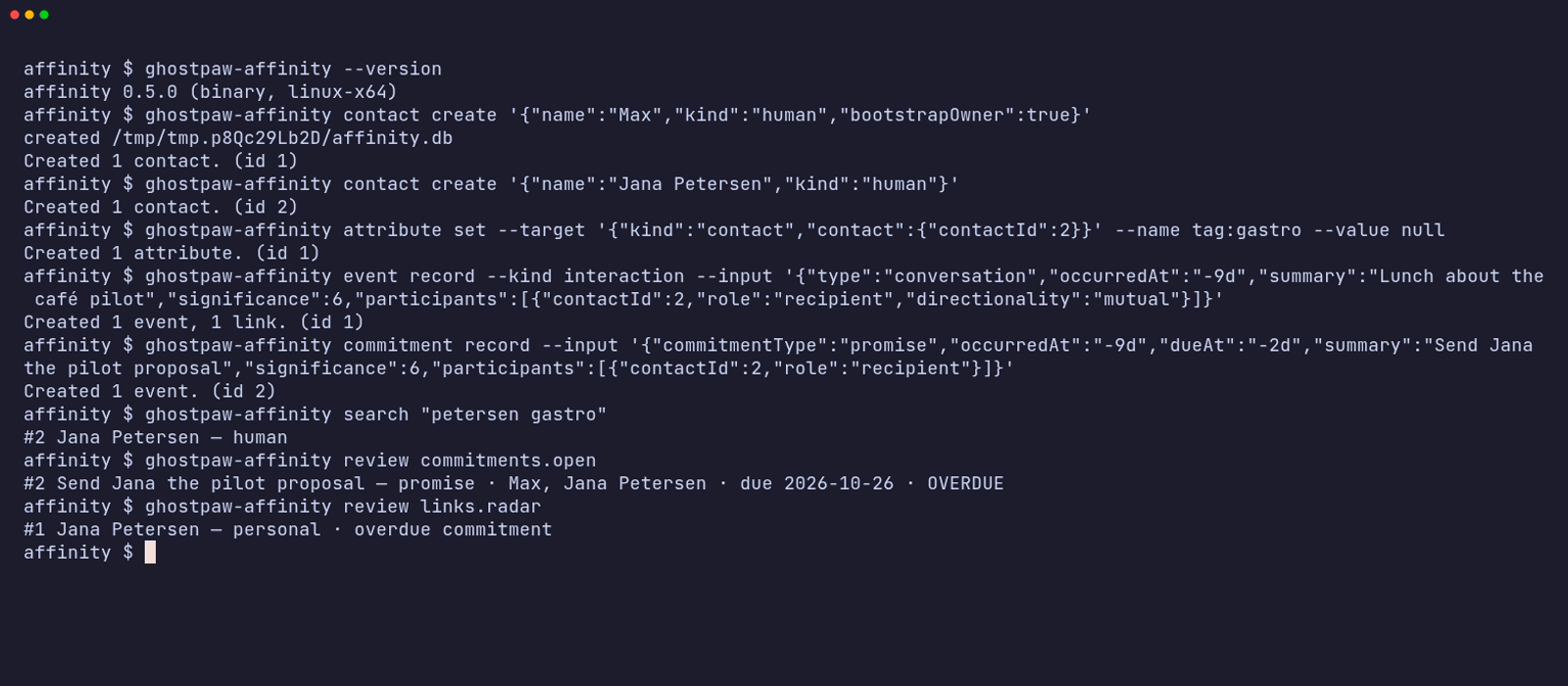
The same session as an animated GIF.
npx / npm (for npm-based environments)
The npm package needs Node 24+
and has zero runtime dependencies:
npx -y @ghostpaw/affinity --help
npm install -g @ghostpaw/affinity
Library (for harnesses)
npm install @ghostpaw/affinity
import { DatabaseSync } from "node:sqlite";
import { initAffinityTables, read, write, tools } from "@ghostpaw/affinity";
See Quick Start and docs/LLM.md for the tool facade.
Other installers and verification
Interactive installers (also verify SHA256SUMS):
curl -fsSL https://raw.githubusercontent.com/GhostPawJS/affinity/main/install.sh | sh
irm https://raw.githubusercontent.com/GhostPawJS/affinity/main/install.ps1 | iex
mise use -g github:GhostPawJS/affinity
ubi --project GhostPawJS/affinity --exe ghostpaw-affinity --in ~/.local/bin
eget GhostPawJS/affinity
For aqua, define a
github_release package in aqua.yaml:
registries:
  - name: affinity
    type: local
    path: affinity-registry.yaml
packages:
  - name: GhostPawJS/affinity@v<VERSION>
    registry: affinity
affinity-registry.yaml:
packages:
  - type: github_release
    repo_owner: GhostPawJS
    repo_name: affinity
    asset: ghostpaw-affinity-{{trimV .Version}}-{{.OS}}-{{.Arch}}.tar.gz
    format: tar.gz
    replacements: { amd64: x64 }
    overrides:
      - goos: windows
        asset: ghostpaw-affinity-{{trimV .Version}}-windows-{{.Arch}}.zip
        format: zip
    files:
      - name: ghostpaw-affinity
SHA256SUMS covers every archive and server.mcpb. To verify a downloaded
archive's build attestation:
gh attestation verify <archive> -R GhostPawJS/affinity
Set GHOSTPAW_VERIFY=attestation for attestation verification in install.sh.
Binaries are unsigned; macOS binaries carry an ad-hoc signature. For a browser
download on macOS, remove quarantine with
xattr -d com.apple.quarantine /path/to/ghostpaw-affinity.
Linux binaries require glibc 2.28+; use npx on Alpine.
See the binary build workflow.
Each archive is roughly 40-46 MB (the binary embeds the Node runtime, 105-150 MB
unpacked); the npm package is about 2 MB unpacked. Every release, including the
one-liners above, is installed and run on ubuntu-24.04, macos-15 and
windows-2025 by the install check.
MCP server
Every client below starts the same stdio server: ghostpaw-affinity mcp.
Without the binary, use npx -y @ghostpaw/affinity mcp as the command instead.
Claude Code
claude mcp add ghostpaw-affinity -- ghostpaw-affinity mcp
or as a plugin, which also installs the skill:
/plugin marketplace add GhostPawJS/affinity
/plugin install ghostpaw-affinity@ghostpaw-affinity
Codex CLI (~/.codex/config.toml)
[mcp_servers.ghostpaw-affinity]
command = "ghostpaw-affinity"
args = ["mcp"]
Cursor (.cursor/mcp.json), Claude Desktop (claude_desktop_config.json)
or a project .mcp.json:
{
  "mcpServers": {
    "ghostpaw-affinity": {
      "command": "ghostpaw-affinity",
      "args": ["mcp"]
    }
  }
}
Claude Desktop users can also install server.mcpb from the
latest GitHub release.
A Dockerfile is included for container hosts:
docker build -t ghostpaw-affinity . && docker run -i --rm -v affinity:/data ghostpaw-affinity.
The server speaks MCP 2026-07-28 (stateless, server/discover) and the
initialize-based revisions 2025-11-25, 2025-06-18, 2025-03-26 and 2024-11-05.
Agent Skill
SKILL.md (repo root) and skills/affinity/SKILL.md follow the
Agent Skills format and ship in the npm package.
Copy skills/affinity/ into your agent's skills folder, or print it:
ghostpaw-affinity skill > SKILL.md
ghostpaw-affinity skill --list
ghostpaw-affinity skill bootstrap-and-cold-start
CLI
export GHOSTPAW_AFFINITY_DB=~/crm/affinity.db
ghostpaw-affinity contact create '{"name":"Fox","kind":"human","bootstrapOwner":true}'
ghostpaw-affinity search "jana"
ghostpaw-affinity contact create '{"name":"Jana Petersen","kind":"human"}'
ghostpaw-affinity identity add --contact '{"contactId":2}' --input '{"type":"email","value":"jana@example.com"}'
ghostpaw-affinity event record --kind interaction --input '{"type":"conversation","occurredAt":"today","summary":"Call re pilot","significance":6,"participants":[{"contactId":2,"role":"recipient","directionality":"mutual"}]}'
ghostpaw-affinity commitment record --input '{"commitmentType":"promise","occurredAt":"today","dueAt":"+3d","summary":"Send proposal","significance":6,"participants":[{"contactId":2,"role":"recipient"}]}'
ghostpaw-affinity attribute set --target '{"kind":"contact","contact":{"contactId":2}}' --name tag:gastro --value null
ghostpaw-affinity review contacts.list --tag gastro
ghostpaw-affinity review contacts.list --attribute pipeline_stage=proposal
ghostpaw-affinity review commitments.open
ghostpaw-affinity review links.radar
ghostpaw-affinity show contact_profile --contact '{"contactId":2}'
ghostpaw-affinity contact export --contact '{"contactId":2}'
ghostpaw-affinity contact delete --contact '{"contactId":2}' --confirm
ghostpaw-affinity skill prints the full cheat sheet; skill --list and
skill <guide> print the workflow guides.
ghostpaw-affinity search <query> [--tag T] [--attribute name[=value]]
ghostpaw-affinity review <view> [--tag T] [--attribute name[=value]]
ghostpaw-affinity show <owner_profile|contact_profile|link> [--contact JSON --link JSON]
ghostpaw-affinity contact create|revise|lifecycle|export|delete|merge
ghostpaw-affinity identity add|revise|verify|remove [flags]
ghostpaw-affinity relationship add|bond|state|tie|untie [flags]
ghostpaw-affinity commitment record|resolve [flags]
ghostpaw-affinity attribute set|unset|replace [flags]
ghostpaw-affinity date add|revise|remove [flags]
ghostpaw-affinity event record [flags]
ghostpaw-affinity duplicate dismiss|undismiss [flags]
ghostpaw-affinity mcp|skill|tools|describe|call|completions|version|help
There are 29 domain commands. review accepts the existing view names,
including contacts.list, contacts.duplicates and dates.upcoming.
show selects an inspection kind; contact and link locators are JSON objects.
Use help contact or contact create --help for schema-derived help; a
mistyped command suggests the closest one. Nested payloads use JSON or @path
to read a file; repeated array flags accept JSON objects
(--entries '{"name":"a","value":"x"}') or one JSON array.
Every time field accepts epoch milliseconds, ISO 8601 with Z or an offset,
YYYY-MM-DD, DD.MM.YYYY (CLI), today, tomorrow, yesterday and signed day offsets
such as +3d or -2d. On the CLI, date-only values use local time (midnight,
or end of day for dueAt); through MCP and the tool facade they use UTC.
Global flags: --db <path>, --json, --quiet, --compact,
--help/-h, --version/-V/-v, --no-color.
NO_COLOR is accepted. In a terminal, commands print a readable summary with
names and dates. With --json or piped stdout they print the tool result as
JSON with ISO date siblings and floats rounded to three decimals; --compact
removes indentation and empty receipt arrays. --quiet suppresses stdout.
Writes list what changed in data.changes, and creates warn about likely
duplicates. Kebab-case flags map to schema properties. -- ends flags.
A positional -, or piped stdin when no other arguments are given, reads a
JSON object (echo '{"name":"Sam","kind":"human"}' | ghostpaw-affinity contact create).
Explicit flags override stdin fields.
Database selection uses --db, GHOSTPAW_AFFINITY_DB, then
~/.ghostpaw/affinity.db; relative paths resolve against the current
directory, and --help shows the resolved path. A new database is reported on
stderr. These commands work offline.
| 0 | Success, including no_op |
| 1 | Other tool error |
| 2 | Usage, schema or invalid input |
| 3 | Clarification needed or not found |
| 4 | Conflict, already resolved or version mismatch |
| 70 | Internal error |
Errors go to stderr. With --json, errors also print to stdout.
--version names the variant: affinity 0.5.0 (binary, linux-x64),
(npm) or (library). Legacy tools [--json], describe <tool>,
call <tool> [JSON|-] and <tool_name> --parameter value remain available.
completions bash|zsh|fish prints shell scripts.
Quick Start
import { DatabaseSync } from "node:sqlite";
import { initAffinityTables, read, write } from "@ghostpaw/affinity";

const db = new DatabaseSync(":memory:");
db.exec("PRAGMA foreign_keys = ON");
initAffinityTables(db);

const { primary: owner } = write.createContact(db, {
  name: "Mika",
  kind: "human",
  bootstrapOwner: true,
});

const { primary: ada } = write.createContact(db, {
  name: "Ada Lovelace",
  kind: "human",
});

write.addIdentity(db, ada.id, {
  type: "email",
  value: "ada@example.com",
});

write.recordInteraction(db, {
  type: "conversation",
  occurredAt: Date.now(),
  summary: "Coffee together",
  significance: 6,
  participants: [
    { contactId: owner.id, role: "actor", directionality: "mutual" },
    { contactId: ada.id, role: "recipient", directionality: "mutual" },
  ],
});

const profile = read.getContactProfile(db, ada.id);
const radar = read.listRadar(db);
Docs
The live demo runs the library in your browser against an in-memory SQLite database. Each view below opens a different part of it:
The Model
Eight concepts, strict separation of concerns:
| Contact | Any tracked entity: person, company, team, service, pet, household, or group |
| Identity | Exact recognition and routing handle such as email, phone, URL, or account id |
| Social Link | A live relationship track with Rank, Affinity, Trust, cadence, Bond, and state |
| Tie | A structural fact such as works_at, belongs_to, reports_to, or kinship |
| Journal Entry | Recorded evidence: interaction, observation, milestone, transaction, or commitment |
| Date Anchor | A recurring yearly date such as a birthday, anniversary, renewal, or memorial |
| Attribute | Flexible metadata and preference layer for contacts and links |
| Affinity Chart | Derived graph view of the active relationship network |
The model means each kind of truth has its own home:
| A person, company, team, service, or household | A Contact |
| An email address or handle | An Identity |
| A friendship or business relationship that changes over time | A Social Link |
| Employment, hierarchy, family, or membership | A Tie |
| “We talked yesterday” | A Journal entry |
| “I promised to send the recap” | A commitment-shaped Journal entry |
| “Their birthday is important every year” | A Date Anchor |
State is derived, not hand-toggled. Rank, hidden Affinity, Trust movement,
Moments, drift, readiness, and graph bridge significance are computed from
evidence and explicit structural truth, not caller-written status flags.
Two Audiences
Human developers
Use the read and write namespaces for direct-code access to the domain:
import { read, write } from "@ghostpaw/affinity";

write.createContact(db, { name: "Ada", kind: "human" });
write.addIdentity(db, contactId, { type: "email", value: "ada@example.com" });
write.recordInteraction(db, {
  type: "support",
  occurredAt: now,
  summary: "Helped prepare for a difficult meeting",
  significance: 7,
  participants: [
    { contactId: ownerId, role: "actor", directionality: "mutual" },
    { contactId, role: "recipient", directionality: "mutual" },
  ],
});

const profile = read.getContactProfile(db, contactId);
const radar = read.listRadar(db);
See HUMAN.md for the full direct-code guide with modeling
boundaries and worked examples.
LLM agents
Use the tools, skills, and soul namespaces for a structured runtime
surface designed to minimize LLM cognitive load:
import { tools, skills, soul } from "@ghostpaw/affinity";

const allTools = tools.affinityTools;
const searchTool = tools.getAffinityToolByName("search_affinity")!;
const result = searchTool.handler(db, { query: "email:ada@example.com" });

const allSkills = skills.affinitySkills;
const prompt = soul.renderAffinitySoulPromptFoundation();
Every tool returns a discriminated result with outcome: "success" | "no_op" | "needs_clarification" | "error", structured entities, next-step hints, and
actionable recovery signals.
See LLM.md for the full AI-facing guide covering soul, tools,
and skills.
Tools
Twelve tools shaped around operator intent, not raw storage operations:
search_affinity | Search contacts by natural key or name |
review_affinity | Dashboard-style list and graph review views |
inspect_affinity_item | Open one exact profile or link detail |
manage_contact | Create, revise, or change contact lifecycle |
merge_contacts | Merge duplicate contacts safely |
manage_duplicate_dismissal | Dismiss or restore a suspected duplicate pair |
manage_identity | Add, revise, verify, or remove identities |
manage_relationship | Seed social links, revise bond/state, manage structural ties |
record_event | Record direct evidence, observations, milestones, or transactions |
manage_commitment | Record or resolve obligations |
manage_date_anchor | Add, revise, or remove recurring important dates |
manage_attribute | Set, unset, or replace contact/link metadata |
Each tool exports runtime metadata, JSON-Schema-compatible inputs, and
structured outputs so harnesses can wire them without parsing vague prose.
Key Properties
- Zero runtime dependencies. Only
node:sqlite (built into Node 24+).
- Single prebundled blob. One ESM + one CJS entry in
dist/. No subpath
exports, no code splitting.
- Pure SQLite storage. CHECK-constrained state, trigger-maintained support
tables, and deterministic derived reads. Bring your own
DatabaseSync.
- Derived mechanics. Rank, hidden Affinity, Trust, cadence, Moments, Radar,
and bridge significance are computed from evidence and structure, never
directly caller-set.
- Intention-shaped writes.
createContact, setStructuralTie,
recordInteraction, recordCommitment, addDateAnchor, mergeContacts:
operations that say what happened or what truth changed, not generic CRUD.
- Additive AI runtime.
soul for posture, tools for actions, skills for
workflow guidance.
- Colocated tests. Every non-type module has a colocated
.test.ts file.
The documented behavior is backed by executable coverage.
Package Surface
import {
initAffinityTables,
read,
write,
tools,
skills,
soul,
} from "@ghostpaw/affinity";
All domain and runtime types are also available at the root for TypeScript
consumers:
import type {
  AffinityDb,
  ContactKind,
  LinkState,
  ContactProfileRecord,
  AffinityChartRecord,
  AffinityToolDefinition,
  AffinitySkill,
  AffinitySoul,
} from "@ghostpaw/affinity";
Documentation
| HUMAN.md | Human developers using the low-level read / write API |
| LLM.md | Agent builders wiring soul, tools, and skills into LLM systems |
| docs/README.md | Architecture overview: model, invariants, mechanics, and source layout |
| docs/entities/ | Per-concept manuals with exact inlined public API listings |
| docs/USECASES.md | Long-form lifecycle narratives across personal, business, and AI-memory angles |
Development
npm install
npm test
npm run typecheck
npm run lint
npm run build
The repo is pinned to Node 24.14.0 via .nvmrc / .node-version /
.tool-versions / mise.toml / Volta. Use whichever version manager you
prefer.
Support
If this package helps your project, consider sponsoring its maintenance:

Anonyfox • MIT License