
Product
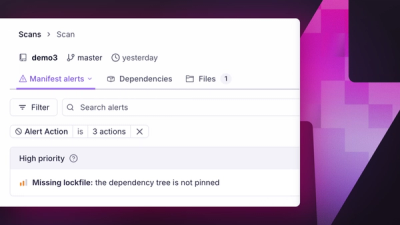
Introducing Manifest Alerts
Socket now detects supply chain risks in project manifests, starting with missing lockfiles that can make dependency installs non-reproducible.
By André Staltz, Trevor Norris - Jun 16, 2026
@git-stunts/alfred
Advanced tools
Production-grade resilience patterns for async ops: retry/backoff+jitter, circuit breaker, bulkhead, timeout.


.o. oooo .o88o. .o8
.888. `888 888 `" "888
.8"888. 888 o888oo oooo d8b .ooooo. .oooo888
.8' `888. 888 888 `888""8P d88' `88b d88' `888
.88ooo8888. 888 888 888 888ooo888 888 888
.8' `888. 888 888 888 888 .o 888 888
o88o o8888o o888o o888o d888b `Y8bod8P' `Y8bod88P"
"Why do we fall, Bruce?"
"So we can
retry({ backoff: 'exponential', jitter: 'decorrelated' })."
Resilience patterns for async operations. Tuff 'nuff for most stuff.
Includes: retry - circuit breaker - bulkhead - timeout - hedge - composition - TestClock - telemetry sinks
npm install @git-stunts/alfred
npx jsr add @git-stunts/alfred
A realistic stack you'll actually ship: total timeout + retry (decorrelated jitter) + circuit breaker + bulkhead.
import { Policy } from '@git-stunts/alfred';

const resilient = Policy.timeout(5_000)
  .wrap(
    Policy.retry({
      retries: 3,
      backoff: 'exponential',
      jitter: 'decorrelated',
      delay: 150,
      maxDelay: 3_000,
      shouldRetry: (err) =>
        err?.name === 'TimeoutError' || err?.code === 'ECONNRESET' || err?.code === 'ETIMEDOUT',
    })
  )
  .wrap(
    Policy.circuitBreaker({
      threshold: 5,
      duration: 60_000,
    })
  )
  .wrap(Policy.bulkhead({ limit: 10, queueLimit: 20 }));

const data = await resilient.execute(async () => {
  const res = await fetch('https://api.example.com/data');
  if (!res.ok) throw new Error(`HTTP ${res.status}`);
  return res.json();
});
Alfred is designed to be platform-agnostic and tested against:
Uses standard Web APIs (AbortController, AbortSignal, Promise.any) with no Node-specific dependencies. Runtime-aware clock management ensures clean process exits in server environments.
Run the interactive "Flaky Fetch Lab" to see resilience policies in action:
npm run demo:web:install && npm run demo:web
Or run the Playwright browser tests:
npm run demo:web:install && npm run test:browser
import { retry, circuitBreaker, bulkhead, timeout } from '@git-stunts/alfred';

// 1) Simple retry with exponential backoff
const data = await retry(() => fetch('https://api.example.com/data'), {
  retries: 3,
  backoff: 'exponential',
  delay: 100,
});

// 2) Circuit breaker — fail fast when a service is down
const breaker = circuitBreaker({ threshold: 5, duration: 60_000 });
const result = await breaker.execute(() => callFlakeyService());

// 3) Bulkhead — limit concurrent executions
const limiter = bulkhead({ limit: 10, queueLimit: 20 });
await limiter.execute(() => heavyOperation());

// 4) Timeout — prevent operations from hanging
const fast = await timeout(5_000, () => slowOperation());
Alfred provides three composition operators for building complex resilience strategies:
| Operator | Fluent | Functional | Semantics |
|---|---|---|---|
| wrap | .wrap(policy) | compose(a, b) | Sequential: A wraps B (outer → inner) |
| or | .or(policy) | fallback(a, b) | Fallback: try A, if fails try B |
| race | .race(policy) | race(a, b) | Concurrent: first success wins |
The classic resilience stack. Read execution order from outside-in: timeout wraps retry wraps circuit breaker wraps bulkhead.
import { Policy } from '@git-stunts/alfred';

const resilient = Policy.timeout(5_000) // 1. Total deadline
  .wrap(
    Policy.retry({
      // 2. Retry transient failures
      retries: 3,
      backoff: 'exponential',
      jitter: 'decorrelated',
      delay: 100,
    })
  )
  .wrap(
    Policy.circuitBreaker({
      // 3. Fail fast when broken
      threshold: 5,
      duration: 30_000,
    })
  )
  .wrap(Policy.bulkhead({ limit: 10, queueLimit: 20 })); // 4. Limit concurrency

await resilient.execute(() => fetch('https://api.example.com/data'));
Try a fast strategy first; if it fails (or times out), fall back to a slower but more reliable approach.
import { Policy } from '@git-stunts/alfred';

// Fast path: short timeout, no retries
const fast = Policy.timeout(500);

// Slow path: longer timeout with retries
const slow = Policy.timeout(5_000).wrap(
  Policy.retry({ retries: 3, backoff: 'exponential', delay: 200 })
);

// Try fast first, fall back to slow
const resilient = fast.or(slow);

await resilient.execute(() => fetch('https://api.example.com/data'));
Spawn parallel "hedge" requests to reduce tail latency. First success wins; losers are cancelled.
import { Policy } from '@git-stunts/alfred';

// Hedge: if primary is slow, spawn backup attempts
const hedged = Policy.hedge({ delay: 100, maxHedges: 2 });

// Combine with bulkhead to prevent self-DDOS
const safe = hedged.wrap(Policy.bulkhead({ limit: 5 }));

// The operation receives an AbortSignal to enable cancellation
await safe.execute((signal) => fetch('https://api.example.com/data', { signal }));
Tip: Only hedge idempotent operations. Non-idempotent operations (writes, payments) should not be hedged.
Both styles produce equivalent results:
// Fluent API
const policy1 = Policy.timeout(5_000)
  .wrap(Policy.retry({ retries: 3 }))
  .wrap(Policy.circuitBreaker({ threshold: 5, duration: 60_000 }));

// Functional API
const policy2 = compose(
  Policy.timeout(5_000),
  Policy.retry({ retries: 3 }),
  circuitBreaker({ threshold: 5, duration: 60_000 }) // functional returns policy object
);
The fluent API is recommended for readability. Use functional compose() when building policies dynamically.
Retries a failed operation with configurable backoff.
import { retry } from '@git-stunts/alfred';

// Basic retry
await retry(() => mightFail(), { retries: 3 });

// Exponential backoff: 100ms, 200ms, 400ms...
await retry(() => mightFail(), {
  retries: 5,
  backoff: 'exponential',
  delay: 100,
  maxDelay: 10_000,
});

// Only retry specific errors
await retry(() => mightFail(), {
  retries: 3,
  shouldRetry: (err) => err?.code === 'ECONNREFUSED',
});

// With jitter to prevent thundering herd
await retry(() => mightFail(), {
  retries: 3,
  backoff: 'exponential',
  delay: 100,
  jitter: 'full', // or "equal" or "decorrelated"
});

// Abort retries early
const controller = new AbortController();
const promise = retry((signal) => fetch('https://api.example.com/data', { signal }), {
  retries: 3,
  backoff: 'exponential',
  delay: 100,
  signal: controller.signal,
});
controller.abort();
| Option | Type | Default | Description |
|---|---|---|---|
retries | number | 3 | Maximum retry attempts |
delay | number | 1000 | Base delay (ms) |
maxDelay | number | 30000 | Maximum delay cap (ms) |
backoff | "constant" | "linear" | "exponential" | "constant" | Backoff strategy |
jitter | "none" | "full" | "equal" | "decorrelated" | "none" | Jitter strategy |
shouldRetry | (error) => boolean | () => true | Filter retryable errors |
onRetry | (error, attempt, delay) => void | - | Callback on each retry |
signal | AbortSignal | - | Abort retries and backoff sleeps |
Fails fast when a service is degraded, preventing cascade failures.
import { circuitBreaker } from '@git-stunts/alfred';

const breaker = circuitBreaker({
  threshold: 5, // Open after 5 failures
  duration: 60_000, // Stay open for 60 seconds
  onOpen: () => console.log('Circuit opened!'),
  onClose: () => console.log('Circuit closed!'),
  onHalfOpen: () => console.log('Testing recovery...'),
});

try {
  await breaker.execute(() => callService());
} catch (err) {
  if (err?.name === 'CircuitOpenError') {
    console.log('Service is down, failing fast');
  }
}
| Option | Type | Default | Description |
|---|---|---|---|
threshold | number | required | Failures before opening |
duration | number | required | How long to stay open (ms) |
successThreshold | number | 1 | Successes to close from half-open |
shouldTrip | (error) => boolean | () => true | Which errors count as failures |
onOpen | () => void | - | Called when circuit opens |
onClose | () => void | - | Called when circuit closes |
onHalfOpen | () => void | - | Called when entering half-open |
Limits the number of concurrent executions to prevent resource exhaustion.
import { bulkhead } from '@git-stunts/alfred';

const limiter = bulkhead({
  limit: 10, // Max 10 concurrent executions
  queueLimit: 20, // Max 20 pending requests in queue
});

try {
  await limiter.execute(() => heavyOperation());
} catch (err) {
  if (err?.name === 'BulkheadRejectedError') {
    console.log('Too many concurrent requests, failing fast');
  }
}

console.log(`Load: ${limiter.stats.active} active`);
| Option | Type | Default | Description |
|---|---|---|---|
limit | number | required | Maximum concurrent executions |
queueLimit | number | 0 | Maximum pending requests in queue |
Token bucket rate limiter for throughput control. Unlike bulkhead (which limits concurrency), rate limit controls requests per second.
import { rateLimit } from '@git-stunts/alfred';

const limiter = rateLimit({ rate: 100 }); // 100 req/sec
await limiter.execute(() => fetch('/api'));
Allow temporary bursts above the base rate:
const limiter = rateLimit({ rate: 100, burst: 150 });
Queue excess requests instead of rejecting immediately:
const limiter = rateLimit({ rate: 10, queueLimit: 50 });
const policy = Policy.rateLimit({ rate: 100 }).wrap(Policy.retry({ retries: 3 }));
| Option | Type | Default | Description |
|---|---|---|---|
rate | number | required | Maximum requests per second |
burst | number | rate | Maximum bucket capacity for burst traffic |
queueLimit | number | 0 | Maximum pending requests in queue |
clock | Clock | - | Custom clock for testing |
telemetry | TelemetrySink | - | Sink for observability events |
When the rate limit is exceeded and no queue space is available, a RateLimitExceededError is thrown:
import { rateLimit, RateLimitExceededError } from '@git-stunts/alfred';

const limiter = rateLimit({ rate: 10 });

try {
  await limiter.execute(() => fetch('/api'));
} catch (err) {
  if (err instanceof RateLimitExceededError) {
    console.log(`Rate limit exceeded: ${err.rate} req/sec`);
    console.log(`Retry after: ${err.retryAfter}ms`);
  }
}
| Error | Thrown When | Properties |
|---|---|---|
RateLimitExceededError | Rate limit exceeded and queue full | rate, retryAfter |
Prevents operations from hanging indefinitely.
import { timeout } from '@git-stunts/alfred';

// Simple timeout
const result = await timeout(5_000, () => slowOperation());

// With callback
const result2 = await timeout(5_000, () => slowOperation(), {
  onTimeout: (elapsed) => console.log(`Timed out after ${elapsed}ms`),
});
Throws TimeoutError if the operation exceeds the time limit.
Speculative execution: if the primary request is slow, spawn parallel "hedge" requests to race for the fastest response.
import { hedge } from '@git-stunts/alfred';

const hedger = hedge({
  delay: 100, // Wait 100ms before spawning a hedge
  maxHedges: 2, // Spawn up to 2 additional requests
});

// If the first request takes > 100ms, a second request starts.
// If still slow after another 100ms, a third starts.
// First successful response wins; others are aborted.
const result = await hedger.execute((signal) => fetch('https://api.example.com/data', { signal }));
| Option | Type | Default | Description |
|---|---|---|---|
delay | number | required | Milliseconds to wait before spawning a hedge |
maxHedges | number | 1 | Maximum number of hedge requests to spawn |
Warning: Hedging spawns parallel requests. Use responsibly to avoid overloading backends.
Only hedge idempotent operations. Reads, lookups, and GET requests are safe. Writes, payments, and state mutations are not — you may end up with duplicate side effects.
Always use AbortSignal. Your operation receives an AbortSignal that fires when a faster hedge wins. Honor it to cancel in-flight work (fetch, database queries, etc.).
Combine with bulkhead + circuit breaker. Prevent self-DDOS and cascading failures:
import { Policy } from '@git-stunts/alfred';

// Safe hedging: bulkhead limits total concurrency, circuit breaker fails fast
const safeHedge = Policy.hedge({ delay: 100, maxHedges: 2 })
  .wrap(Policy.bulkhead({ limit: 10 }))
  .wrap(Policy.circuitBreaker({ threshold: 5, duration: 30_000 }));

await safeHedge.execute((signal) => fetch(url, { signal }));
delay should be based on your P50/P90 latency. Too short = excessive load. Too long = no benefit.A reusable pattern for hedging database reads or cache lookups:
import { Policy } from '@git-stunts/alfred';

function createHedgedReader(options = {}) {
  const { delay = 50, maxHedges = 1, concurrencyLimit = 5 } = options;

  return Policy.hedge({ delay, maxHedges }).wrap(Policy.bulkhead({ limit: concurrencyLimit }));
}

const hedgedRead = createHedgedReader({ delay: 50, maxHedges: 1 });

// Use for any read-only operation
const user = await hedgedRead.execute((signal) => db.users.findById(id, { signal }));
const cached = await hedgedRead.execute((signal) => cache.get(key, { signal }));
Race requests to multiple endpoints (e.g., IPv4 vs IPv6, primary vs replica):
import { Policy } from '@git-stunts/alfred';

async function happyEyeballsFetch(urls, options = {}) {
  const { delay = 50 } = options;

  // Create a hedge policy that spawns one hedge per additional URL
  const racer = Policy.hedge({ delay, maxHedges: urls.length - 1 });

  let urlIndex = 0;
  return racer.execute((signal) => {
    const url = urls[urlIndex++ % urls.length];
    return fetch(url, { signal }).then((res) => {
      if (!res.ok) throw new Error(`HTTP ${res.status}`);
      return res;
    });
  });
}

// First successful response wins
const response = await happyEyeballsFetch([
  'https://api-primary.example.com/data',
  'https://api-replica.example.com/data',
]);
Hedge uses Promise.any() internally. This is available in:
For older runtimes, use a polyfill like core-js or promise.any.
Building complex policies is easier with the chainable Policy class.
import { Policy, ConsoleSink } from '@git-stunts/alfred';

const telemetry = new ConsoleSink();

const resilient = Policy.timeout(30_000)
  .wrap(Policy.retry({ retries: 3, backoff: 'exponential', telemetry }))
  .wrap(Policy.circuitBreaker({ threshold: 5, duration: 60_000, telemetry }))
  .wrap(Policy.bulkhead({ limit: 5, queueLimit: 10, telemetry }));

await resilient.execute(() => riskyOperation());
| Method | Description |
|---|---|
Policy.retry(options) | Create a retry policy |
Policy.circuitBreaker(options) | Create a circuit breaker policy |
Policy.timeout(ms, options) | Create a timeout policy |
Policy.bulkhead(options) | Create a bulkhead policy |
Policy.rateLimit(options) | Create a rate limit policy |
Policy.hedge(options) | Create a hedge policy |
Policy.noop() | Create a pass-through (no-op) policy |
| Method | Description |
|---|---|
.wrap(policy) | Wrap with another policy (sequential composition) |
.or(policy) | Fall back to another policy if this one fails |
.race(policy) | Race this policy against another |
.execute(fn) | Execute the policy chain |
// Fallback example: try primary, fall back to cache on failure
const withFallback = Policy.retry({ retries: 2 }).or(Policy.noop()); // fallback policy

// Race example: use whichever responds first
const racing = Policy.timeout(1_000).race(Policy.timeout(2_000));
Combines multiple policy objects. Policies execute left -> right (outermost -> innermost).
Policy objects must have an .execute(fn) method. Use circuitBreaker() and bulkhead() directly, or use the Policy class for retry() and timeout().
import { compose, circuitBreaker, bulkhead, Policy } from '@git-stunts/alfred';

const resilient = compose(
  Policy.timeout(30_000), // Total timeout
  Policy.retry({ retries: 3, backoff: 'exponential' }), // Retry failures
  circuitBreaker({ threshold: 5, duration: 60_000 }), // Fail fast if broken
  bulkhead({ limit: 5, queueLimit: 10 }) // Limit concurrency
);

await resilient.execute(() => riskyOperation());
Executes the primary policy; if it fails, executes the secondary.
import { fallback, circuitBreaker, Policy } from '@git-stunts/alfred';

const withFallback = fallback(
  Policy.retry({ retries: 3 }),
  circuitBreaker({ threshold: 5, duration: 60_000 })
);

await withFallback.execute(() => riskyOperation());
Executes both policies concurrently; the first to succeed wins.
import { race, Policy } from '@git-stunts/alfred';

const racing = race(Policy.timeout(1_000), Policy.timeout(2_000));

// Whichever completes first wins
await racing.execute(() => fetchFromMultipleSources());
Alfred provides composable telemetry sinks to monitor policy behavior.
import { Policy, ConsoleSink, InMemorySink, MultiSink } from '@git-stunts/alfred';

const sink = new MultiSink([new ConsoleSink(), new InMemorySink()]);

await Policy.retry({
  retries: 3,
  telemetry: sink,
}).execute(() => doSomething());
| Sink | Description |
|---|---|
ConsoleSink | Logs events to stdout |
InMemorySink | Stores events in an array (useful for testing) |
MetricsSink | Aggregates metrics (counters, latency stats) |
MultiSink | Broadcasts to multiple sinks |
NoopSink | Discards all events (disables telemetry) |
Aggregates metrics for production monitoring.
import { Policy, MetricsSink } from '@git-stunts/alfred';

const metrics = new MetricsSink();

const policy = Policy.retry({ retries: 3, telemetry: metrics }).wrap(
  Policy.circuitBreaker({ threshold: 5, duration: 60_000, telemetry: metrics })
);

await policy.execute(() => doSomething());

console.log(metrics.stats);
// {
//   retries: 2,
//   failures: 1,
//   successes: 1,
//   circuitBreaks: 0,
//   circuitRejections: 0,
//   bulkheadRejections: 0,
//   timeouts: 0,
//   hedges: 0,
//   latency: { count: 1, sum: 150, min: 150, max: 150, avg: 150 }
// }

metrics.clear(); // Reset all metrics
All policies emit events:
Use TestClock for deterministic tests without real delays. All time-based policies (retry, timeout, hedge) support clock injection.
import { retry, timeout, TestClock, TimeoutError } from '@git-stunts/alfred';

test('retries with exponential backoff', async () => {
  const clock = new TestClock();
  let attempts = 0;

  const operation = async () => {
    attempts++;
    if (attempts < 3) throw new Error('fail');
    return 'success';
  };

  const promise = retry(operation, {
    retries: 3,
    backoff: 'exponential',
    delay: 1_000,
    clock,
  });

  await clock.tick(0);
  expect(attempts).toBe(1);

  await clock.advance(1_000);
  expect(attempts).toBe(2);

  await clock.advance(2_000);
  expect(attempts).toBe(3);

  expect(await promise).toBe('success');
});

test('timeout triggers after virtual time', async () => {
  const clock = new TestClock();

  const slowOp = () => clock.sleep(10_000).then(() => 'done');
  const promise = timeout(5_000, slowOp, { clock });

  await clock.advance(5_000);

  await expect(promise).rejects.toThrow(TimeoutError);
});
import {
  RetryExhaustedError,
  CircuitOpenError,
  TimeoutError,
  BulkheadRejectedError,
  RateLimitExceededError,
} from '@git-stunts/alfred';

try {
  await resilientOperation();
} catch (err) {
  if (err instanceof RetryExhaustedError) {
    console.log(`Failed after ${err.attempts} attempts`);
    console.log(`Last error: ${err.cause.message}`);
  } else if (err instanceof CircuitOpenError) {
    console.log(`Circuit open since ${err.openedAt}`);
  } else if (err instanceof TimeoutError) {
    console.log(`Timed out after ${err.elapsed}ms`);
  } else if (err instanceof BulkheadRejectedError) {
    console.log(`Bulkhead full: ${err.limit} active, ${err.queueLimit} queued`);
  } else if (err instanceof RateLimitExceededError) {
    console.log(`Rate limited: ${err.rate} req/sec, retry after ${err.retryAfter}ms`);
  }
}
| Error | Thrown When | Properties |
|---|---|---|
RetryExhaustedError | All retry attempts failed | attempts, cause |
CircuitOpenError | Circuit breaker is open | openedAt, failureCount |
TimeoutError | Operation exceeded time limit | timeout, elapsed |
BulkheadRejectedError | Bulkhead limit and queue are full | limit, queueLimit |
RateLimitExceededError | Rate limit exceeded and queue full | rate, retryAfter |
All policy options can be passed as functions for dynamic/live-tunable behavior. This table documents when each option is resolved:
| Policy | Option | Resolution Timing | Description |
|---|---|---|---|
| retry | retries | per attempt | Checked after each failure |
| retry | delay | per attempt | Calculated before each backoff sleep |
| retry | maxDelay | per attempt | Applied when calculating delay |
| retry | backoff | per attempt | Strategy resolved per delay calculation |
| retry | jitter | per attempt | Jitter type resolved per delay calculation |
| bulkhead | limit | per admission | Checked when request tries to execute |
| bulkhead | queueLimit | per admission | Checked when request tries to queue |
| circuitBreaker | threshold | per event | Checked on each failure |
| circuitBreaker | duration | per event | Checked when testing for half-open transition |
| circuitBreaker | successThreshold | per event | Checked on each success in half-open state |
| timeout | ms | per execute | Resolved once at start of timeout |
| hedge | delay | per execute | Resolved once at start of execute |
| hedge | maxHedges | per execute | Resolved once at start of execute |
execute() is called. Changes during execution have no effect.let maxRetries = 2;
// Pass a function to make it dynamic
await retry(operation, {
retries: () => maxRetries, // Resolved per attempt
delay: 100,
});
// In another part of your code, you can adjust:
maxRetries = 5; // Future failures will see the new limit
let concurrencyLimit = 10;

const bh = bulkhead({
  limit: () => concurrencyLimit, // Resolved per admission
  queueLimit: 20,
});

// Later, reduce concurrency (takes effect on next admission)
concurrencyLimit = 5;
Apache-2.0 © 2026 by James Ross
Built by FLYING•ROBOTS
FAQs
Production-grade resilience patterns for async ops: retry/backoff+jitter, circuit breaker, bulkhead, timeout.
We found that @git-stunts/alfred demonstrated a healthy version release cadence and project activity because the last version was released less than a year ago. It has 1 open source maintainer collaborating on the project.
Did you know?

Socket for GitHub automatically highlights issues in each pull request and monitors the health of all your open source dependencies. Discover the contents of your packages and block harmful activity before you install or update your dependencies.
Product
Socket now detects supply chain risks in project manifests, starting with missing lockfiles that can make dependency installs non-reproducible.

Research
/Security News
The trojanized extensions use TinyGo-compiled WebAssembly and Solana transaction memos to resolve command-and-control infrastructure.

Security News
Anthropic says the directive cited national security concerns over a narrow jailbreak, but offered no specific technical details.