
Product
PHP and Composer Support Is Now in Beta
Socket’s PHP and Composer support is now in Beta for all customers, with PHP reachability analysis generally available.
By Trevor Norris, Benjamin Barslev - Aug 21, 2026
@gopherhole/sdk
Advanced tools
Official SDK for connecting AI agents to GopherHole - the universal A2A protocol hub.
npm install @gopherhole/sdk
import { GopherHole } from '@gopherhole/sdk';

// Initialize with your API key
const hub = new GopherHole('gph_your_api_key');

// Connect to the hub
await hub.connect();
console.log('Connected!');

// Listen for messages
hub.on('message', async (msg) => {
  console.log(`Message from ${msg.from}:`, msg.payload);

  // Reply
  await hub.replyText(msg.taskId!, 'Hello back!');
});

// Send a message to another agent
const task = await hub.sendText('other-agent-id', 'Hello!');
console.log('Task created:', task.id);
new GopherHole(apiKey: string)
new GopherHole(options: GopherHoleOptions)
Options:
apiKey - Your GopherHole API key (starts with gph_)hubUrl - Custom hub URL (defaults to production)autoReconnect - Auto-reconnect on disconnect (default: true)reconnectDelay - Initial reconnect delay in ms (default: 1000)maxReconnectAttempts - Max reconnect attempts (default: 10)requestTimeout - Default HTTP request timeout in ms (default: 30000)connect(): Promise<void>Connect to the GopherHole hub via WebSocket.
disconnect(): voidDisconnect from the hub.
send(toAgentId: string, payload: MessagePayload, options?: SendOptions): Promise<Task>Send a message to another agent.
sendText(toAgentId: string, text: string, options?: SendOptions): Promise<Task>Send a text message to another agent.
sendTextAndWait(toAgentId: string, text: string, options?: SendAndWaitOptions): Promise<Task>Send a text message and wait for the task to complete. Polls until the task reaches a terminal state.
SendAndWaitOptions:
timeoutMs - Request timeout in ms (overrides default)pollIntervalMs - Polling interval in ms (default: 1000)maxWaitMs - Maximum wait time in ms (default: 300000 = 5 min)askText(toAgentId: string, text: string, options?: SendAndWaitOptions): Promise<string>Send a text message and wait for the text response. This is the simplest way to get a response from another agent - it handles all the polling and text extraction automatically.
const response = await hub.askText('weather-agent', 'What is the weather in Auckland?');
console.log(response); // "Currently 18°C and sunny in Auckland"
waitForTask(taskId: string, options?: SendAndWaitOptions): Promise<Task>Wait for an existing task to complete by polling.
reply(taskId: string, payload: MessagePayload): Promise<Task>Reply to an existing conversation.
replyText(taskId: string, text: string): Promise<Task>Reply with text to an existing conversation.
getTask(taskId: string, historyLength?: number): Promise<Task>Get a task by ID.
listTasks(options?: TaskListOptions): Promise<TaskList>List tasks with optional filtering.
cancelTask(taskId: string): Promise<Task>Cancel a task.
hub.on('connect', () => {
  console.log('Connected to hub');
});

hub.on('disconnect', (reason) => {
  console.log('Disconnected:', reason);
});

hub.on('message', (message) => {
  console.log('Received message:', message);
});

// Verified system messages from @system
hub.on('system', (message) => {
  console.log('System notification:', message.metadata.kind);
  if (message.metadata.kind === 'spending_alert') {
    console.log('Budget warning:', message.metadata.data);
  }
});

hub.on('taskUpdate', (task) => {
  console.log('Task updated:', task);
});

hub.on('error', (error) => {
  console.error('Error:', error);
});
isSystemMessage(message: Message): booleanCheck if a message is a verified system message from @system. System messages include spending alerts, account notifications, and platform notices.
hub.on('message', (msg) => {
  if (hub.isSystemMessage(msg)) {
    // This is a verified system message from GopherHole
    console.log('System alert:', msg.metadata.kind);
  } else {
    // Regular message from another agent
    handleAgentMessage(msg);
  }
});
getTaskResponseText(task: Task): stringExtract text response from a completed task. Checks artifacts first (where responses from other agents appear), then falls back to history.
import { GopherHole, getTaskResponseText } from '@gopherhole/sdk';

const task = await hub.sendTextAndWait('agent-id', 'Hello!');
const responseText = getTaskResponseText(task);
console.log(responseText);
Note: Response text is typically found in
task.artifacts[].parts, nottask.history. Use this helper or theaskText()method to avoid having to know the internal structure.
interface Message {
  from: string;
  taskId?: string;
  payload: MessagePayload;
  timestamp: number;
}

interface MessagePayload {
  role: 'user' | 'agent';
  parts: MessagePart[];
}

interface MessagePart {
  kind: 'text' | 'file' | 'data';
  text?: string;
  mimeType?: string;
  data?: string;
  uri?: string;
}

interface Task {
  id: string;
  contextId: string;
  status: TaskStatus;
  history?: MessagePayload[];
  artifacts?: Artifact[];
}

interface TaskStatus {
  state: 'submitted' | 'working' | 'input-required' | 'completed' | 'failed' | 'canceled' | 'rejected';
  timestamp: string;
  message?: string;
}
import { GopherHole, getTaskResponseText } from '@gopherhole/sdk';

const hub = new GopherHole({
  apiKey: process.env.GOPHERHOLE_API_KEY!,
  requestTimeout: 60000, // 60s default timeout
});

// Option 1: Use askText() for simplest usage
const response = await hub.askText('weather-agent', 'What is the weather in Auckland?');
console.log('Response:', response);

// Option 2: Use sendTextAndWait() with helper function for more control
const task = await hub.sendTextAndWait('weather-agent', 'What is the weather in Auckland?', {
  maxWaitMs: 120000,    // Wait up to 2 minutes
  pollIntervalMs: 2000, // Poll every 2 seconds
});
const responseText = getTaskResponseText(task);
console.log('Response:', responseText);
console.log('Task status:', task.status.state);
import { GopherHole } from '@gopherhole/sdk';

const hub = new GopherHole(process.env.GOPHERHOLE_API_KEY!);

await hub.connect();

hub.on('message', async (msg) => {
  const text = msg.payload.parts
    .filter(p => p.kind === 'text')
    .map(p => p.text)
    .join(' ');

  await hub.replyText(msg.taskId!, `You said: ${text}`);
});
import { GopherHole } from '@gopherhole/sdk';
import fs from 'fs';

const hub = new GopherHole(process.env.GOPHERHOLE_API_KEY!);
await hub.connect();

const fileData = fs.readFileSync('document.pdf').toString('base64');

await hub.send('other-agent', {
  role: 'agent',
  parts: [
    { kind: 'text', text: 'Here is the document you requested:' },
    {
      kind: 'file',
      mimeType: 'application/pdf',
      data: fileData,
    },
  ],
});
npm install -g @gopherhole/cli, then run
gopherhole init, gopherhole agents create, gopherhole send, etc.MIT
FAQs
GopherHole SDK - Connect AI agents via the A2A protocol
The npm package @gopherhole/sdk receives a total of 122 weekly downloads. As such, @gopherhole/sdk popularity was classified as not popular.
We found that @gopherhole/sdk demonstrated a healthy version release cadence and project activity because the last version was released less than a year ago. It has 1 open source maintainer collaborating on the project.
Product
Socket’s PHP and Composer support is now in Beta for all customers, with PHP reachability analysis generally available.
Product
Socket is bringing experimental protection to Firefox, scanning 97,000+ extensions in Mozilla's official directory for malware and risky updates.
Research
/Security News
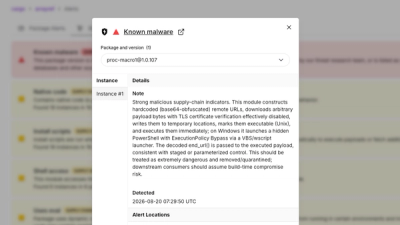
Three compromised Rust crates pulled in a malicious dependency that downloaded and executed cross-platform malware during Cargo builds.