
Company News
AWS Security Hub Adds Socket for Supply Chain Security
Socket is now in the AWS Security Hub Extended plan. Adopt it through AWS, apply committed spend, and block malicious open source packages.
By Feross Aboukhadijeh - Aug 04, 2026
@gridscoot/mcp
Advanced tools
MCP server for Gridscoot — Australian price comparison for AI agents. Search products, compare prices across retailers, track price drops.
MCP server for Gridscoot — AU price comparison for AI agents.


A Model Context Protocol (MCP) server that lets Claude, Cline, Continue.dev, and other MCP-compatible clients call Gridscoot's catalogue to find the cheapest in-stock listing of any product at an Australian retailer. Includes 365-day price history (so an agent can tell a genuine deal from a "marked up to mark down" trick) and live stock signals.
Six tools cover the full price-discovery loop: free-text search, per-product comparison across retailers, price history, real-time stock check, retailer directory, and a price-drop alert subscription.
The same tool registry is the canonical source for both this stdio package and the HTTP transport at /api/mcp on the deployed Gridscoot host (per ADR-0004).
npx -y @gridscoot/mcp
You'll typically not invoke the binary directly — point your MCP client config at it instead (see below).
Add the following to ~/Library/Application Support/Claude/claude_desktop_config.json (macOS) or %APPDATA%\Claude\claude_desktop_config.json (Windows):
{
  "mcpServers": {
    "gridscoot": {
      "command": "npx",
      "args": ["-y", "@gridscoot/mcp"],
      "env": {
        "GRIDSCOOT_API_KEY": "gs_test_..."
      }
    }
  }
}
Restart Claude Desktop. The six Gridscoot tools then appear in the tool picker.
Open Cline's MCP settings (Cline: Open MCP Settings) and add to the mcpServers block:
{
  "mcpServers": {
    "gridscoot": {
      "command": "npx",
      "args": ["-y", "@gridscoot/mcp"],
      "env": {
        "GRIDSCOOT_API_KEY": "gs_test_..."
      },
      "disabled": false,
      "autoApprove": []
    }
  }
}
In ~/.continue/config.yaml (or the JSON variant):
mcpServers:
  - name: gridscoot
    command: npx
    args:
      - "-y"
      - "@gridscoot/mcp"
    env:
      GRIDSCOOT_API_KEY: gs_test_...
| Tool | Description | Write? | Required | Optional |
|---|---|---|---|---|
search_products | Free-text search across all connected AU retailers; returns ranked offers with current pricing, availability, and delivery estimates. | no | query | max_price_aud, min_price_aud, location_postcode, delivery_by, in_stock_only (default true), category_hint, max_results (default 10, max 50) |
compare_product | All retailer offers for a known canonical product. | no | product_id | gtin, location_postcode, include_shipping (default true), sort_by (total_price | item_price | delivery_speed | retailer_rating) |
get_price_history | Trailing price history across retailers — used to evaluate whether a current deal is genuine or business-as-usual. | no | product_id | days (default 90, max 365), retailers |
check_availability | Real-time stock check at a specific retailer, including click-and-collect where supported. | no | product_id, retailer_id | postcode |
list_retailers | Lists retailers indexed by Gridscoot. Useful for meta queries and as a filter for other calls. | no | — | category, country (default AU; NZ from Phase 2+) |
track_price | Subscribes a user to price-drop alerts; returns a subscription ID. Write tool — dry-run-gated when the calling key is in dry-run mode. | yes | product_id, user_token | target_price_aud, retailers |
All tools return a single text-content MCP response with a JSON envelope; isError: true is set on failure. Every input field has a Zod-described shape and a .describe() annotation that surfaces in tools/list.
API keys carry one or more scopes. Each tool requires a scope to be callable:
mcp:read — grants search_products, compare_product, get_price_history, check_availability, list_retailers.mcp:track_price — grants track_price (the only write tool in the v0 surface). Independently grantable so a buyer can issue read-only keys to subagents and reserve write capability for a trusted parent.Keys bound to an agent identity in dry-run mode have their write calls queued for review instead of executed directly. See Authentication.
The MCP server reads the Bearer token from the GRIDSCOOT_API_KEY environment variable and forwards it to Gridscoot's backend in the Authorization header on every outbound request. Tokens have the format gs_<env>_<random> (e.g. gs_test_..., gs_live_...). The env var is read per-call, so rotated keys take effect without restarting the MCP server.
If GRIDSCOOT_API_KEY is unset, the server logs a one-time warning to stderr and lets requests proceed unauthenticated — the backend will respond with 401 and the tool result surfaces the error to the agent.
Create a key from the Gridscoot dashboard at /account/keys. Plaintext is shown once at creation — copy it into your MCP client config immediately and don't commit it to source control.
Set GRIDSCOOT_MCP_DRY_RUN=true (or 1) in the MCP client's env block to put the server into dry-run mode. Write tools (track_price) are not invoked; the server returns a { dryRun: true, would_call: { tool, params } } envelope instead. Read tools are unaffected. Use this when wiring a new agent and you want to inspect what it would mutate before letting it loose. The HTTP transport at /api/mcp enforces the same gate based on the resolved agent's dry_run_until window in the database.
Per the Gridscoot terms, the default per-key limits are:
search_products, compare_product, get_price_history, check_availability, list_retailers).track_price (the write tool).A 429 response includes the reset window. Treat these as upper bounds; for catalogue-scale workloads use the bulk REST surface at /api/v1/* instead of fanning out through MCP.
Gridscoot ships a free local-LLM tier — zero cost to users running Ollama, llama.cpp, or any local Claude-compatible runtime. Configure the MCP server the same way; the tier difference is enforced server-side based on the calling key's plan. The full search/compare/history surface is open on the free tier; the only restriction is track_price, which requires an authenticated buyer account.
git clone https://github.com/TBD/gridscoot.git
cd gridscoot
npm install
npm run typecheck                       # full monorepo
npm run --workspace=@gridscoot/mcp build
The MCP package shares its tool registry with the HTTP transport at apps/web/src/app/api/mcp/route.ts. Edits to packages/mcp/src/tools/*.ts apply to both surfaces.
To run the stdio server against a local backend:
GRIDSCOOT_API_BASE=http://localhost:3000 \
GRIDSCOOT_API_KEY=gs_test_... \
  node --experimental-strip-types ./src/server.ts
The @gridscoot/mcp/middleware subpath (auth + rate-limit + dry-run helpers for self-hosted HTTP deployments) declares @supabase/supabase-js and @gridscoot/observability as optional peer dependencies. The stdio binary and the tool registry never load them; they're only resolved if you import from @gridscoot/mcp/middleware. External consumers running the stdio server can ignore them entirely — npm install @gridscoot/mcp succeeds with no peer warnings.
MIT (see LICENSE). Per ADR-0005 the tool registry is recreated in-tree — there are no runtime third-party MCP wrapper dependencies; the only MCP runtime is the official @modelcontextprotocol/sdk. Schemas are authored in Zod and converted to JSON Schema via zod-to-json-schema for the MCP tools/list response.
Gridscoot is in Phase 7 launch prep. Status, ADRs, and roadmap live in the monorepo README.
FAQs
MCP server for Gridscoot — Australian price comparison for AI agents. Search products, compare prices across retailers, track price drops.
We found that @gridscoot/mcp demonstrated a healthy version release cadence and project activity because the last version was released less than a year ago. It has 1 open source maintainer collaborating on the project.
Did you know?

Socket for GitHub automatically highlights issues in each pull request and monitors the health of all your open source dependencies. Discover the contents of your packages and block harmful activity before you install or update your dependencies.
Company News
Socket is now in the AWS Security Hub Extended plan. Adopt it through AWS, apply committed spend, and block malicious open source packages.
Research
/Security News
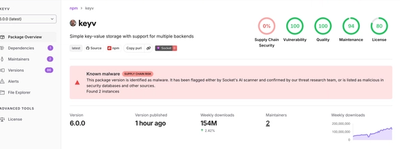
Popular npm packages keyv and cacheable compromised.

Security News
A misconfiguration gave three Anthropic models internet access, and one, believing it was in a simulation, shipped a credential-stealing package to PyPI.