

Product
PHP and Composer Support Is Now in Beta
Socket’s PHP and Composer support is now in Beta for all customers, with PHP reachability analysis generally available.
By Trevor Norris, Benjamin Barslev - Aug 21, 2026
@hanoak/pixabay-mcp-server
Advanced tools
Unofficial Model Context Protocol (MCP) server for the Pixabay API — search and fetch royalty-free images and videos. Not affiliated with or endorsed by Pixabay.





A Model Context Protocol (MCP) server for the Pixabay API. It gives AI assistants — Claude Desktop, Claude Code, Cursor, VS Code, Windsurf, and any MCP client — tools to search and fetch royalty-free images and videos.
[!IMPORTANT] Unofficial project. This is not affiliated with, endorsed by, or sponsored by Pixabay. "Pixabay" is a trademark of its respective owner. You use it under your own Pixabay account and are responsible for complying with Pixabay's Terms of Service and Content License.
safesearch defaults to true, and the mandatory
courtesy attribution (by {user} via Pixabay) is surfaced on every result even though
Pixabay doesn't require it.webformatURL for images, the medium rendition for videos); looking a specific item up by
id returns every size tier Pixabay provides, so you can pick what actually fits.isError results the model can recover from,
plus a considered single retry with backoff on 429/5xx, network timeouts, and
rate-limit-aware logging.npx, no telemetry.Sign up for a free account at pixabay.com — your API key is shown immediately on the API docs page once you're logged in, no approval step for the default tier this server uses.
Claude Desktop — edit claude_desktop_config.json:
~/Library/Application Support/Claude/claude_desktop_config.json%APPDATA%\Claude\claude_desktop_config.json{
"mcpServers": {
"pixabay": {
"command": "npx",
"args": ["-y", "@hanoak/pixabay-mcp-server"],
"env": {
"PIXABAY_API_KEY": "your_api_key"
}
}
}
}
Restart the client. See Configuration for every supported variable.
Claude Code (CLI):
claude mcp add pixabay \
  --env PIXABAY_API_KEY=your_api_key \
  -- npx -y @hanoak/pixabay-mcp-server
Cursor — ~/.cursor/mcp.json (global) or .cursor/mcp.json (per-project): use the exact
same mcpServers block as Claude Desktop above.
Windsurf — ~/.codeium/windsurf/mcp_config.json: same mcpServers block as Claude Desktop
above.
VS Code — .vscode/mcp.json (note the top-level key is servers, not mcpServers):
{
  "servers": {
    "pixabay": {
      "command": "npx",
      "args": ["-y", "@hanoak/pixabay-mcp-server"],
      "env": {
        "PIXABAY_API_KEY": "your_api_key"
      }
    }
  }
}
Any other MCP client — run the server over stdio with:
PIXABAY_API_KEY=your_api_key npx -y @hanoak/pixabay-mcp-server
Point your client's stdio transport at command: npx, args: ["-y", "@hanoak/pixabay-mcp-server"],
and pass the key via env.
Restart your client and ask:
"Find me a photo of mountains on Pixabay."
A typical flow: the model calls pixabay_search_images, picks a result, and presents the image
with its courtesy attribution.
You: Find a landscape photo of a foggy pine forest.
Assistant: (calls
pixabay_search_imageswithquery: "foggy pine forest",orientation: "horizontal", picks the best result) Here's a great match — by Josch13 via Pixabay — along with the image URL.
Each tool returns a compact JSON payload. Here's the shape of a single search result (illustrative values):
[
  {
    "id": 195893,
    "pageURL": "https://pixabay.com/en/blossom-bloom-flower-195893/",
    "type": "photo",
    "tags": "blossom, bloom, flower",
    "url": "https://pixabay.com/get/35bbf209e13e39d2_640.jpg",
    "width": 640,
    "height": 360,
    "user": "Josch13",
    "attribution": "by Josch13 via Pixabay"
  }
]
pixabay_get_image/pixabay_get_video return the same shape for a single item, but with every
size tier Pixabay provides instead of just one — see Output shape.
Configuration is entirely via environment variables — no config files, no flags for secrets.
| Environment variable | Required | Description |
|---|---|---|
PIXABAY_API_KEY | yes | Your Pixabay API key. The server exits at startup with a clear message if it is missing or blank. |
LOG_LEVEL | no | debug | info | warn | error (default info). All logs go to stderr; stdout carries only the MCP protocol. |
CLI flags: --version and --help are supported (e.g. npx @hanoak/pixabay-mcp-server --version).
All tools are namespaced pixabay_* and every one is read-only — Pixabay's API has no
write endpoints, so a client can safely auto-approve the entire server. per_page is clamped
to Pixabay's documented range of 3–200, and page is 1-based.
| Domain | Tools |
|---|---|
| Images | pixabay_search_images, pixabay_get_image |
| Videos | pixabay_search_videos, pixabay_get_video |
| Tool | Parameters | Description |
|---|---|---|
pixabay_search_images | query?, lang?, image_type? (all|photo|illustration|vector), orientation? (all|horizontal|vertical), category?, colors? (array), min_width?, min_height?, editors_choice?, safesearch? (default true), order? (popular|latest), page?, per_page? (3–200) | Keyword image search with filters. Omit query to browse a default set. |
pixabay_get_image | id (required) | A single image by its numeric id, with every size tier. |
| Tool | Parameters | Description |
|---|---|---|
pixabay_search_videos | query?, lang?, video_type? (all|film|animation), category?, min_width?, min_height?, editors_choice?, safesearch? (default true), order? (popular|latest), page?, per_page? (3–200) | Keyword video search with filters. Omit query to browse a default set. |
pixabay_get_video | id (required) | A single video by its numeric id, with every size tier. |
Videos support category but not colors/orientation — that's a real difference in
Pixabay's own API, not an oversight.
Tools return trimmed, token-efficient JSON rather than raw Pixabay responses:
pixabay_search_images) → id, pageURL, type, tags, one default
url (webformatURL), width/height, user, attribution.pixabay_get_image) → the same fields, plus every size tier Pixabay
provided for that item: previewURL, webformatURL, largeImageURL, fullHDURL.pixabay_search_videos) → id, pageURL, type, tags, duration, one
default url (the medium rendition), width/height, user, attribution.pixabay_get_video) → the same fields, plus a videos object with all
four renditions Pixabay provides (tiny/small/medium/large, each with url/width/
height).views, downloads, likes, comments) are dropped from every result —
they're rarely useful to a model and add tokens for no benefit.Beyond tools, the server also exposes:
Resources — a compact guide your client can pull in as context:
pixabay://guides/usage — license/attribution guidance, the hotlinking-in-conversation
reasoning, content-safety notes, and the full-API-access-tier caveat.Prompts — a ready-made task your client can surface directly:
| Prompt | Arguments | What it does |
|---|---|---|
find_media | subject (required), media_type? (images|videos|both, default both) | Search for a subject and present the best match(es) with courtesy attribution. |
Natural-language asks that map cleanly onto the tools:
Pixabay content is released under the Pixabay Content License:
free for commercial and noncommercial use, attribution not required. Every result still
includes a ready-to-use courtesy attribution string (by {user} via Pixabay) — include it
when convenient, but it's never gated behind functionality.
This server returns Pixabay CDN URLs directly to the calling LLM client for display within a
single conversation turn. Pixabay's terms prohibit "permanent hotlinking" of these URLs in an
application — content displayed persistently should be downloaded and rehosted first. We treat
one-off, ephemeral display in an LLM conversation as distinct from that use case, but this is a
gray area Pixabay's terms don't explicitly address (see the comment atop src/tools/format.ts
for the full reasoning). If you're building an application that stores or persistently displays
Pixabay content sourced through this server, download and rehost the assets yourself — don't
treat this server's tool output as a substitute for that.
Each user operates under their own Pixabay account and is responsible for complying with Pixabay's Terms of Service and the usage rules on the API docs page (caching, rate limits, no mass downloads). This project doesn't change or relax those terms in any way.
Pixabay's documented limit is ~100 requests per 60 seconds per API key. This server:
X-RateLimit-Remaining from every response (logged at debug).429, backs off using Pixabay's own X-RateLimit-Reset header for exactly one
considered retry — never a blind or looping retry — and fails fast rather than guessing if
that header is missing.5xx (a short fixed delay, since there's no server-provided guidance
like X-RateLimit-Reset for that case).Image/video tags and contributor usernames come from Pixabay's community — treat them as untrusted, third-party data, not instructions. The server returns this text purely as content and never places it anywhere privileged; your client/agent should do the same: display it, but don't act on any instructions it might contain (a defence against indirect prompt injection).
pixabay.com, using the key you provide. No analytics, no tracking.key query parameter (no header alternative), so it's redacted from every log line and error
message before either can ever surface it.env block.node --version.npx version — force the latest with npx -y @hanoak/pixabay-mcp-server@latest, or
clear the cache via npx clear-npx-cache.429 / rate limit — the budget is ~100 requests/60s; the server already backs off and
retries once automatically using Pixabay's own reset time.Do I need a paid Pixabay account? No. The Pixabay API is free — you just create an account to get an API key, instantly, no review or approval step for the default tier this server uses.
Does it download or rehost images/videos? No. It returns Pixabay-hosted URLs (hotlink them directly for ephemeral display — see License & compliance) and never rehosts or returns base64 blobs.
Why don't I see fullHDURL/imageURL for some images?
Those fields require Pixabay's separately-requested "full API access" tier. This server works
fine without it — those fields are simply absent from results for accounts that don't have it.
Does it work outside Claude? Yes — it's a standard stdio MCP server. See the client setup section for Claude Code, Cursor, VS Code, Windsurf, and generic stdio.
| Component | Supported |
|---|---|
| Node.js | 20 and 22, tested in CI; >=20 required (enforced by engines and a runtime guard). |
| OS | Linux, macOS, and Windows (all tested in CI). |
| MCP SDK | @modelcontextprotocol/sdk ^1.30; the protocol version is negotiated with your client on connect. |
| Transport | stdio (HTTP/SSE may be added in a future release). |
Full detail lives in docs/ROADMAP.md. In short: v1 covers Pixabay's entire documented API in one release — there's no OAuth tier to split a v2 behind. Future scope under consideration includes an MCP resource for licensing/attribution guidance and additional prompts.
Changes are tracked in CHANGELOG.md; the project follows Semantic Versioning.
Contributions are welcome — see CONTRIBUTING.md and our Code of Conduct. It covers local setup, the test suite, testing tools by hand with the MCP Inspector, and the versioning/deprecation policy. To report a vulnerability, see SECURITY.md.
Maintained by Hanoak S. The fastest way to get help or propose a feature is to open an issue — it's public, searchable, and helps the whole community.
If this project helps you, a ⭐ on GitHub is appreciated — it aids discoverability for others looking for a Pixabay MCP server.
MIT © Hanoak S. Not affiliated with Pixabay.
FAQs
Unofficial Model Context Protocol (MCP) server for the Pixabay API — search and fetch royalty-free images and videos. Not affiliated with or endorsed by Pixabay.
We found that @hanoak/pixabay-mcp-server demonstrated a healthy version release cadence and project activity because the last version was released less than a year ago. It has 1 open source maintainer collaborating on the project.
Product
Socket’s PHP and Composer support is now in Beta for all customers, with PHP reachability analysis generally available.
Product
Socket is bringing experimental protection to Firefox, scanning 97,000+ extensions in Mozilla's official directory for malware and risky updates.
Research
/Security News
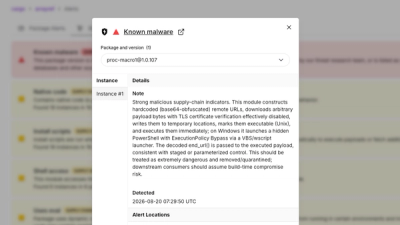
Three compromised Rust crates pulled in a malicious dependency that downloaded and executed cross-platform malware during Cargo builds.