Security News
arXiv Is Rate Limiting Authors Following a Flood of AI Slop Submissions
arXiv now limits authors to two submissions a month as AI slop overwhelms moderators, delays good papers, and sparks debate over applying the limit to everyone.
@hashnode/cli
Advanced tools
Hashnode CLI is a command-line interface tool that allows you to manage your Hashnode blogs or docs directly from your terminal. It provides commands to verify your local changes and preview your documentation.
Note: The Hashnode CLI is currently under active development. Some features may be incomplete or subject to change. We appreciate your patience and feedback as we work to improve the tool.
To install the Hashnode CLI, run the following command:
npm install -g @hashnode/cli
The docs command is the main entry point for Hashnode documentation-related commands.
hashnode docs [command]
Check your local changes for any errors.
hashnode docs verify [options]
Options:
-c, --cwd <cwd>: The working directory. Defaults to the current directory.-o, --write-file: Write the result to a file.This command performs the following checks:
FAQs
Manage Hashnode posts, drafts and publications from the terminal. Requires a publication on Hashnode Pro.
The npm package @hashnode/cli receives a total of 225 weekly downloads. As such, @hashnode/cli popularity was classified as not popular.
We found that @hashnode/cli demonstrated a healthy version release cadence and project activity because the last version was released less than a year ago. It has 2 open source maintainers collaborating on the project.

Security News
arXiv now limits authors to two submissions a month as AI slop overwhelms moderators, delays good papers, and sparks debate over applying the limit to everyone.

Research
/Security News
A new GhostAction wave hits hundreds of GitHub repos, expanding CI/CD secret theft to cloud and AI credentials in source code and git history.

Research
/Security News
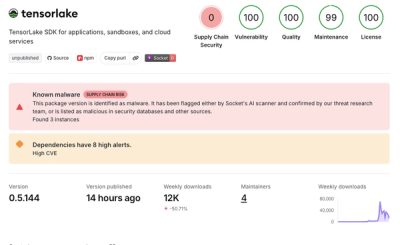
Tensorlake npm SDK version 0.5.144 was compromised in a ChainDrop / Shai-Hulud attack, delivering credential-stealing malware.