

Product
PHP and Composer Support Is Now in Beta
Socket’s PHP and Composer support is now in Beta for all customers, with PHP reachability analysis generally available.
By Trevor Norris, Benjamin Barslev - Aug 21, 2026
@imqueue/mcp
Advanced tools
Model Context Protocol server for @imqueue — lets AI coding agents search the docs and scaffold typed services & clients.
A Model Context Protocol server for @imqueue. It lets AI coding agents (Claude Code, ChatGPT, Codex, Cursor, VS Code, JetBrains, …) search the @imqueue documentation, scaffold typed services & clients, and drive the imq CLI — so they generate correct, idiomatic @imqueue code instead of guessing.
📖 Full documentation: imqueue.org/mcp — per-client setup, complete tools reference, agent workflows and the safety model.
Two surfaces, and they are not the same. The local server (npx -y @imqueue/mcp) has all 14 tools. The hosted server (mcp.imqueue.org/mcp) has seven, all read-only — see below for why.
| Tool | What it does |
|---|---|
search_docs | Search the official docs (guides, tutorial, CLI manual, API reference, articles) and return the most relevant pages + URLs. |
get_doc | Fetch the full markdown of a doc page by URL. |
list_packages | List the documented @imqueue packages with install commands, current versions and licences. |
package_status | The current version, licence, minimum Node and last release date of any published @imqueue package, or all of them. |
scaffold_service | Generate an IMQService subclass with @expose()d, JSDoc-typed methods + a bootstrap (offline, no CLI needed). |
scaffold_client | Show how to generate and use the fully-typed client for a service (offline). |
All six are read-only: they fetch or generate text and write nothing.
All five also declare an MCP outputSchema and return structuredContent alongside the human-readable markdown, so a client can consume results as data — take results[0].url from search_docs and hand it to get_doc, or write scaffold_service's files[] straight to disk — instead of parsing prose and code fences. For the scaffolders and the catalogue the markdown is rendered from that same structure, so the two can't drift.
get_doc's schema is metadata only, on purpose — and that turns out to be the more interesting design than having no schema at all. A schema obliges the server to send structuredContent, but nothing says structuredContent must repeat what is in content: it describes the structured part of the answer. So the page travels once, in content, and the schema carries url (the mirror actually fetched, which is not always the URL you passed), mimeType, bytes (so a caller can decide before reading) and truncated. Putting markdown in there as well would have doubled the largest response the server can produce — measured on /api/rpc/latest/, 16.6 kB of text plus 16.6 kB of structure for one read. The absence of a body field is itself self-describing: a caller reading the schema sees no content field and knows the page is in content, which is where every client already looks.
The CLI-backed tools have no schema: they return imq stdout, which has no shape worth promising.
@imqueue/cli on PATH)These drive the real CLI, so they act on the machine the server runs on. They exist in the local install only; the hosted server does not register them.
| Tool | What it does |
|---|---|
cli_status | Detect imq and report its version. |
cli_install | Install @imqueue/cli globally (npm i -g @imqueue/cli) when it's missing. |
cli_help | imq <command> --help — exact, version-accurate flags (no side effects). |
create_service | imq service create — dry-run by default (writes nothing); pass apply: true to actually create the project. |
generate_client | imq client generate <Service> — the real typed client (the service must be running). |
fleet | imq ctl <start|stop|restart|status> — manage a directory of service repos. status is read-only. |
config | imq config <check|get|set|init> — read/write CLI configuration (set for automation; init is interactive). |
logs | imq log — dump current fleet logs (never follows; capped) or clean them. |
Calls run with stdin closed and a timeout, so a missing-flag prompt fails fast instead of hanging. If imq isn't installed, run cli_install or use the offline scaffold_* tools.
Docs are fetched live from imqueue.org's machine-readable feeds, so the server never ships stale content: /llms.txt for the curated page index, per-page …/index.md mirrors for bodies, /search-index.json, /search-text.json and /search-sections.json for the search corpus, and /status.json for package versions and licences. imqueue.com's /llms.txt and peer feeds are read too, for the commercial pages. Nothing outside those two hosts is ever fetched — the allowlist is enforced in src/docs.ts and refuses anything else.
Versions and licences come from that last feed rather than being compiled in, deliberately: @imqueue releases far more often than this server does, so a baked-in version would be wrong within days and wrong with total confidence. npmjs.com serves bot detection to an unattended fetch, which is why imqueue.org reads the registry at build time and republishes the answer where anything can read it.
Requires Node.js ≥ 18. No build step for users — run straight from npm:
npx -y @imqueue/mcp
claude mcp add imqueue -- npx -y @imqueue/mcp
@imqueue is listed in OpenAI's plugin directory — shared by ChatGPT and Codex. In ChatGPT, open the Plugins tab and install it; in the Codex CLI, run /plugins. No config file, no Node.
That route installs the hosted server, so it is the seven read-only tools and none of the CLI bridge (see below). Codex can run the local server alongside it — MCP servers live under mcp_servers in ~/.codex/config.toml, in TOML rather than the usual JSON:
[mcp_servers.imqueue]
command = "npx"
args = ["-y", "@imqueue/mcp"]
ChatGPT connects to MCP servers over HTTP only, so it has no local option; the plugin is all of it there.
Add to your MCP config (.cursor/mcp.json, claude_desktop_config.json, …):
{
  "mcpServers": {
    "imqueue": {
      "command": "npx",
      "args": ["-y", "@imqueue/mcp"]
    }
  }
}
VS Code and Visual Studio use a top-level
serverskey with"type": "stdio"instead ofmcpServers. See imqueue.org/mcp/installation for the exact config file path and snippet for every client.
If your client supports remote MCP servers and you only need docs and scaffolding, point it at the hosted endpoint instead:
{ "mcpServers": { "imqueue": { "url": "https://mcp.imqueue.org/mcp" } } }
It serves seven tools, all read-only: the six above plus local_install_guide, which returns the setup steps for the local install. This is also what OpenAI's plugin directory installs for ChatGPT and Codex — the same endpoint under the same limits, packaged as one click.
It does not offer the CLI-backed tools, by design. Those act on your machine — your project files, your running services, your CLI config — which a server running on Cloudflare's edge cannot reach. Advertising them there would mean listing tools that can never do what their names say, so they are not registered at all in remote mode. If you need them, install locally.
npm install
npm run build      # tsc -> dist/
npm run dev        # run from source with tsx
npm test           # unit tests (node:test under tsx) — no network needed
npm run smoke      # local surface: handshake + tools/list + annotations + tool calls
npm run verify     # all of the above plus both type-checks; also the publish gate
The unit tests cover what does not need the network: the ranker on a fixed corpus,
the exact identifiers the scaffolders emit, URL resolution, telemetry, and the hosted
Worker's HTTP surface — worker/worker.ts is a plain fetch handler, so it is called
with a Request and asserted on the Response, with no wrangler and no deploy.
The hosted surface has its own check, because it is a different contract:
npm run dev:worker                                   # wrangler dev on :8787
node scripts/remote-smoke.mjs http://localhost:8787/mcp
npm run smoke:remote                                 # or against production
It asserts the exact seven-tool list and that every one of them is read-only — the assertion that stops a future refactor from quietly re-exposing a CLI tool on the hosted endpoint.
User: "Create an @imqueue user service with a getUser(id) method."
The agent calls
scaffold_service({ name: "user", methods: [{ name: "getUser", params: [{ name: "id", type: "number" }], returns: "User" }] })and gets a ready-to-pasteUserService+ bootstrap, thensearch_docs("run a service")/get_doc(...)to wire it up.
GPL-3.0 — free and open source.
Need to use @imqueue/mcp in a closed-source product, or want commercial support? A commercial license is available — see imqueue.com. Full docs: imqueue.org/mcp. See SPEC.md for the design and registry-distribution plan.
FAQs
Model Context Protocol server for @imqueue — lets AI coding agents search the docs and scaffold typed services & clients.
The npm package @imqueue/mcp receives a total of 111 weekly downloads. As such, @imqueue/mcp popularity was classified as not popular.
We found that @imqueue/mcp demonstrated a healthy version release cadence and project activity because the last version was released less than a year ago. It has 2 open source maintainers collaborating on the project.
Product
Socket’s PHP and Composer support is now in Beta for all customers, with PHP reachability analysis generally available.
Product
Socket is bringing experimental protection to Firefox, scanning 97,000+ extensions in Mozilla's official directory for malware and risky updates.
Research
/Security News
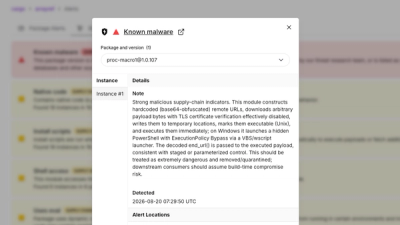
Three compromised Rust crates pulled in a malicious dependency that downloaded and executed cross-platform malware during Cargo builds.