
Product
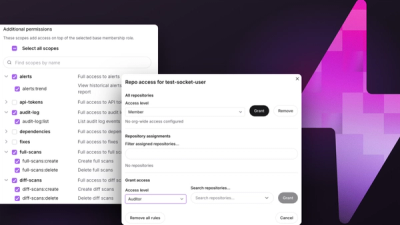
Introducing Repository Access Permissions and Custom Roles
Socket now supports Custom Roles and Repository Access Permissions so organizations can control who can access specific repositories and actions.
By Joe Werle - Jun 19, 2026
@inferagraph/log-analytics
Advanced tools
Azure Log Analytics datasource for InferaGraph (KQL via @azure/monitor-query or APIM)
Azure Log Analytics datasource plugin for @inferagraph/core. Reads graph nodes, edges, and content from a Log Analytics workspace via KQL.
Migrating from
@inferagraph/log-analytics-datasource?pnpm remove @inferagraph/log-analytics-datasource pnpm add @inferagraph/log-analyticsThe class was renamed
LogAnalyticsDatasource→LogAnalyticsDataSource(capitalS). A newlogAnalyticsDataSource(config)factory is the recommended on-ramp; directnew LogAnalyticsDataSource(config)remains as an escape hatch.
Three auth modes are supported:
app-registration — server-side app registration with client secretmanaged-identity — Azure-hosted managed identityapim — route through an Azure API Management endpoint (no Azure SDK)The first two use @azure/monitor-query and @azure/identity. The third uses globalThis.fetch (Node 20+).
SSR caveat:
app-registrationandmanaged-identityare server-side only. The client secret / managed identity must NEVER reach the browser. Use Next.js Server Components, Route Handlers, or other server-side code paths. For browser-callable scenarios, use theapimmode and put your APIM in front of the workspace.
pnpm add @inferagraph/log-analytics @inferagraph/core
@azure/monitor-query and @azure/identity are bundled as direct dependencies.
The datasource is configured with three things:
auth — how to talk to Log Analyticsqueries — KQL strings (or builder functions) per operationmapping — which result columns become id, sourceId, targetId, type, etc.The recommended on-ramp is the logAnalyticsDataSource(config) factory; direct new LogAnalyticsDataSource(config) is an escape hatch for subclassing or other advanced cases.
import { logAnalyticsDataSource } from '@inferagraph/log-analytics';

const datasource = logAnalyticsDataSource({
  workspaceId: '00000000-0000-0000-0000-000000000000',
  workspaceName: 'graph-prod',
  auth: {
    kind: 'app-registration',
    tenantId: process.env.AZURE_TENANT_ID!,
    clientId: process.env.AZURE_CLIENT_ID!,
    clientSecret: process.env.AZURE_CLIENT_SECRET!,
  },
  queries: {
    nodes: 'GraphNodes_CL | project id=node_id, type=node_type, name',
    edges:
      'GraphEdges_CL | project edge_id, source=source_id, target=target_id, rel=rel_type',
    search: (ctx) =>
      `GraphNodes_CL | where name contains '${ctx.params.query}' | project id=node_id, type=node_type, name`,
  },
  mapping: {
    nodes: { idColumn: 'id', typeColumn: 'type' },
    edges: {
      idColumn: 'edge_id',
      sourceColumn: 'source',
      targetColumn: 'target',
      typeColumn: 'rel',
    },
  },
  timespan: { duration: 'P30D' },
});

await datasource.connect();
const view = await datasource.getInitialView();
await datasource.disconnect();
Server-side only. Do not import this from a
'use client'component — secrets must not ship to the browser.
const datasource = logAnalyticsDataSource({
  workspaceId: process.env.AZURE_LA_WORKSPACE_ID!,
  workspaceName: 'graph-prod',
  auth: { kind: 'managed-identity' },
  queries: { /* …same as above… */ },
  mapping: { /* …same as above… */ },
});
Server-side only. The managed identity is bound to the Azure host and cannot be used from a browser.
const datasource = logAnalyticsDataSource({
  workspaceId: process.env.AZURE_LA_WORKSPACE_ID!,
  workspaceName: 'graph-prod',
  auth: {
    kind: 'apim',
    endpoint: 'https://api.example.com/log-analytics',
    headers: { 'Ocp-Apim-Subscription-Key': process.env.APIM_KEY! },
    // Optional: customize per-op routing or body shape
    buildRequest: (op, kql, ctx) => ({
      url: `https://api.example.com/log-analytics/${op}`,
      body: { workspaceId: ctx.workspaceId, query: kql },
    }),
  },
  queries: { /* …same as above… */ },
  mapping: { /* …same as above… */ },
});
The default APIM request is POST {endpoint} with body { workspaceId, query, op }. Override body and/or url via buildRequest. The executor accepts both response shapes:
{ rows: [{ ... }] } (already row-objects){ tables: [{ columns: [{name, ...}], rows: [[...], ...] }] } (Log Analytics REST shape)LogAnalyticsDataSourceConfig| Field | Type | Description |
|---|---|---|
workspaceId | string | Log Analytics workspace GUID |
workspaceName | string | Human label (used in error messages) |
auth | LogAnalyticsAuth | Discriminated union — see auth modes above |
queries | LogAnalyticsQueryConfig | Per-op KQL or (ctx) => kql |
mapping | LogAnalyticsMapping | Column-name → id/source/target/type mapping |
timespan | { duration: string } | ISO 8601 duration. Default 'P1D'. |
LogAnalyticsQueryConfig| Field | Required | Fallback if omitted |
|---|---|---|
nodes | yes | — |
edges | yes | — |
node | no | filter nodes results in memory by id |
neighbors | no | run nodes + edges, BFS in memory |
search | no | search() throws |
filter | no | filter() throws |
content | no | getContent() returns undefined |
LogAnalyticsMapping| Section | Required | Notes |
|---|---|---|
nodes.idColumn | yes | Column whose value becomes NodeData.id |
nodes.typeColumn | no | If set, value is exposed as attributes.type |
edges.{idColumn, sourceColumn, targetColumn, typeColumn} | yes | All four required |
content.{idColumn, bodyColumn} | yes (when queries.content set) | — |
content.contentTypeColumn | no | Default content type is 'text' |
getInitialView runs the nodes and edges queries, slices nodes to limit, then keeps only edges whose source AND target are in the returned node set.getNeighbors uses queries.neighbors if configured; otherwise falls back to in-memory BFS over queries.nodes + queries.edges. The depth parameter limits traversal.findPath is always an in-memory BFS over queries.nodes + queries.edges (KQL has no practical native path-finding for arbitrary graphs).NodeData.attributes / EdgeData.attributes (mirrors the CosmosDB datasource — the host application decides what's relevant).MIT
FAQs
Azure Log Analytics datasource for InferaGraph (KQL via @azure/monitor-query or APIM)
We found that @inferagraph/log-analytics demonstrated a healthy version release cadence and project activity because the last version was released less than a year ago. It has 1 open source maintainer collaborating on the project.
Did you know?

Socket for GitHub automatically highlights issues in each pull request and monitors the health of all your open source dependencies. Discover the contents of your packages and block harmful activity before you install or update your dependencies.
Product
Socket now supports Custom Roles and Repository Access Permissions so organizations can control who can access specific repositories and actions.
Product
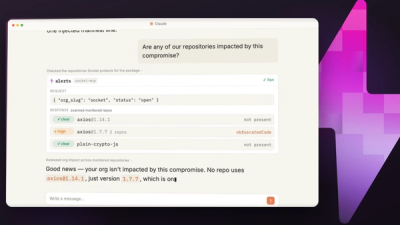
Socket MCP now lets AI assistants review org alerts, investigate threats using the Socket threat feed, and inspect package files in addition to dependency scoring.
Product
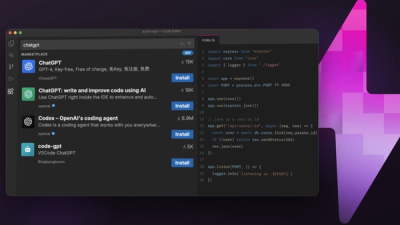
Socket Firewall blocks malicious VS Code and Open VSX extensions before install, protecting developers from compromised editor marketplaces.