
Product
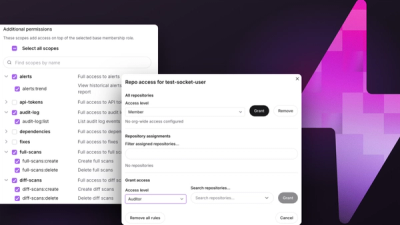
Introducing Repository Access Permissions and Custom Roles
Socket now supports Custom Roles and Repository Access Permissions so organizations can control who can access specific repositories and actions.
By Joe Werle - Jun 19, 2026
@inferagraph/openai-provider
Advanced tools
OpenAI provider plugin for @inferagraph/core. Includes chat (complete + stream with tool calls) and embeddings (embed).
pnpm add @inferagraph/openai-provider @inferagraph/core
import { openaiProvider } from '@inferagraph/openai-provider';
import { InferaGraph } from '@inferagraph/core/react';

<InferaGraph
  data={data}
  llm={openaiProvider({
    apiKey: process.env.OPENAI_API_KEY!,
    model: 'gpt-4o-mini',                   // optional; default 'gpt-4o-mini'
    embeddingModel: 'text-embedding-3-small', // optional; default 'text-embedding-3-small'
  })}
/>
| Option | Description |
|---|---|
apiKey | OpenAI API key. Server-side only. Ignored when client is provided. |
model | Chat model. Default 'gpt-4o-mini'. |
embeddingModel | Default embedding model. Default 'text-embedding-3-small'. Per-call override via EmbedOptions.model. |
baseURL | Override the OpenAI endpoint — works for Azure OpenAI, OpenRouter, GitHub Models, or any compatible API. Ignored when client is provided. |
organization | Optional OpenAI org id. Ignored when client is provided. |
project | Optional OpenAI project id. Ignored when client is provided. |
client | Pre-built OpenAI SDK client. When supplied, all other connection fields are ignored. Primary use case: tests / mocks. |
Use azureOpenaiProvider — it encapsulates Azure OpenAI v1 SDK construction so you never build an OpenAI / AzureOpenAI client by hand:
import { azureOpenaiProvider } from '@inferagraph/openai-provider';

azureOpenaiProvider({
  endpoint: process.env.AZURE_OPENAI_ENDPOINT!, // e.g. https://my-resource.openai.azure.com/
  apiKey: process.env.AZURE_OPENAI_KEY!,
  deployment: 'gpt-4o',                          // chat deployment name
  embeddingDeployment: 'text-embedding-3-small', // optional; omit for chat-only
});
| Option | Description |
|---|---|
endpoint | Bare resource URL. Trailing slashes are trimmed; the factory appends /openai/v1/ for you. The v1 surface replaces dated api-version query strings entirely (Azure docs). |
apiKey | Azure OpenAI API key. Server-side only. |
deployment | Chat deployment name. Sent as model on chat completions. |
embeddingDeployment | Embedding deployment name. Sent as model on embeddings calls. Optional — when omitted the provider has no embed capability. |
client | Pre-built OpenAI SDK client. When supplied, all other connection fields are ignored. Primary use case: tests / mocks. |
The factory uses the standard OpenAI class (NOT AzureOpenAI) — the v1 endpoint is fully OpenAI-compatible.
For OpenRouter, GitHub Models, or any other OpenAI-compatible API, the openaiProvider baseURL (or pre-built client) escape hatch still works:
openaiProvider({
  apiKey: process.env.OTHER_PROVIDER_KEY!,
  baseURL: 'https://other-openai-compatible-host/v1',
  model: 'gpt-4o',
});
For Azure specifically, prefer azureOpenaiProvider over hand-rolling openaiProvider({ client: new AzureOpenAI(...) }) — the new factory keeps Azure-specific URL math out of your codebase.
stream() translates the locked LLMToolDefinition[] shape into OpenAI's function-tool format and emits unified LLMStreamEvents (text / tool_call / done). Tool calls are buffered per index across deltas and flushed after the text stream closes — matching the contract's documented order.
streamMessages(messages, opts) (recommended)stream(prompt: string) accepts a single user prompt. streamMessages(messages) accepts a structured conversation array, which unlocks:
system role for system prompts. Tool-use-trained models heavily discount instructions delivered as user-role content; passing them under system keeps directives where the model is trained to obey them. (Better than prepending to the user message.)assistant role to replay prior model turns — multi-turn conversation memory, corrective-retry flows after malformed tool calls, etc.user / assistant turns following an optional leading system turn.Signature (peer dep @inferagraph/core@^0.8.0 exports the LLMMessage / LLMRole types):
import type { LLMMessage, LLMRole } from '@inferagraph/core';

provider.streamMessages(
  messages: LLMMessage[],
  opts?: StreamOptions,
): AsyncIterable<LLMStreamEvent>;
Example — system prompt plus a 2-turn exchange:
import { openaiProvider } from '@inferagraph/openai-provider';
import type { LLMMessage } from '@inferagraph/core';

const provider = openaiProvider({
  apiKey: process.env.OPENAI_API_KEY!,
  model: 'gpt-4o-mini',
});

const messages: LLMMessage[] = [
  { role: 'system', content: 'You are a concise assistant. Reply in one sentence.' },
  { role: 'user', content: 'Who wrote the Iliad?' },
  { role: 'assistant', content: 'Tradition attributes the Iliad to Homer.' },
  { role: 'user', content: 'And the Odyssey?' },
];

for await (const ev of provider.streamMessages!(messages)) {
  if (ev.type === 'text') process.stdout.write(ev.delta);
  if (ev.type === 'done') break;
}
The OpenAI SDK keeps system inline as the first message in the chat.completions messages array, so the contract array maps onto the SDK call essentially 1:1 — roles survive end-to-end.
stream(prompt) still works and is unchanged. It is internally a thin wrapper that calls streamMessages([{ role: 'user', content: prompt }]), so single-prompt behavior is identical. New consumers should prefer streamMessages whenever a system prompt or prior turns are involved.
embed(texts) returns Vector[] (one per input, in input order) using the configured embeddingModel. Empty inputs short-circuit to [] rather than calling the API.
MIT
FAQs
OpenAI provider for InferaGraph
We found that @inferagraph/openai-provider demonstrated a healthy version release cadence and project activity because the last version was released less than a year ago. It has 1 open source maintainer collaborating on the project.
Did you know?

Socket for GitHub automatically highlights issues in each pull request and monitors the health of all your open source dependencies. Discover the contents of your packages and block harmful activity before you install or update your dependencies.
Product
Socket now supports Custom Roles and Repository Access Permissions so organizations can control who can access specific repositories and actions.
Product
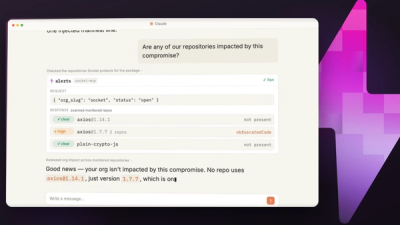
Socket MCP now lets AI assistants review org alerts, investigate threats using the Socket threat feed, and inspect package files in addition to dependency scoring.
Product
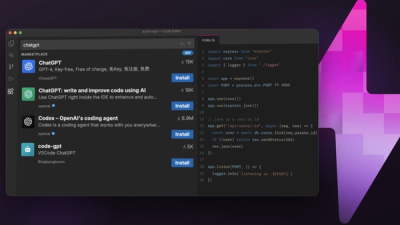
Socket Firewall blocks malicious VS Code and Open VSX extensions before install, protecting developers from compromised editor marketplaces.