@inquirer/expand
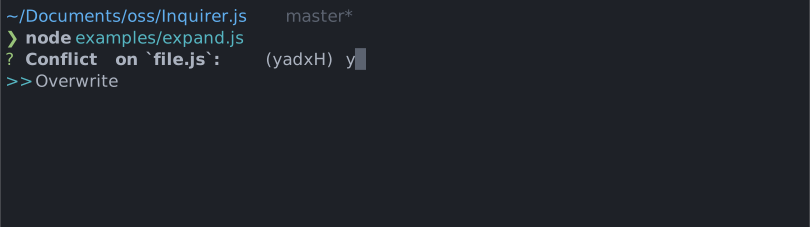
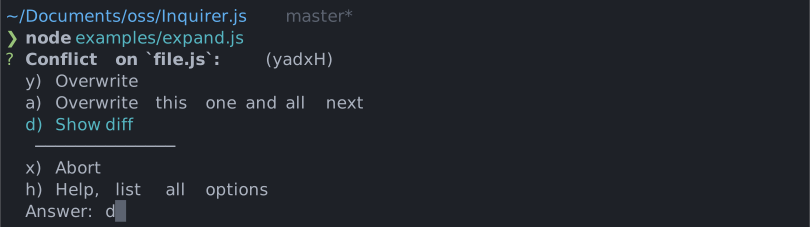
Compact single select prompt. Every option is assigned a shortcut key, and selecting h will expand all the choices and their descriptions.
Installation
| yarn | pnpm |
|---|
yarn add @inquirer/prompts
|
pnpm add @inquirer/prompts
|
| bun | deno |
|---|
bun add @inquirer/prompts
|
deno add npm:@inquirer/prompts
|
| npm |
|---|
npm install @inquirer/prompts
|
| Or |
| yarn | pnpm |
|---|
yarn add @inquirer/expand
|
pnpm add @inquirer/expand
|
| bun | deno |
|---|
bun add @inquirer/expand
|
deno add npm:@inquirer/expand
|
| npm |
|---|
npm install @inquirer/expand
|
On Deno, prompts detect the terminal's unicode and color support from the environment, so run your script with --allow-env.
Usage
import { expand } from '@inquirer/prompts';
const answer = await expand({
message: 'Conflict on file.js',
default: 'y',
choices: [
{
key: 'y',
name: 'Overwrite',
value: 'overwrite',
},
{
key: 'a',
name: 'Overwrite this one and all next',
value: 'overwrite_all',
},
{
key: 'd',
name: 'Show diff',
value: 'diff',
},
{
key: 'x',
name: 'Abort',
value: 'abort',
},
],
});
Options
| message | string | yes | The question to ask |
| choices | Choice[] | yes | Array of the different allowed choices. The h/help option is always provided by default |
| default | string | no | Default choices to be selected. (value must be one of the choices key) |
| expanded | boolean | no | Expand the choices by default |
| theme | See Theming | no | Customize look of the prompt. |
Separator objects can be used in the choices array to render non-selectable lines in the choice list. By default it'll render a line, but you can provide the text as argument (new Separator('-- Dependencies --')). This option is often used to add labels to groups within long list of options.
Choice object
The Choice object is typed as
type Choice<Value> = {
  value: Value;
  name?: string;
  key: string;
};
Here's each property:
value: The value is what will be returned by await expand().name: The string displayed in the choice list. It'll default to the stringify value.key: The input the use must provide to select the choice. Must be a lowercase single alphanumeric character string.
Theming
You can theme a prompt by passing a theme object option. The theme object only need to includes the keys you wish to modify, we'll fallback on the defaults for the rest.
type Theme = {
  prefix: string | { idle: string; done: string };
  spinner: {
    interval: number;
    frames: string[];
  };
  style: {
    answer: (text: string) => string;
    message: (text: string, status: 'idle' | 'done' | 'loading') => string;
    error: (text: string) => string;
    defaultAnswer: (text: string) => string;
    highlight: (text: string) => string;
  };
};
License
Copyright (c) 2023 Simon Boudrias (twitter: @vaxilart)
Licensed under the MIT license.