



Security News
The Code You Didn't Write Is Still Yours to Defend
AI agents are pulling packages into environments no scanner is watching, creating exposure before security teams can see it.
By Brad Arkin - Jun 23, 2026
@ixo/impactxclient-sdk
Advanced tools
One ixo client to rule them all, One ixo client to find, One ixo client to bring them all, and in impact bind them

@ixo/impactxclient-sdk






The IXO Impacts Client SDK @ixo/impactxclient-sdk is a type-safe TypeScript SDK for Javascript developers.
It is compatible with most Javascript frameworks, including React, React Native, Vue.js, and Node.js.
The Impacts Client SDK is designed to interact with the IXO blockchain and other Cosmos appchains. It provides a comprehensive set of tools to query a Cosmos blockchain, form messages, and sign transactions. The SDK also supports interchain communication and smart contract interactions.
The Impacts Client SDK provides support for both ESM (ECMAScript Modules) and CJS (CommonJS).
npm install @ixo/multiclient-sdk
or
yarn add @ixo/multiclient-sdk
The Query Client and Signing Client provide simple interfaces to abstract away the complexity of querying data on the IXO blockchain and signing messages for broadcasting to the IXO blockchain. These clients also work for other Cosmos appchains.
./utilsImport the utils object from @ixo/impactxclient-sdk to destructure utlity functions to help with using this SDK.
import { utils } from "@ixo/impactxclient-sdk";

const conversionUtils = utils.conversions;
const didUtils = utils.did;
const mnemonicUtils = utils.mnemonic;
const addressUtils = utils.address;
First connect to an RPC Client in order to interact with a blockchain; in this case the IXO blockchain.
The Cosmos Chain Resolver SDK, created by IXO, provides a simple way to retrieve RPC endpoints for any Cosmos chain.
We added a custom Query Client that includes the Cosmos modules and IXO modules, as well as Custom Queries.
Remember to set the RPC_ENDPOINT environment variable.
RPC_ENDPOINT providers can be found at the Cosmos Chain Registry Github repository for Mainnet.Example that describes how to set up your queryClient with an RPC endpoint.
import { ixo, createQueryClient } from "@ixo/impactxclient-sdk";

const queryClient = await createQueryClient(RPC_ENDPOINT);
IXO created a custom QueryClient to facilitate queries to the cosmos and ixo modules, as well as to provide Custom Queries.
First connect to an RPC client.
Example code snippet assuming that the queryClient has been initialised with an RPC endpoint.
import { ixo, createQueryClient } from "@ixo/impactxclient-sdk";

const queryClient = await createQueryClient(RPC_ENDPOINT);

// Example of querying the Cosmos Bank module for the balances of an account on the IXO blockchain
const balance = await client.cosmos.bank.v1beta1.allBalances({
  address: "ixo1addresshere",
});
// Example of querying the IXO Entity module for all entities on the IXO blockchain
const entities = await queryClient.ixo.entity.v1beta1.entityList();
Import the customQueries object from @ixo/impactxclient-sdk. Use the object to destructure currency functions that will allow you to get the token info based on the provided denom or the contract functions that will provide ixo or daodao contract codes for instantiation.
Example of custom queries.
import { customQueries } from "@ixo/impactxclient-sdk";

// get token info based on denom (coinMinimalDenom)
const token = customQueries.currency.findTokenFromDenom("uixo");

// get ibc token info based on ibc hash (and instantiated query client)
const ibcToken = await customQueries.currency.findIbcTokenFromHash(
  queryClient,
  "ibc/u05AC4BBA78C5951339A47DD1BC1E7FC922A9311DF81C85745B1C162F516FF2F1"
);
// `findIbcTokensFromHashes` requires an array of hashes to fetch multiple ibc token infos

// get coincodex info for a coin
const coinCodexInfo = customQueries.currency.findTokenInfoFromDenom("ixo");
// `findTokensInfoFromDenoms` requires an array of denoms to fetch multiple coinCodex infos
// get daodao contract codes (for devnet) to instatiate
const contractCodes = customQueries.contract.getContractCodes(
  "devnet",
  "daodao"
); // contractCodes = [{ name: "dao_core", code: 3 }, ...];
const { code } = contractCodes.find((contract) => contract.name === "dao_core");

// get specific contract code (for testnet) to instantiate
const daoCoreContractCode = customQueries.contract.getContractCode(
  "testnet",
  "dao_core"
);
A message to the IXO blockchain requires three steps:
See Note
IXO has developed an improved signing client named SignX that interacts seamlessly with the Impacts X mobile app. Read more about how to utilise the SignX client instead of using this SigningClient.
The following example describes one type of message. Reference the __tests__ directory of this repository for further examples of most messages and how to format them.
import { ixo } from "@ixo/impactxclient-sdk";

const message = {
  typeUrl: "/ixo.iid.v1beta1.MsgCreateIidDocument",
  value: ixo.iid.v1beta1.MsgCreateIidDocument.fromPartial({
    id: did,
    verifications: [
      ixo.iid.v1beta1.Verification.fromPartial({
        relationships: ["authentication"],
        method: ixo.iid.v1beta1.VerificationMethod.fromPartial({
          id: did,
          type: "EcdsaSecp256k1VerificationKey2019",
          publicKeyMultibase: "F" + toHex(pubkey),
          controller: controller,
        }),
      }),
    ],
    signer: address,
    controllers: [did],
  }),
};
Reference Composing Messages for information about composing messages in general.
./codegen/ibc/bundleimport { ibc } from "@ixo/impactxclient-sdk";
Here are the docs on creating signers in cosmos-kit that can be used with Keplr and other wallets.
IXO added a custom Stargate Signing Client that can be exported and is creatable under createSigningClient.
Note
It only supports Direct Proto signing through the RPC endpoint. It already has all the proto defininitions in the registry for IXO blockchain modules.
import { createSigningClient } from "@ixo/impactxclient-sdk";

const signingClient = await createSigningClient(RPC_URL, offlineWallet);
Note
The following, named
getSigningixoClient, is an alternative tocreateSigningClient.
Use getSigningixoClient to get your SigningStargateClient, with the proto/amino messages full-loaded.
There is no need to manually add amino types, just import and initialize the client:
import { getSigningixoClient } from "@ixo/impactxclient-sdk";

const stargateClient = await getSigningixoClient({
  rpcEndpoint,
  signer, // OfflineSigner
});
To broadcast messages, you can create signers with a variety of options:
Proto Signer
import { getOfflineSignerProto as getOfflineSigner } from "cosmjs-utils";
Amino Signer Note
The SDK currently does not include amino types. Use the Proto Signer for now.
import { getOfflineSignerAmino as getOfflineSigner } from "cosmjs-utils";
Once the Signer type has been imported, the signer can be created.
WARNING
It is not recommended to write your mnemonic, also known as seed phrase, in plain text. The example below is only for illustration and has no balances. Please take care of your security and use best practices such as AES encryption and/or methods from 12factor applications.
import { chains } from "chain-registry";

const mnemonic =
  "unfold client turtles either pilots stocks floors glow toward bullets cars science";
const chain = chains.find(({ chain_name }) => chain_name === "ixo");
const signer = await getOfflineSigner({
  mnemonic,
  chain,
});
Now that you have your stargateClient, you can broadcast messages that were composed as described in Composing Messages.
This example demonstrates broadcasting the /cosmos.bank.v1beta1.MsgSend message.
const msg = send({
  amount: [
    {
      denom: "coin",
      amount: "1000",
    },
  ],
  toAddress: address,
  fromAddress: address,
});

const fee: StdFee = {
  amount: [
    {
      denom: "coin",
      amount: "864",
    },
  ],
  gas: "86364",
};
const response = await stargateClient.signAndBroadcast(address, [msg], fee);
Available at the IXO Blockchain repository.
See potential use cases that may be applicable to your application.
./codegen/ixo/bundle.d.tsThe IID (Interchain Identifier) Module establishes a decentralized identity mechanism, ensuring a standardized approach for all entities within the system. By harnessing the power of DIDs (Decentralized Identifiers) and IIDs, this module facilitates a robust, secure, and universally recognizable identity framework, paving the way for a seamless integration across various platforms and networks.
./codegen/ixo/iid/v1beta1/query./codegen/ixo/iid/v1beta1/txThe Entity Module introduces a holistic approach to NFT-backed identities, bridging the gap between decentralized identifiers and tangible assets. Upon entity creation, a symbiotic relationship forms between an IID Document, an NFT, and the Entity's metadata. Further enriched with the concept of Entity Accounts, this module ensures a seamless transition of ownership, while offering a robust framework for entities to operate within a decentralized landscape.
./codegen/ixo/entity/v1beta1/query./codegen/ixo/entity/v1beta1/txEmbracing the versatility of the EIP-1155 standard, the Token Module offers a sophisticated mechanism for managing multi-token smart contracts. Whether you're dealing with fungible or non-fungible tokens, this module streamlines the process of creation, minting, and management. From defining token collections to ensuring transparent on-chain token attributes, the Token Module stands as a beacon of efficiency and flexibility in the decentralized token ecosystem.
./codegen/ixo/token/v1beta1/query./codegen/ixo/token/v1beta1/txThe Claims Module provides an advanced structure for handling Verifiable Claims (VCs), cryptographic attestations regarding a subject. By aligning with the W3C standard and incorporating unique IXO system identifiers, this module offers a comprehensive solution for creating, evaluating, and managing claims. It enables entities to define protocols, authorize agents, and maintain a verifiable registry, ensuring authenticity and transparency in all claim-related processes.
./codegen/ixo/claims/v1beta1/query./codegen/ixo/claims/v1beta1/txThe Bonds Module provides universal token bonding curve functions to mint, burn or swap any token in a Cosmos blockchain.
./codegen/ixo/bonds/v1beta1/query./codegen/ixo/bonds/v1beta1/txAvailable at the Cosmos SDK repository. View the examples provided by the Cosmos SDK team.
./codegen/contracts./codegen/cosmos/bundle./codegen/cosmwasm/bundle./codegen/ibc/bundle./codegen/ica/bundle./codegen/ics23/bundle./codegen/tendermint/bundleIn order to instantiate and execute smart contracts on the IXO blockchain, messages on the wasm module have to be invoked. The wasm message contains the smart contract details and the message to execute.
Available at the CosmWasm module repository.
./codegen/cosmwasm/bundleThere are a few steps to follow when working with a CosmWasm smart contract.
Instantiation is only required when the contract is not available on the chain instance that you are working with.
./custom_queries/contractHere is an example code snippet that shows how to instantiate and execute messages on a contract using the ixo1155 contract code:
import { createSigningClient, customQueries, cosmwasm, cosmos } from '@ixo/impactxclient-sdk';

/*
// Create a signing client in order to sign messages.
// Retrieve the Account Address for the connected user account.
*/
const client = await createSigningClient(rpc, offlineSigner);
const account = {};
const myAddress = account.address;

/*
// NB: Instantiation is only required when the contract is not available on the chain instance that you are working with.
// 1. Create the instantiation message for the contract.
// - Retrieve the Code for this contract (using ixo1155 for this example).
// - Remember to provide 1 uixo as message funding.
// 2. Sign the message and broadcast it to the IXO blockchain.
// - The most important part of this response is the Contract Address.
// - It is required for all further interactions with the contract.
*/
const contractCodes = customQueries.contract.getContractCodes('devnet', 'ixo');
const contractCode = contractCodes.find((contract) => contract.name === 'ixo1155');
const instantiateContractMessage = {
  typeUrl: '/cosmwasm.wasm.v1.MsgInstantiateContract',
  value: cosmwasm.wasm.v1.MsgInstantiateContract.fromPartial({
    admin: myAddress,
    codeId: contractCode.code,
    funds: [
      cosmos.base.v1beta1.Coin.fromPartial({
        amount: '1',
        denom: 'uixo',
      }),
    ],
    label: account.did + 'contract' + contractCode.code,
		msg: new Uint8Array(Buffer.from(JSON.stringify({
      minter: myAddress
    }))),
    sender: myAddress,
  }),
};

const instantiateContractResponse = await client.signAndBroadcast(
  myAddress,
  [instantiateContractMessage],
  "auto"
);
const contractAddress = JSON.parse(instantiateContractResponse.rawLog!)[0]
  .events
  .instantiate
  .attributes
  ._contract_address
  .value;

/*
// Execute messages on the contract with these steps:
// 1. All contract messages need to be wrapped in the /cosmwasm.wasm.v1.MsgExecuteContract blockchain message.
// - Remember to provide 1 uixo as message funding.
// 2. Create the message that you want to execute on the contract and include it in the msg field.
// - This example executes the batch_mint message.
// 3. Sign the message and broadcast it to the IXO blockchain.
// - A successful message execution means that the transaction was completed.
*/

// tokenId is an example in this case to support the batch_mint contract message.
const tokenId = 'CARBON:bafybeib22s3lyz3guicawoboeieltpyewkdnuuheklpeu3zbrwekmpdew5';
const executeContractMessage = {
  typeUrl: '/cosmwasm.wasm.v1.MsgExecuteContract',
  value: cosmwasm.wasm.v1.MsgExecuteContract.fromPartial({
    contract: contractAddress,
    funds: [
      cosmos.base.v1beta1.Coin.fromPartial({
        amount: '1',
        denom: 'uixo',
      }),
    ],
		msg: new Uint8Array(Buffer.from(JSON.stringify({
      batch_mint: {
        to: myAddress,
        batch: [[tokenId, '5000', 'uri']],
      },
    }))),
    sender: myAddress,
  }),
};
const executeContractResponse = await client.signAndBroadcast(
  myAddress,
  [executeContractMessage],
  "auto"
);
IXO developed a smart contract named ixoSwap to enable swapping of tokens on the IXO network. Read more about the contract in the Swimm documentation. The contract has been audited by an independent party.
Examples of how to use the ixoSwap contract are available here:
__tests__ directory of this repository.The basic DAO contracts are forked from the DAO-DAO Github organisation's dao-contracts repository.
IXO has implemented the contracts in an innovative manner and this implementation is generally available as DAO Tooling in the Impacts Portal.
Examples of how to use DAODAO Contracts can be found here.
See potential use cases that may be applicable to your application.
Install the below Library and import into your main app entry file. This ensures the required Polyfils are covered on mobile.
yarn add @walletconnect/react-native-compat
To ensure no issues with the React Native bigInt implementation, be sure to wrap your decimal gas amounts and others in a JS Double.
Types were generated from the *.proto files of the IXO appchain using the @osmonauts/telescope@0.92.2 package.
See
@ixo/impactxclient-sdk/types/index.d.tsfor the complete list of types.
IXO welcomes contributions and comments of all kinds!
First off, thank you for applying your mind and time to improving this repo - it helps the Internet of Impacts to save our planet! Whether you are contributing in your own space-time or following a bounty; we are grateful!
Clone the repository. After successfully cloning:
yarn
yarn build
Contract schemas live in ./contracts, and protos in ./proto. Look inside of scripts/codegen.js and configure the settings for bundling your SDK and contracts into ixo-multiclient-sdk:
yarn codegen
Build the types and then publish:
yarn build:ts
yarn publish
This SDK is licensed under the Apache 2 License. See the LICENSE file for more information.
FAQs
One ixo client to rule them all, One ixo client to find, One ixo client to bring them all, and in impact bind them
The npm package @ixo/impactxclient-sdk receives a total of 422 weekly downloads. As such, @ixo/impactxclient-sdk popularity was classified as not popular.
We found that @ixo/impactxclient-sdk demonstrated a healthy version release cadence and project activity because the last version was released less than a year ago. It has 2 open source maintainers collaborating on the project.
Did you know?

Socket for GitHub automatically highlights issues in each pull request and monitors the health of all your open source dependencies. Discover the contents of your packages and block harmful activity before you install or update your dependencies.
Security News
AI agents are pulling packages into environments no scanner is watching, creating exposure before security teams can see it.

Security News
GitHub Actions checkout now blocks risky pull_request_target checkouts by default to help prevent pwn request supply chain attacks.
Product
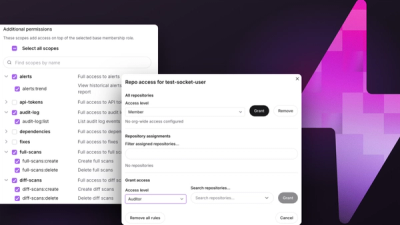
Socket now supports Custom Roles and Repository Access Permissions so organizations can control who can access specific repositories and actions.