
Security News
The Code You Didn't Write Is Still Yours to Defend
AI agents are pulling packages into environments no scanner is watching, creating exposure before security teams can see it.
By Brad Arkin - Jun 23, 2026
@ixo/oracles-events
Advanced tools
@ixo/oracles-eventsReal-time event system for QiForge. Handles streaming communication between your oracle (server) and client applications via Server-Sent Events (SSE) and WebSocket (WS) connections.
Table of Contents
The @ixo/oracles-events package enables real-time communication between your oracle and client applications. While your LLM processes conversations using LangGraph, events stream live updates to clients showing tool execution, rendering custom UI components, and enabling browser-side interactions.
Key Features:
@ixo/oracles-client-sdkUse Case: One-way streaming from server to client
Best For: Tool call updates, component rendering, status notifications
Endpoint: /sse/events?sessionId={sessionId}
Use Case: Bidirectional real-time communication
Best For: Browser tool calls, interactive features, immediate responses
Implementation: Socket.IO with session-based rooms
Purpose: Notifies clients when LLM executes tools on the server
Use Cases: API calls, database queries, long-running operations
// Start tool execution
new ToolCallEvent({
  sessionId: 'user-session-123',
  requestId: 'request-456',
  toolName: 'get_weather',
  args: { location: 'New York' },
  status: 'isRunning',
}).emit();

// Tool completes
new ToolCallEvent({
  sessionId: 'user-session-123',
  requestId: 'request-456',
  toolName: 'get_weather',
  status: 'done',
  output: 'Temperature: 72°F, Sunny',
}).emit();
Purpose: Instructs client to render custom UI components
Use Cases: Dynamic lists, charts, forms, interactive elements
new RenderComponentEvent({
  sessionId: 'user-session-123',
  requestId: 'request-456',
  componentName: 'ProductList',
  args: {
    products: [
      { name: 'Product A', price: 29.99 },
      { name: 'Product B', price: 39.99 },
    ],
  },
  status: 'done',
}).emit();
Purpose: Enables LLM to execute tools directly in user's browser
Use Cases: UI navigation, DOM manipulation, browser-specific operations
// Server-side: Call browser tool
import { callBrowserTool } from '@ixo/common';

const result = await callBrowserTool({
  sessionId: 'user-session-123',
  toolCallId: 'tool-call-789',
  toolName: 'navigateToPage',
  args: { url: '/products' },
});
Purpose: Notifies clients to refresh message cache
Use Cases: New messages, conversation state changes
Purpose: Manages conversation flow and navigation state
Use Cases: Multi-step conversations, wizard flows
pnpm install @ixo/oracles-events
Create your event by extending BaseEvent:
// src/events/my-custom-event/types.ts
export const EVENT_NAME = 'my_custom_event' as const;

export interface IMyCustomEvent {
  message: string;
  priority: 'high' | 'normal' | 'low';
  metadata?: Record<string, any>;
}
// src/events/my-custom-event/my-custom-event.ts
import {
  BaseEvent,
  shouldHaveSessionId,
  WithRequiredEventProps,
} from '../base-event/base-event';
import { EVENT_NAME, IMyCustomEvent } from './types';

export class MyCustomEvent extends BaseEvent<IMyCustomEvent> {
  constructor(public payload: WithRequiredEventProps<IMyCustomEvent>) {
    super();
    shouldHaveSessionId(payload);
  }

  public eventName = EVENT_NAME;
  static eventName = EVENT_NAME;
}
// src/graph-event-emitter.ts
import { MyCustomEvent } from './events/my-custom-event/my-custom-event';

export class GraphEventEmitter {
  static registerEventHandlers(server: Server): void {
    MyCustomEvent.registerEventHandlers(server);
    // ... other events
  }
}
// src/events/index.ts
export { MyCustomEvent } from './my-custom-event/my-custom-event';
export type { IMyCustomEvent } from './my-custom-event/types';
// src/types/index.ts
import type { MyCustomEvent } from '../events';

export type AllEvents =
  | ToolCallEvent
  | RenderComponentEvent
  | BrowserToolCallEvent
  | MessageCacheInvalidationEvent
  | RouterEvent
  | MyCustomEvent; // Add your event here

export type MyCustomEventPayload = WithRequiredEventProps<IMyCustomEvent>;
There are two ways to emit events depending on your use case:
Use Case: Standard event flow that automatically reaches clients via WebSocket
How it works: event.emit() → rootEventEmitter → GraphEventEmitter (if registered) → WebSocket clients
// In your LangGraph node or service
import { ToolCallEvent } from '@ixo/oracles-events';

const event = new ToolCallEvent({
  sessionId: 'user-session-123',
  requestId: 'request-456',
  toolName: 'get_weather',
  args: { location: 'New York' },
  status: 'isRunning',
});

// This follows the complete flow:
// 1. event.emit() → rootEventEmitter.emit(eventName, payload)
// 2. GraphEventEmitter (registered in ws.gateway.ts) listens to rootEventEmitter
// 3. Automatically broadcasts to WebSocket clients in the session
event.emit();
Complete Event Flow:
Your Code → event.emit() → rootEventEmitter → GraphEventEmitter → WebSocket Server → Client
Registered Events: ToolCallEvent, RenderComponentEvent, BrowserToolCallEvent, MessageCacheInvalidationEvent, RouterEvent
Use Case: Direct emission to specific communication channels
How it works: Bypass event system and emit directly to SSE/WebSocket services
// Direct SSE emission (like in messages.service.ts)
import { SseService } from 'src/sse/sse.service';

@Injectable()
export class MyService {
  constructor(private readonly sseService: SseService) {}

  sendEventToClient(sessionId: string) {
    const event = new MyCustomEvent({
      sessionId,
      requestId: 'request-456',
      message: 'Direct emission',
      priority: 'high',
    });

    // Direct emission to SSE clients
    this.sseService.publishToSession(sessionId, event);
  }
}
Use Case: Emit events back into the internal events system
How it works: Direct rootEventEmitter usage for service-to-service communication
// Internal emission (like in ws.gateway.ts)
import { rootEventEmitter } from '@ixo/oracles-events';

// Emit back into the events system for internal processing
rootEventEmitter.emit('browser_tool_result', {
  sessionId: 'user-session-123',
  toolCallId: 'tool-123',
  result: { success: true },
  timestamp: new Date().toISOString(),
});
When to use each method:
The following diagram shows the complete flow from your code to the client:
graph LR
    A["🧠 Your Code<br/>event.emit()"] --> B["📡 rootEventEmitter"]
    B --> C["🎯 GraphEventEmitter<br/>(listens to rootEventEmitter)"]
    C --> D["📱 WebSocket → Client"]

    style A fill:#e3f2fd,stroke:#1976d2,stroke-width:2px
    style B fill:#fff3e0,stroke:#f57c00,stroke-width:2px
    style C fill:#e8f5e8,stroke:#388e3c,stroke-width:2px
    style D fill:#fce4ec,stroke:#d81b60,stroke-width:2px
How it works:
event.emit() in your coderootEventEmitter (internal event bus)GraphEventEmitter listens to rootEventEmitter and forwards to WebSocketThat's it! Once GraphEventEmitter is registered in ws.gateway.ts, all events automatically reach clients.
Many events support status tracking:
// Start long-running operation
new ToolCallEvent({
  sessionId,
  requestId,
  toolName: 'complex_analysis',
  status: 'isRunning',
}).emit();

// Update with progress (optional)
new ToolCallEvent({
  sessionId,
  requestId,
  toolName: 'complex_analysis',
  status: 'isRunning',
  output: 'Progress: 50% complete',
}).emit();

// Complete operation
new ToolCallEvent({
  sessionId,
  requestId,
  toolName: 'complex_analysis',
  status: 'done',
  output: 'Analysis complete: Found 25 insights',
}).emit();
Chain multiple events for complex workflows:
// 1. Show tool execution
new ToolCallEvent({
  sessionId,
  requestId,
  toolName: 'data_analysis',
  status: 'isRunning',
}).emit();

// 2. Complete tool and render results
const data = await performAnalysis();
new ToolCallEvent({
  sessionId,
  requestId,
  toolName: 'data_analysis',
  status: 'done',
  output: `Analyzed ${data.length} records`,
}).emit();

// 3. Render custom component with results
new RenderComponentEvent({
  sessionId,
  requestId,
  componentName: 'AnalysisChart',
  args: { data, chartType: 'bar' },
  status: 'done',
}).emit();
Every event payload must include:
interface RequiredEventProps {
  sessionId: string; // Chat session identifier
  requestId: string; // Request identifier (for tracking)
}
// Use consistent IDs for related events
const sessionId = 'user-session-123';
const requestId = 'message-request-456';

// Multiple events for the same request
new ToolCallEvent({ sessionId, requestId /* ... */ });
new RenderComponentEvent({ sessionId, requestId /* ... */ });
import { MyCustomEvent } from '../my-custom-event';
import { rootEventEmitter } from '../../root-event-emitter';

describe('MyCustomEvent', () => {
  it('should emit with correct payload', () => {
    const payload = {
      sessionId: 'test-session',
      requestId: 'test-request',
      message: 'test message',
      priority: 'high' as const,
    };

    const event = new MyCustomEvent(payload);
    const emitSpy = jest.spyOn(rootEventEmitter, 'emit');

    event.emit();

    expect(emitSpy).toHaveBeenCalledWith(MyCustomEvent.eventName, payload);
  });

  it('should require sessionId', () => {
    expect(() => {
      new MyCustomEvent({
        requestId: 'test-request',
        message: 'test',
        priority: 'normal',
      } as any);
    }).toThrow();
  });
});
import { createTestEvent } from '../test-utils';

it('should register event handlers correctly', () => {
  const mockServer = {
    on: jest.fn(),
    emit: jest.fn(),
  };

  MyCustomEvent.registerEventHandlers(mockServer as any);

  expect(mockServer.on).toHaveBeenCalledWith(
    MyCustomEvent.eventName,
    expect.any(Function),
  );
});
tool_call, render_component, my_custom_eventuser_preferences_updated not updatepayment_status_changedWithRequiredEventProps<T> for constructor parametersFor comprehensive system architecture, event flows, and integration patterns, see Events System Architecture.
Thank you for using @ixo/oracles-events!
FAQs
Events for QiForge
We found that @ixo/oracles-events demonstrated a healthy version release cadence and project activity because the last version was released less than a year ago. It has 2 open source maintainers collaborating on the project.
Did you know?

Socket for GitHub automatically highlights issues in each pull request and monitors the health of all your open source dependencies. Discover the contents of your packages and block harmful activity before you install or update your dependencies.
Security News
AI agents are pulling packages into environments no scanner is watching, creating exposure before security teams can see it.

Security News
GitHub Actions checkout now blocks risky pull_request_target checkouts by default to help prevent pwn request supply chain attacks.
Product
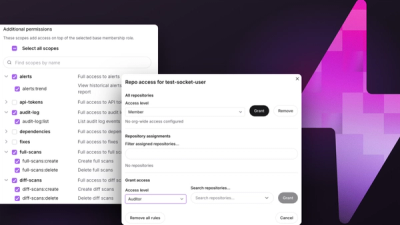
Socket now supports Custom Roles and Repository Access Permissions so organizations can control who can access specific repositories and actions.