
Research
/Security News
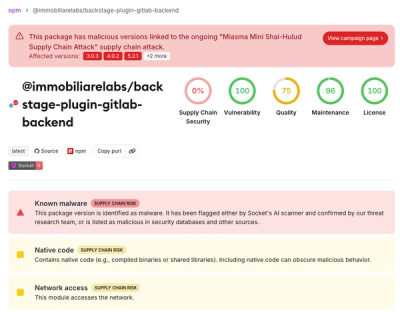
Miasma Mini Shai-Hulud Hits ImmobiliareLabs npm Packages
Miasma Mini Shai-Hulud hits @immobiliarelabs Backstage plugins, targeting GitLab and LDAP auth packages on npm.
By Socket Research Team - Jun 26, 2026
@ksefnik/http
Advanced tools
KSeF HTTP adapter — authentication, challenge, sessions, invoice fetch (Polish e-Invoice API v2)
Production HTTP client for KSeF 2.0 (Krajowy System e-Faktur, Polish national e-invoicing system, live from 2026-02-01).
Implements the KsefClient interface from @ksefnik/core against the real api.ksef.mf.gov.pl endpoints. Plug it into the Ksefnik facade via createHttpAdapter(...) and you get end-to-end invoice retrieval, reconciliation, and MCP-mediated automation with zero additional code in consumers.
Research source of truth: CIRFMF/ksef-docs — see NOTES.md for a summary of the auth flow, endpoint map, and rate limits used by this package.
pnpm add @ksefnik/http @ksefnik/core @ksefnik/shared
import { createKsefnik } from '@ksefnik/core'
import { createHttpAdapter } from '@ksefnik/http'
import { readFileSync } from 'node:fs'

const adapter = createHttpAdapter({
  nip: '7010002137',
  token: process.env.KSEF_TOKEN!,
  environment: 'production',
  publicKeyPem: readFileSync('./ksef-public-key.pem', 'utf8'),
})

const ksef = createKsefnik({
  config: { nip: '7010002137', environment: 'production', token: process.env.KSEF_TOKEN! },
  adapter,
})

await adapter.initSession?.()
const invoices = await ksef.invoices.fetch({ from: '2026-03-01', to: '2026-03-31' })
await adapter.closeSession?.()
| Environment | Base URL |
|---|---|
production | https://api.ksef.mf.gov.pl/v2 |
demo | https://api-demo.ksef.mf.gov.pl/v2 |
test | https://api-test.ksef.mf.gov.pl/v2 |
POST /auth/challenge — server returns { challenge, timestamp }."{ksefToken}|{timestamp}" with RSA-OAEP SHA-256 using the MF public key.POST /auth/ksef-token — server returns { authenticationToken, referenceNumber } (temporary JWT).POST /auth/token/redeem (Authorization: Bearer <authenticationToken>) — returns { accessToken, refreshToken }.Authorization: Bearer <accessToken>.POST /auth/token/refresh with the refresh token.Crypto: RSA-OAEP SHA-256 only, implemented via node:crypto webcrypto.subtle. Zero external dependencies.
import { KsefApiError, KsefAuthError, KsefRateLimitError } from '@ksefnik/http'

try {
  await ksef.invoices.fetch(...)
} catch (error) {
  if (error instanceof KsefAuthError) {
    // 401/403 — refresh token expired, re-issue KSeF token in the portal
  } else if (error instanceof KsefRateLimitError) {
    // 429 — honour error.retryAfter (seconds) and retry
  } else if (error instanceof KsefApiError) {
    // 4xx/5xx with error.statusCode and error.detailCode
  }
}
The underlying withRetry from @ksefnik/core automatically retries KsefRateLimitError and 5xx responses with exponential backoff.
Per limity-api.md:
| Endpoint | req/s | req/min | req/h |
|---|---|---|---|
POST /invoices/query/metadata | 8 | 16 | 20 |
GET /invoices/ksef/{ref} | 8 | 16 | 64 |
| Default | 10 | 30 | 120 |
fetchInvoices uses mapWithConcurrency(5) by default to stay well within the bursting envelope.
sendInvoice — stub throws "not implemented".getUpo — stub throws "not implemented".POST /invoices/exports + polling) — v2.KSEF_TEST_NIP=... \
KSEF_TEST_TOKEN=... \
KSEF_TEST_PUBLIC_KEY_PATH=./ksef-test-pub.pem \
pnpm --filter @ksefnik/http smoke
The smoke script talks to api-test.ksef.mf.gov.pl for manual end-to-end verification. It is not run in CI.
Types for every KSeF 2.0 request/response in src/session.ts, src/invoices.ts, and src/public-key.ts are generated from the live production contract via openapi-typescript. The hand-written runtime (HTTP layer, retry, error mapping, session orchestration) is kept, but the shapes themselves are single-source-of-truth from MF.
pnpm --filter @ksefnik/http generate
This fetches https://api.ksef.mf.gov.pl/docs/v2/openapi.json and writes src/generated/ksef-api.ts (≈10k lines, 253 schemas, 59 paths). The generated file is committed to git so the package builds without network access, but should be refreshed whenever MF publishes a spec change.
pnpm --filter @ksefnik/http generate — pulls the latest contractpnpm --filter @ksefnik/http build — TypeScript flags any breaking changes at compile time (missing fields, renamed enums, nullability changes, etc.)session.ts/invoices.ts/public-key.ts until the build is greenpnpm --filter @ksefnik/http test — unit + integration tests must stay greenKSEF_ENV=production pnpm --filter @ksefnik/http smoke — live verification against the real API| Layer | Source |
|---|---|
| Request/response shapes (challenge, ksef-token, redeem, refresh, auth status, query metadata, public-key certs) | generated — src/generated/ksef-api.ts re-exported via src/generated/index.ts |
Runtime HTTP client (src/http.ts) | hand-written — fetch, AbortSignal timeout, User-Agent, response parsing |
Error mapping to KsefAuthError/KsefRateLimitError/KsefApiError | hand-written — src/errors.ts + src/http.ts |
Retry with Retry-After honoring | hand-written — src/retry.ts |
| Auth flow orchestration (challenge → ksef-token → polling → redeem → refresh) | hand-written — src/session.ts |
Pagination + isTruncated guard + concurrency | hand-written — src/invoices.ts |
KsefHttpClient facade implementing @ksefnik/core KsefClient interface | hand-written — src/client.ts |
The generated file adds ~600KB to source control but adds zero runtime cost (pure .d.ts-style type exports — TSC erases them at build time).
MIT. Part of the ksefnik monorepo.
FAQs
KSeF HTTP adapter — authentication, challenge, sessions, invoice fetch (Polish e-Invoice API v2)
The npm package @ksefnik/http receives a total of 17 weekly downloads. As such, @ksefnik/http popularity was classified as not popular.
We found that @ksefnik/http demonstrated a healthy version release cadence and project activity because the last version was released less than a year ago. It has 1 open source maintainer collaborating on the project.
Did you know?

Socket for GitHub automatically highlights issues in each pull request and monitors the health of all your open source dependencies. Discover the contents of your packages and block harmful activity before you install or update your dependencies.
Research
/Security News
Miasma Mini Shai-Hulud hits @immobiliarelabs Backstage plugins, targeting GitLab and LDAP auth packages on npm.

Security News
Rolldown paused Rust React Compiler integration after a 5MB binary size increase raised concerns about shipping React-specific code to all Vite users.

Security News
/Research
Mini Shai-Hulud expands into the Go ecosystem after hitting LeoPlatform npm packages and targeting GitHub Actions workflows.