

Security News
The Code You Didn't Write Is Still Yours to Defend
AI agents are pulling packages into environments no scanner is watching, creating exposure before security teams can see it.
By Brad Arkin - Jun 23, 2026
@kuindji/sql-type-parser
Advanced tools
🎵 Generated with Claude Opus 4.5 and GPT 5.1
🙏 Inspired by and built upon telefrek/sql - a TypeScript SQL parsing series
@kuindji/sql-type-parser is a type-level SQL parser for TypeScript that transforms SQL query string literals into their corresponding AST types at compile time. It enables:
This library is intentionally pragmatic:
npm install @kuindji/sql-type-parser
First, describe your database structure as a TypeScript type:
type MySchema = {
    defaultSchema: "public";
    schemas: {
        public: {
            users: {
                id: number;
                name: string;
                email: string;
                role: "admin" | "user";
            };
            orders: {
                id: number;
                user_id: number;
                total: number;
                status: "pending" | "completed";
            };
        };
    };
};
QueryResult<SQL, Schema>Infers the result type of a SELECT query:
import type { QueryResult } from "@kuindji/sql-type-parser";

type Result = QueryResult<"SELECT id, name, role FROM users", MySchema>;
// { id: number; name: string; role: "admin" | "user" }

type JoinResult = QueryResult<
    `SELECT u.name, o.total
     FROM users AS u
     INNER JOIN orders AS o ON u.id = o.user_id`,
    MySchema
>;
// { name: string; total: number }
SelectQueryBuilder and createSelectQueryIf you prefer to build queries fluently instead of writing raw strings, you can use the SELECT query builder. It assembles an SQL string at runtime and keeps a schema-aware row type at compile time.
import { createSelectQuery } from "@kuindji/sql-type-parser";
import type { BuilderReturnType, BuilderSQL } from "@kuindji/sql-type-parser";
import type { ECommerceSchema } from "./schema";

const ActiveUsers = createSelectQuery<ECommerceSchema>()
    .select([ "id", "email" ])
    .from("users")
    .where("is_active = TRUE");

type ActiveUsersSQL = BuilderSQL<typeof ActiveUsers>;
// "SELECT id, email FROM users WHERE is_active = TRUE"

type ActiveUsersRow = BuilderReturnType<typeof ActiveUsers>;
// { id: number; email: string }

const sql = ActiveUsers.toString(); // runtime SQL string
The builder:
See examples/select for more complete builder and DB integration examples.
createSelectFn<Schema>To plug this library into your existing database client, you can wrap it with createSelectFn. You pass in a function that actually executes SQL, and you get back a select function that is typed from your schema and queries.
import { createSelectFn } from "@kuindji/sql-type-parser";

type Schema = MySchema;

const select = createSelectFn<Schema>((sql, params) =>
    pool.query(sql, params).then(result => result.rows)
);

// Query string is checked against Schema and result is inferred
const users = await select("SELECT id, name FROM users WHERE id = $1", [ 1 ]);
// users: Array<{ id: number; name: string }>
The returned function can also accept a SelectQueryBuilder instead of a raw string, so you can build queries fluently and still run them through your normal DB interface.
ValidateSQL<SQL, Schema>Validates a query at compile time. Returns true if valid, or an error message:
import type { ValidateSQL } from "@kuindji/sql-type-parser";

type Valid = ValidateSQL<"SELECT id FROM users", MySchema>;
// true

type Invalid = ValidateSQL<"SELECT unknown_col FROM users", MySchema>;
// "Column 'unknown_col' not found in any table"
Validation is intentionally shallow: it focuses on tables and columns that can be resolved from your schema, and does not guarantee that every possible SQL construct is valid for your database.
InsertResult<SQL, Schema>Infers the RETURNING clause result for INSERT queries:
import type { InsertResult } from "@kuindji/sql-type-parser";

type Result = InsertResult<
    "INSERT INTO users (name, email) VALUES ($1, $2) RETURNING id, name",
    MySchema
>;
// { id: number; name: string }
UpdateResult<SQL, Schema>Infers the RETURNING clause result for UPDATE queries:
import type { UpdateResult } from "@kuindji/sql-type-parser";

type Result = UpdateResult<
    "UPDATE users SET name = $1 WHERE id = $2 RETURNING id, name, email",
    MySchema
>;
// { id: number; name: string; email: string }
DeleteResult<SQL, Schema>Infers the RETURNING clause result for DELETE queries:
import type { DeleteResult } from "@kuindji/sql-type-parser";

type Result = DeleteResult<
    "DELETE FROM users WHERE id = $1 RETURNING *",
    MySchema
>;
// { id: number; name: string; email: string; role: "admin" | "user" }
ParseSQL<SQL>Parses a SQL string into an AST type (for advanced use cases):
import type { ParseSQL, SQLSelectQuery } from "@kuindji/sql-type-parser";

type AST = ParseSQL<"SELECT id FROM users">;
// SQLSelectQuery<SelectClause<...>>
The parser understands a wide range of common SELECT, INSERT, UPDATE, and DELETE queries, including:
Support is geared toward typical application queries and type inference rather than exhaustively modelling every dialect and edge case.
unknown or string."user-id" instead of "user id".The intent is to give you useful feedback about result types and schema usage, not to be a perfect replacement for your database’s own SQL validator.
MIT
FAQs
Type-level SQL parser for TypeScript
The npm package @kuindji/sql-type-parser receives a total of 21 weekly downloads. As such, @kuindji/sql-type-parser popularity was classified as not popular.
We found that @kuindji/sql-type-parser demonstrated a healthy version release cadence and project activity because the last version was released less than a year ago. It has 1 open source maintainer collaborating on the project.
Did you know?

Socket for GitHub automatically highlights issues in each pull request and monitors the health of all your open source dependencies. Discover the contents of your packages and block harmful activity before you install or update your dependencies.
Security News
AI agents are pulling packages into environments no scanner is watching, creating exposure before security teams can see it.

Security News
GitHub Actions checkout now blocks risky pull_request_target checkouts by default to help prevent pwn request supply chain attacks.
Product
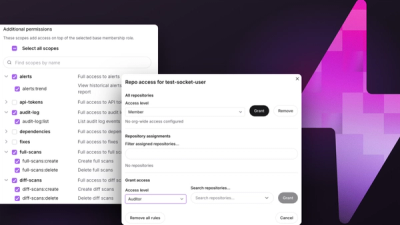
Socket now supports Custom Roles and Repository Access Permissions so organizations can control who can access specific repositories and actions.