@maple-kit/cli
The maple binary for Maple — visual
review comments on deployed previews, written for people and read by agents.
Pre-release. Every package here is 0.x and makes no compatibility promise.
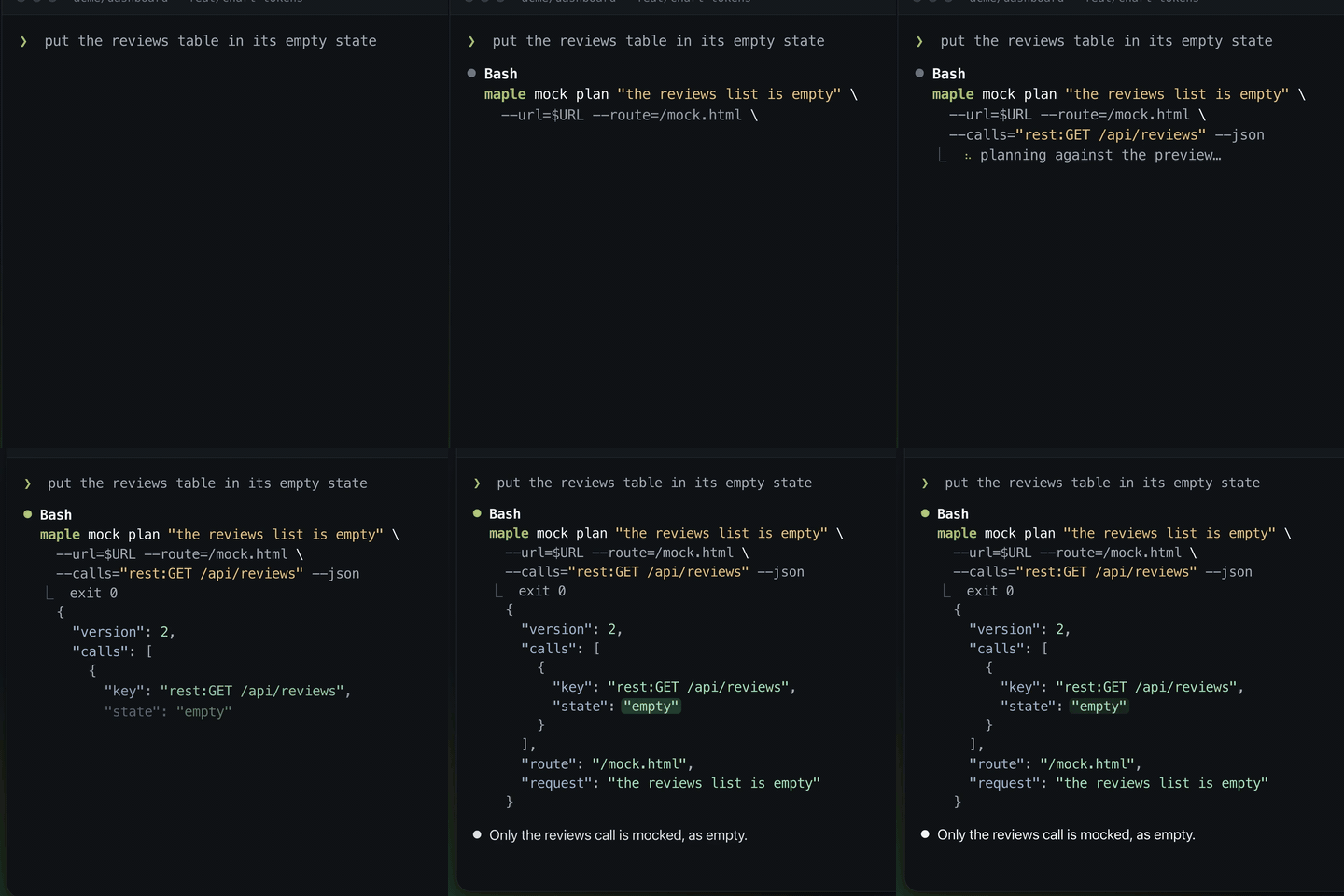
Every command that prints a table also takes --json, so an agent drives it
from a terminal as easily as a person does. A flag's value can follow it
(--owner acme) or be joined to it (--owner=acme), and a flag the command
does not take is an error that lists the ones it does.
Install
npm install -g @maple-kit/cli
Commands
maple review | Put the overlay on your running app through a proxy, with nothing wired in |
maple connectors | Show the connector kinds and the methods each one may implement |
maple mock schema | Write an OpenAPI document of a tRPC router's response types |
maple mock plan | Print the recipe a preview's route plans for a sentence |
maple setup app | Print the prefilled GitHub App registration URL and the steps after it |
maple setup verify | Check that a comment App's Device Flow is on |
maple setup ci | Print or write the gate workflow, and the ruleset that requires it |
maple solo | Keep a preview's comments on this machine: start the bridge, print the link |
maple setup
Registering Maple's GitHub Apps, and gating a merge on the review. The
permissions each App is registered with are one constant in this package,
GITHUB_APP_PERMISSIONS, so this is where they are read from rather than
copied.
maple setup app --owner=acme
maple setup app --owner=acme --gate
maple setup verify --client-id=<Iv…>
maple setup ci --require-approval --write
setup app prints a URL that opens GitHub's New GitHub App form already filled
in, then the steps no URL parameter can set: Device Flow, token expiry, the
logo, the installation and where the Client ID goes. --personal registers
under a personal account instead of an organisation, and --json prints the
URL, permissions and steps as one object.
setup verify asks GitHub for a device code the way a reviewer's first sign-in
will, and prints neither code it receives.
setup ci writes .github/workflows/maple.yml on maple-kit/maple-action@v0,
refusing to overwrite one that is there, and prints the gh api command that
makes maple/visual-review a required check pinned to GitHub Actions.
maple mock plan
Asks a deployed Maple route to read a sentence as a mock, and prints the
recipe Maple Mock's box would apply. It asks the route rather than a
model, so CI holds no key and gets exactly the box's own plan.
maple mock plan "the reviews list is empty" \
  --url=https://preview.example.com/api/maple \
  --route=/reviews \
  --calls="rest:GET /api/reviews,rest:GET /api/audit" \
  --json
{
  "version": 2,
  "calls": [{ "key": "rest:GET /api/reviews", "state": "empty" }],
  "route": "/reviews",
  "request": "the reviews list is empty"
}
--url | Where Maple's route is mounted on the preview. |
--route | The page's route pattern the recipe applies on, such as /projects/:id. |
--calls | The calls the page makes, comma-separated, named as the box names them. |
It exits 1, saying why, when the sentence names no state or the plan is not
sure enough to mock anything: the same gate the box applies.
maple mock schema
maple mock schema server/router.ts --out=.maple/schema.json [--export=AppRouter] [--superjson]
Reads the router's TypeScript types statically, runs none of its code, and
writes the document Maple's route serves as each call's shape. It needs
@trpc/openapi, an optional peer loaded only by this command.
maple connectors
Connector kinds
  store         required: list, append
                optional: appendMany, setStatus, head, watch, approvals, approve, unapprove
  media         required: putBlob, getUrl
                optional: remove
  observability required: getReplayLink
                optional: fetchEvents
  identity      required: resolveUser
                optional: none
  gate          required: publish
                optional: read
  classifier    required: none
                optional: score, classify, plan
Built from core's own tables, so it cannot drift from the code. A connector's
capabilities are exactly the methods it defines.
Listing, reading and resolving review comments is the agent's job, over
@maple-kit/mcp.
Licence
Apache-2.0. See LICENSE and NOTICE.