@maple-kit/mock
The runtime behind Maple Mock: a page's API responses, rewritten into the state
a reviewer asked to see — empty, failing, forbidden, loading, one item or a
thousand — and its flags and role set to whatever the reviewer names.
Pre-release. Every package here is 0.x and makes no compatibility promise.
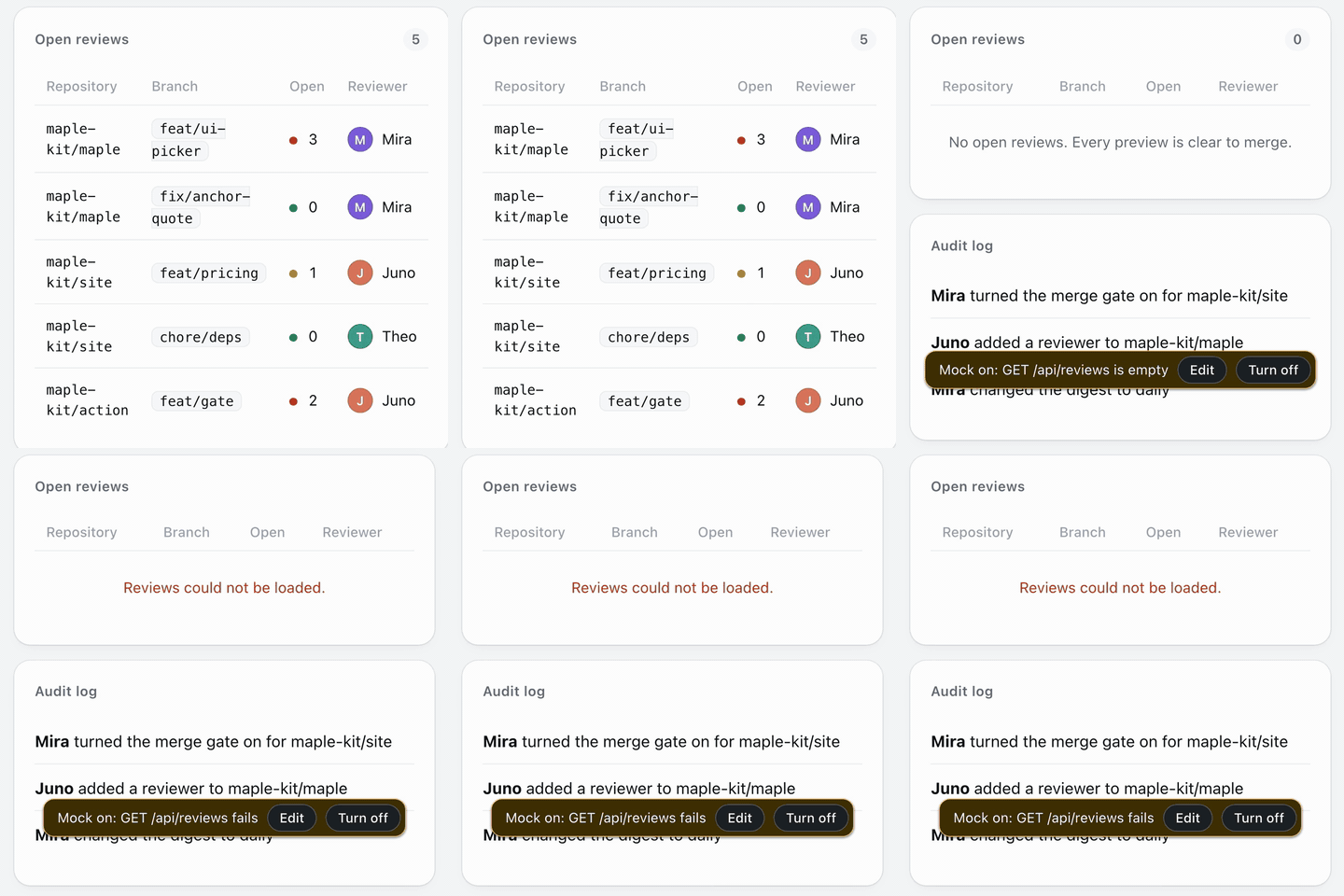
Any state, on request. The same table with real data, then empty, then failing. A banner names the state in force. | 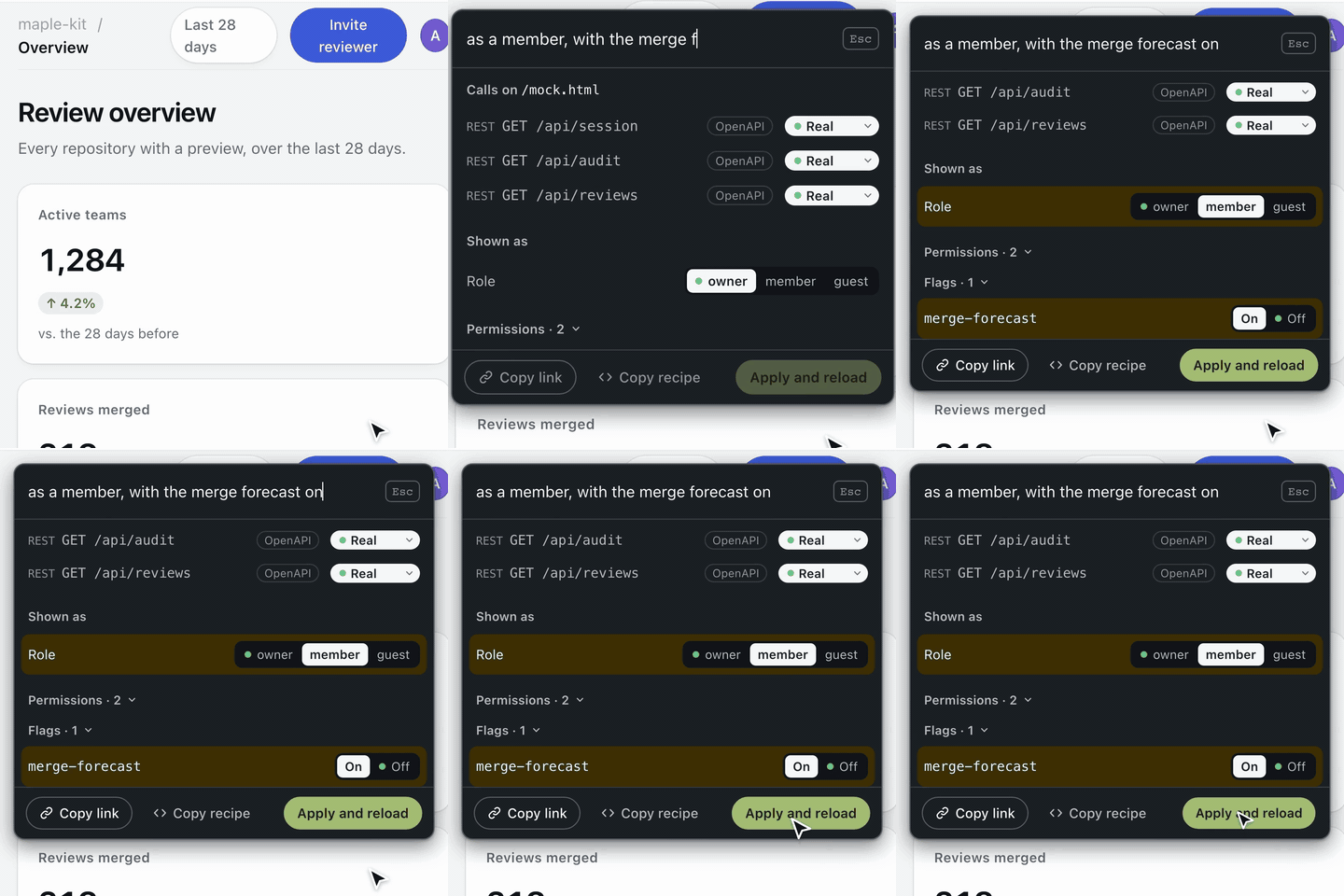
As any user, with any flag. "As a member, with the merge forecast on" becomes a role and a flag, checked before the page reloads. |
Why
The states a reviewer most needs to see are the ones a preview never shows:
the empty dashboard, the failed request, the page a viewer is not allowed to
open. Maple Mock puts a preview into any of them from one sentence, with no
fixtures to write and no backend to seed.
A model picks; code writes every byte. A classifier may be asked which
state was meant and which calls it concerns. It is never asked to write a
response body. A transform reshapes the response the page already received,
or one sampled from its schema, so the app's own parser still accepts the
result. Nothing in the runtime calls a model.
The states
empty | Each list as [], with the envelope beside it: count 0, no next page. |
one | The first item, with the same envelope. |
many | The items repeated to fifty, each with a unique id, and the count to match. |
long | Every text as long as the page could really receive, to its maxLength. |
sparse | Everything that may be missing, missing. |
mixed | Every combination that matters, rather than more items. |
error | A 500 in the protocol's own error shape. |
forbidden | A 403 in the protocol's own error shape. |
loading | Nothing, until the request is abandoned. |
A failure never reaches the server: a write named error is answered in the
page and never sent.
Install
import "@maple-kit/mock/install";
or, with options:
import { installMock } from "@maple-kit/mock";
import { launchDarklyFlags } from "@maple-kit/mock/launchdarkly";

if (__MAPLE_PREVIEW__) {
  installMock({ route: "/api/maple", flags: [launchDarklyFlags()], logger });
}
route is where Maple's route is mounted. Nothing under it is mocked, its
/mock/schema answers each call's shape, and its /mock/plan reads a
sentence. Behind a build-time constant, a production build drops the import
entirely.
It patches fetch and XMLHttpRequest and reads REST and tRPC, including
batches, streams and superjson. A call the recipe does not name passes through
untouched.
The box
<MapleMock /> from @maple-kit/ui/mock is the box a reviewer types into,
over createMockClient() from @maple-kit/mock/client. Inside <Maple /> it
is already mounted. It lists the calls the page made, reads the sentence into
a plan, and lets the reviewer check and change it before Apply and reload.
Copy link gives anyone else the same page in the same state.
The recipe
A mock is a small record, validated by parseRecipe from
@maple-kit/core/mock:
{
  version: 2,
  calls: [{ key: "rest:GET /api/reviews", state: "empty" }],
  flags: { "merge-forecast": true },
  as: { role: "member" },
  route: "/reviews",
  request: "as a member, with no reviews and the merge forecast on",
}
Applying one reloads the page with the recipe in sessionStorage and in the
?maple-mock= parameter, so a link reproduces it:
import { linkRecipe } from "@maple-kit/core/mock";
import { saveRecipe } from "@maple-kit/mock";

saveRecipe(sessionStorage, recipe);
location.assign(linkRecipe(location.href, recipe));
A comment written under a mock records the recipe, so the agent reading it
over MCP gets a link that replays the page the reviewer saw.
Planning from a sentence
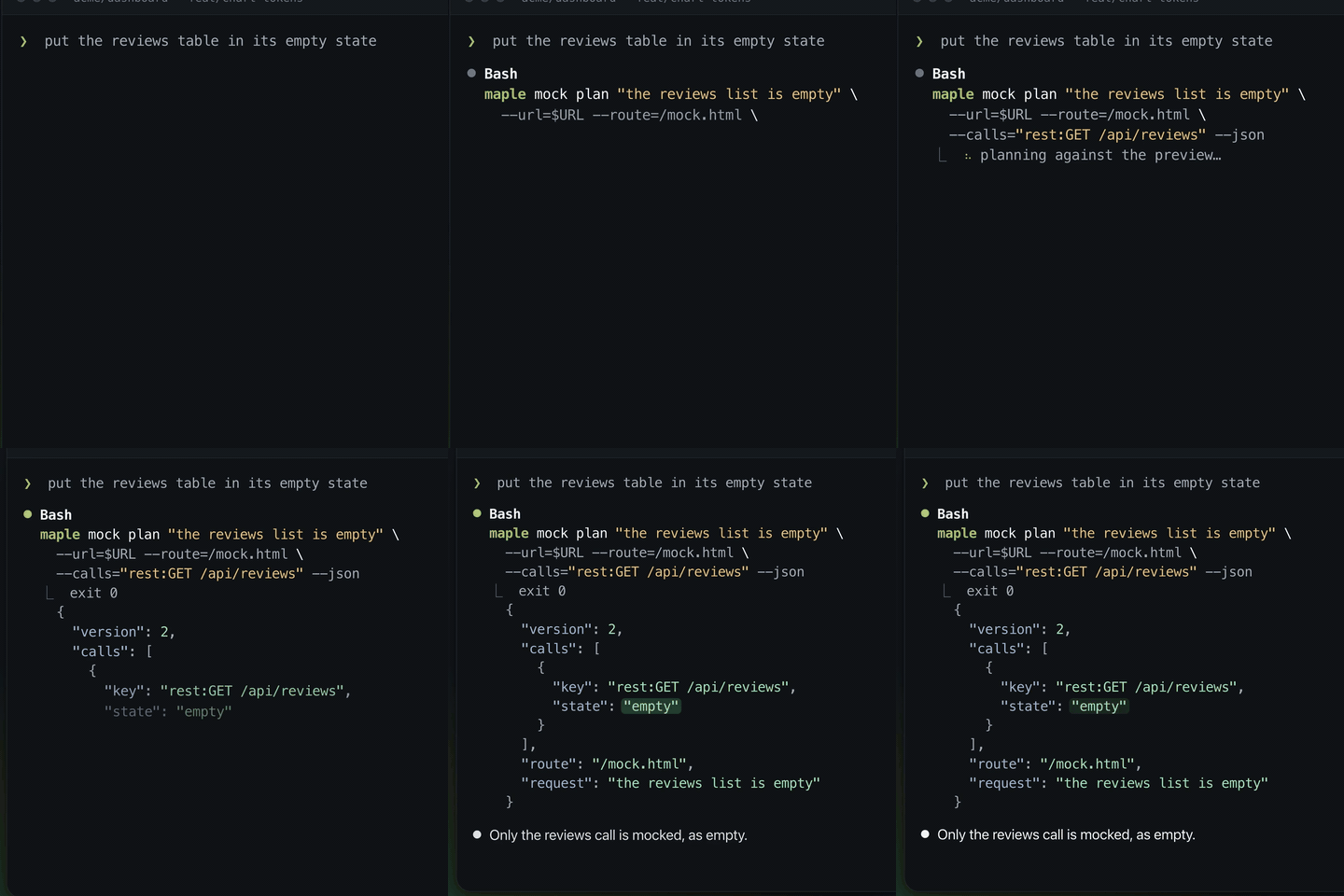
The route's /mock/plan turns a sentence into a recipe, through any
classifier that defines plan: keywordClassifier() from
@maple-kit/core/connectors offline, or
@maple-kit/classifier with a model. The
maple CLI asks the same route, so an agent or CI gets the box's own plan
without holding a key:
maple mock plan "the reviews list is empty" \
  --url=https://preview.example.com/api/maple \
  --route=/reviews --calls="rest:GET /api/reviews" --json
For tRPC, maple mock schema server/router.ts writes the OpenAPI document the
route serves as each call's shape.
Flags and roles
A recipe's flags are answered where the page evaluates them, and as tells
the page who the reviewer is. The server still acts as the real reviewer.
OpenFeature, the most portable, wraps the provider you already have. It
answers the flags the recipe names and delegates every other one:
import { withMockFlags } from "@maple-kit/mock/openfeature";

OpenFeature.setProvider(withMockFlags(new VendorProvider(options)));
LaunchDarkly is read on the wire instead: launchDarklyFlags() from
@maple-kit/mock/launchdarkly, passed to installMock({ flags }), answers the
browser SDK's poll and stream with the recipe's flags written in.
The role comes from the host's own session call, named in the route's
mock.identity. Maple never guesses which field carries authorisation, and a
call the role may not make answers the page's own 403:
identity: {
  call: "rest:GET /api/session",
  role: { path: "role" },
  permissions: { path: "permissions" },
  requires: { "rest:GET /api/audit": { roles: ["owner"] } },
}
An app that renders the role on the server has no session call. Give
mock.identity a read(request) and the roles in place of call, and show
the page displayedIdentity(request, real, { preview, roles }) from
@maple-kit/mock/server where it seeds the client. That value is for display
only: never authorise with it, and keep checking the real session.
On the server, requestRecipe(request) from @maple-kit/mock/server
reads the recipe from a request's ?maple-mock= link or the page's cookie, for
flags and roles evaluated in a server render.
Tests and Storybook
For Storybook or a test that already runs MSW, put the handlers first:
import { mockHandlers } from "@maple-kit/mock/node";

const server = setupServer(...mockHandlers(recipe), ...handlers);
Entries
@maple-kit/mock | installMock, and reading and writing the recipe: link, tab, encode. |
@maple-kit/mock/install | The in-page transport with every default, imported first from the entry. |
@maple-kit/mock/client | The box's controller, which finds the transport without importing it. |
@maple-kit/mock/openfeature | withMockFlags(provider), for flags evaluated through OpenFeature. |
@maple-kit/mock/launchdarkly | launchDarklyFlags(), LaunchDarkly's browser SDK answered on the wire. |
@maple-kit/mock/server | requestRecipe(request), the recipe for flags and roles read server-side. |
@maple-kit/mock/msw | Handlers for a host that already runs MSW's setupWorker. |
@maple-kit/mock/node | The same handlers for setupServer in tests or a server render. |
@maple-kit/mock/testing | The flag-provider contract suite and an in-memory provider. Needs vitest. |
This package uses no React, no Effect and no model. @maple-kit/ui and
@maple-kit/react import it; it never imports them.
Documentation
- Maple Mock — the design record: the recipe, the codecs, the transforms, the plan, flags and roles
Licence
Apache-2.0. See LICENSE and NOTICE.