
Product
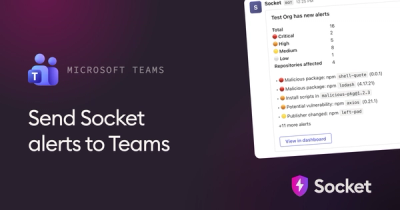
Microsoft Teams Notifications Are Now Available in Socket
Socket can now send alerts and supply chain attack notifications to Microsoft Teams, with filters that route the right updates to each channel.
By Jeppe Hasseriis - Sep 01, 2026
@meetergo/mcp-server
Advanced tools
meetergo MCP server — let AI agents book, reschedule and cancel meetings
Lets an AI agent actually run a calendar: find slots, book, reschedule, cancel, review what is coming up, and keep the contact record straight.
Not to be confused with the docs MCP server at
https://developer.meetergo.com/mcp, which searches documentation and cannot
change anything. Both are useful and they do different jobs:
| Docs MCP | This server | |
|---|---|---|
| Endpoint | developer.meetergo.com/mcp | runs locally over stdio |
| Tools | SearchMeetergo | 17 scheduling and CRM tools |
| Can it book? | No | Yes |
| Use it to | write an integration | be the integration |
Create a Personal Access Token at
my.meetergo.com/integrations — it looks
like rgo-… — then add the server to your MCP client:
{
  "mcpServers": {
    "meetergo": {
      "command": "npx",
      "args": ["-y", "@meetergo/mcp-server"],
      "env": { "MEETERGO_TOKEN": "rgo-your_token_here" }
    }
  }
}
Works with Claude Desktop, Claude Code, Cursor, or anything else that speaks MCP.
A Personal Access Token always acts as its owner. To run an agent across a whole
company — an assistant booking on behalf of several colleagues — use a Platform
API Key (ak_live:<uuid>:<secret>) and name the target user:
"env": {
  "MEETERGO_TOKEN": "ak_live:...",
  "MEETERGO_USER_ID": "the-user-uuid"
}
The two token types have opposite requirements, and the server checks both at startup rather than letting you find out mid-booking:
MEETERGO_USER_ID — the API demands an
acting user on nearly every route;| Variable | Required | Purpose |
|---|---|---|
MEETERGO_TOKEN | yes | rgo-… Personal Access Token or ak_live:… Platform API Key |
MEETERGO_USER_ID | with a Platform API Key | The user to act as |
MEETERGO_API_URL | API base override, default https://api.meetergo.com/v4 | |
MEETERGO_TIMEOUT_MS | Per-request timeout, default 30000 |
Rate limits and transient upstream errors (429, 502, 503, 504) are retried up to
three times, honouring Retry-After where the API sends one.
Retries are not applied blindly. A booking or cancellation that fails ambiguously — a timeout, a dropped connection, a 502 — may already have been applied by the API, and there is no idempotency key to make a second attempt safe. Only reads are retried on those; writes are retried solely on a 429, the one response that states the request was never processed.
| Tool | Writes? | Purpose |
|---|---|---|
get_me | Confirm the token works — start here when something looks empty | |
list_meeting_types | What can be booked | |
get_availability | Bookable slots for a meeting type | |
book_appointment | yes | Book a slot |
reschedule_appointment | yes | Move an appointment |
cancel_appointment | yes | Cancel, or drop one attendee |
list_appointments | Paginated calendar with filters | |
get_todays_appointments | Today only | |
get_appointment | One appointment in full, including attendeeIds | |
add_guest | yes | Add a guest email to an appointment |
update_appointment_notes | yes | Write call prep or an outcome back |
create_one_time_booking_link | yes | Send a single-use link instead of booking for someone |
search_contacts | Find a contact before creating a duplicate | |
get_contact | Full record, by contactId or by attendeeId from a booking | |
create_contact | yes | Add a contact |
update_contact | yes | Edit a contact |
list_calendar_connections | Which calendars are attached |
Writes carry readOnlyHint: false, and cancel_appointment carries
destructiveHint: true, so hosts can require confirmation before an agent
changes anything real.
The Platform API has 100 operations. Every tool definition consumes context in the model's window, and selection accuracy drops as the list grows — an agent picking between 100 near-identical operations picks worse than one choosing between seventeen.
The bar for a tool here is that it closes a loop an agent can complete on its own: discover, schedule, change, review, follow up, and know who it is talking to. Configuration surfaces stay out — meeting-type creation, routing-form definitions and page branding all need a large request body the model would have to invent from a docstring, and a mistyped payload is worse than no tool. Those belong in the dashboard, and stay reachable over REST.
npm test          # vitest
npm run build     # tsc -> dist
The tests assert the wire format, not just the tool list: which path each
tool calls, and the exact body shape the API's DTOs require. That is deliberate.
0.1.x shipped five tools that could never succeed — wrong paths, wrong query
keys, a flat body where BookingDto wants a nested attendee — and every test
passed, because they only ever checked that the tools existed. Adding or
changing a tool means pinning its request against the route in apps/api.
The community chill-lichen/meetergo-mcp
server (Python, BSD-3) covers a wider slice of the API — routing forms,
webhooks, page branding. It found several endpoint-path bugs before we did.
Worth a look if you need surface this server deliberately leaves out.
FAQs
meetergo MCP server — let AI agents book, reschedule and cancel meetings
The npm package @meetergo/mcp-server receives a total of 107 weekly downloads. As such, @meetergo/mcp-server popularity was classified as not popular.
We found that @meetergo/mcp-server demonstrated a healthy version release cadence and project activity because the last version was released less than a year ago. It has 1 open source maintainer collaborating on the project.
Product
Socket can now send alerts and supply chain attack notifications to Microsoft Teams, with filters that route the right updates to each channel.

Security News
pnpm 12 rewrites the package manager in Rust, cutting install times by up to 90% while preserving pnpm 11 workflows and lockfiles.
Security News
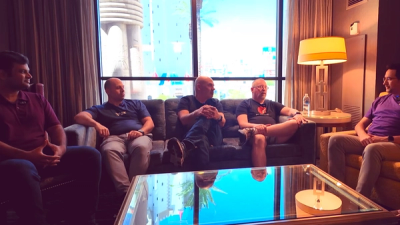
Socket CTO Ahmad Nassri joins AppSec leaders at Black Hat to discuss active malware, package manager risks, and software supply chain defense.