
Product
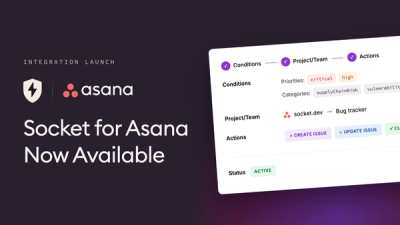
Socket for Asana Is Now Available
Create and manage Asana tasks directly from Socket alerts, with manual task creation, automated ticketing rules, and two-way sync.
By Jeppe Hasseriis - Aug 25, 2026
@memberjunction/credentials
Advanced tools
MemberJunction: Credential Engine - secure credential management with caching, encryption, and audit logging.
Secure credential management engine for MemberJunction. Provides centralized storage, retrieval, validation, and audit logging of credentials with automatic field-level encryption and JSON Schema validation.
The @memberjunction/credentials package manages the full credential lifecycle: storing encrypted values, resolving credentials by name or ID, validating against JSON Schema constraints, and logging every access for audit compliance.
graph TD
    A["CredentialEngine<br/>(Singleton)"] --> B["Credential Types<br/>(Schema Definitions)"]
    A --> C["Credentials<br/>(Encrypted Values)"]
    A --> D["Credential Categories<br/>(Organization)"]
    A --> E["Audit Log<br/>(Access Tracking)"]
    A --> F["Ajv Validator<br/>(JSON Schema)"]

    G["Consumer Code"] --> A
    G -->|"getCredential()"| H["ResolvedCredential<T>"]
    G -->|"storeCredential()"| C
    G -->|"validateCredential()"| I["ValidationResult"]

    style A fill:#2d6a9f,stroke:#1a4971,color:#fff
    style B fill:#7c5295,stroke:#563a6b,color:#fff
    style C fill:#2d8659,stroke:#1a5c3a,color:#fff
    style D fill:#b8762f,stroke:#8a5722,color:#fff
    style E fill:#b8762f,stroke:#8a5722,color:#fff
    style F fill:#7c5295,stroke:#563a6b,color:#fff
    style H fill:#2d8659,stroke:#1a5c3a,color:#fff
    style I fill:#2d8659,stroke:#1a5c3a,color:#fff
npm install @memberjunction/credentials
import { CredentialEngine, APIKeyCredentialValues } from '@memberjunction/credentials';

// Initialize at application startup
await CredentialEngine.Instance.Config(false, contextUser);

// Retrieve a credential with typed values
const cred = await CredentialEngine.Instance.getCredential<APIKeyCredentialValues>(
  'OpenAI',
  { contextUser, subsystem: 'AIService' }
);

// Use the decrypted values
console.log(cred.values.apiKey); // Strongly typed as string
flowchart TD
    A["getCredential(name, options)"] --> B{directValues<br/>provided?}
    B -->|Yes| C["Return direct values<br/>source: request"]
    B -->|No| D{credentialId<br/>provided?}
    D -->|Yes| E["Lookup by ID"]
    D -->|No| F["Lookup by name"]
    E --> G["Parse & return values<br/>source: database"]
    F --> G
    G --> H["Log access to Audit Log"]
    H --> I["Update LastUsedAt"]

    style A fill:#2d6a9f,stroke:#1a4971,color:#fff
    style C fill:#2d8659,stroke:#1a5c3a,color:#fff
    style G fill:#2d8659,stroke:#1a5c3a,color:#fff
    style H fill:#b8762f,stroke:#8a5722,color:#fff
Resolution priority:
directValues in options (bypasses database, useful for testing)credentialId in options (specific credential lookup)credentialName parameter (most common usage)| Type | Interface | Fields |
|---|---|---|
| API Key | APIKeyCredentialValues | apiKey |
| API Key with Endpoint | APIKeyWithEndpointCredentialValues | apiKey, endpoint |
| OAuth2 Client Credentials | OAuth2ClientCredentialValues | clientId, clientSecret, tokenUrl, scope |
| Basic Auth | BasicAuthCredentialValues | username, password |
| Azure Service Principal | AzureServicePrincipalCredentialValues | tenantId, clientId, clientSecret |
| AWS IAM | AWSIAMCredentialValues | accessKeyId, secretAccessKey, region |
| Database Connection | DatabaseConnectionCredentialValues | host, port, database, username, password |
| Twilio | TwilioCredentialValues | accountSid, authToken |
const credential = await CredentialEngine.Instance.storeCredential(
  'API Key',                    // Credential type name
  'OpenAI Production',          // Credential name
  { apiKey: 'sk-...' },         // Values (encrypted on save)
  {
    isDefault: true,
    description: 'Production OpenAI API key',
    expiresAt: new Date('2025-12-31')
  },
  contextUser
);
The engine validates credential values against the FieldSchema defined on each Credential Type using Ajv. Supported constraints include required, const, enum, format, pattern, minLength/maxLength, and minimum/maximum.
Default and const values are auto-populated before validation, and validation errors produce clear, human-readable messages.
Every credential operation (Decrypt, Create, Update, Validate) is logged to the Audit Logs entity with:
Values field uses MJ field-level encryptioncontextUserExpiresAt field enforces credential rotation| Package | Purpose |
|---|---|
@memberjunction/core | Base engine, metadata, entity system |
@memberjunction/global | Global state management |
@memberjunction/core-entities | Credential entity types |
ajv | JSON Schema validation |
ajv-formats | Format validators (uri, email, date) |
ISC
FAQs
MemberJunction: Credential Engine - secure credential management with caching, encryption, and audit logging.
The npm package @memberjunction/credentials receives a total of 283 weekly downloads. As such, @memberjunction/credentials popularity was classified as not popular.
We found that @memberjunction/credentials demonstrated a healthy version release cadence and project activity because the last version was released less than a year ago. It has 11 open source maintainers collaborating on the project.
Product
Create and manage Asana tasks directly from Socket alerts, with manual task creation, automated ticketing rules, and two-way sync.

Security News
Open VSX has removed three extension IDs from its malicious-extension list as the legitimate publishers they impersonated move to claim the names for themselves.

Product
Socket’s PHP and Composer support is now in Beta for all customers, with PHP reachability analysis generally available.