

Product
PHP and Composer Support Is Now in Beta
Socket’s PHP and Composer support is now in Beta for all customers, with PHP reachability analysis generally available.
By Trevor Norris, Benjamin Barslev - Aug 21, 2026
@microsoft/fabric-mcp
Advanced tools
Microsoft Fabric MCP Server - Model Context Protocol implementation for Fabric
 Microsoft Fabric MCP Server NPM Package
A local-first Model Context Protocol (MCP) server that provides AI agents with comprehensive access to Microsoft Fabric's public APIs, item definitions, and best practices. The Fabric MCP Server packages complete OpenAPI specifications into a single context layer for AI-assisted development—without connecting to live Fabric environments.
Microsoft Fabric MCP Server gives your AI agents the knowledge they need to generate robust, production-ready code for Microsoft Fabric—all without directly accessing your environment.
Key capabilities:
To use Fabric MCP server from node one must have Node.js (LTS) installed and available on your system PATH — this provides both npm and npx. We recommend Node.js 20 LTS or later. To verify your installation run: node --version, npm --version, and npx --version.
Configure the mcp.json file with the following:
{
    "mcpServers": {
        "fabric-mcp-server": {
        "command": "npx",
        "args": [
            "-y",
            "@microsoft/fabric-mcp@latest",
            "server",
            "start",
            "--mode",
            "all"
            ]
        }
    }
}
Note: When manually configuring Visual Studio and Visual Studio Code, use servers instead of mcpServers as the root object.
Client-Specific Configuration
| IDE | File Location | Documentation Link |
|---|---|---|
| Claude Code | ~/.claude.json or .mcp.json (project) | Claude Code MCP Configuration |
| Claude Desktop | ~/.claude/claude_desktop_config.json (macOS)%APPDATA%\Claude\claude_desktop_config.json (Windows) | Claude Desktop MCP Setup |
| Cursor | ~/.cursor/mcp.json or .cursor/mcp.json | Cursor MCP Documentation |
| VS Code | .vscode/mcp.json (workspace)settings.json (user) | VS Code MCP Documentation |
| Windsurf | ~/.codeium/windsurf/mcp_config.json | Windsurf Cascade MCP Integration |
refresh on the tools list
What Fabric workload types are available?
The Fabric MCP Server supercharges your agents with Microsoft Fabric context. Here are some prompts you can try:
The Fabric MCP Server exposes tools organized into three categories:
| Tool Name | Description |
|---|---|
docs_workloads | Lists Fabric workload types that have public API specifications available. |
docs_workload-api-spec | Retrieves the complete OpenAPI specification for a specific Fabric workload. |
docs_platform-api-spec | Retrieves the OpenAPI specification for core Fabric platform APIs. |
docs_item-definitions | Retrieves JSON schema definitions for items in a Fabric workload API. |
docs_best-practices | Retrieves best practice documentation and guidance for a specific topic. |
docs_api-examples | Retrieves example API request/response files for a specific workload. |
| Tool Name | Description |
|---|---|
onelake_list_workspaces | Lists available Microsoft Fabric workspaces. |
onelake_list_items | Lists workspace items with high-level metadata. |
onelake_list_items_dfs | Lists Fabric items via the DFS endpoint. |
onelake_list_files | Lists files using the hierarchical file-list endpoint. |
onelake_download_file | Downloads a OneLake file. |
onelake_upload_file | Uploads a file to OneLake storage. |
onelake_delete_file | Deletes a file from OneLake storage. |
onelake_create_directory | Creates a directory via the DFS endpoint. |
onelake_delete_directory | Deletes a directory (optionally recursive). |
onelake_get_table_config | Retrieves table API configuration for a workspace item. |
onelake_list_table_namespaces | Lists table namespaces (schemas) exposed through the table API. |
onelake_get_table_namespace | Retrieves metadata for a specific namespace. |
onelake_list_tables | Lists tables published within a namespace. |
onelake_get_table | Retrieves the definition for a specific table. |
| Tool Name | Description |
|---|---|
core_create-item | Creates new Fabric items (Lakehouses, Notebooks, etc.). |
| Tool Name | Description |
|---|---|
datafactory_list-pipelines | Lists all pipelines in a Microsoft Fabric workspace. |
datafactory_create-pipeline | Creates a new pipeline in a workspace. |
datafactory_get-pipeline | Gets details of a specific pipeline. |
datafactory_run-pipeline | Runs a pipeline on demand. |
datafactory_list-dataflows | Lists all Dataflow Gen2 items in a workspace. |
datafactory_create-dataflow | Creates a new Dataflow Gen2 item. |
datafactory_execute-query | Executes an M (Power Query) query against a dataflow. |
Always verify available commands via
--help. Command names and availability may change between releases.
The Fabric MCP Server is a local-first tool that runs entirely on your machine. It provides API specifications, schemas, and best practices without connecting to live Microsoft Fabric environments.
MCP as a phenomenon is very novel and cutting-edge. As with all new technology standards, consider doing a security review to ensure any systems that integrate with MCP servers follow all regulations and standards your system is expected to adhere to.
The software may collect information about you and your use of the software and send it to Microsoft. Microsoft may use this information to provide services and improve our products and services. You may turn off the telemetry as described in the repository. There are also some features in the software that may enable you and Microsoft to collect data from users of your applications. If you use these features, you must comply with applicable law, including providing appropriate notices to users of your applications together with a copy of Microsoft's privacy statement. You can learn more about data collection and use in the help documentation and our privacy statement. Your use of the software operates as your consent to these practices.
We welcome contributions to the Fabric MCP Server! Whether you're fixing bugs, adding new features, or improving documentation, your contributions are welcome.
Please read our Contributing Guide for guidelines on:
This project has adopted the Microsoft Open Source Code of Conduct. For more information, see the Code of Conduct FAQ or contact open@microsoft.com with any additional questions or comments.
This project is licensed under the MIT License — see the LICENSE file for details.
FAQs
Microsoft Fabric MCP Server - Model Context Protocol implementation for Fabric
We found that @microsoft/fabric-mcp demonstrated a healthy version release cadence and project activity because the last version was released less than a year ago. It has 2 open source maintainers collaborating on the project.
Product
Socket’s PHP and Composer support is now in Beta for all customers, with PHP reachability analysis generally available.
Product
Socket is bringing experimental protection to Firefox, scanning 97,000+ extensions in Mozilla's official directory for malware and risky updates.
Research
/Security News
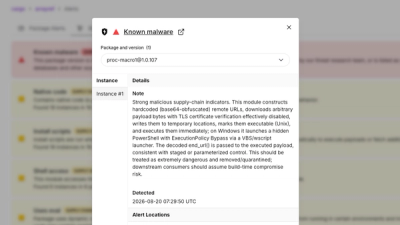
Three compromised Rust crates pulled in a malicious dependency that downloaded and executed cross-platform malware during Cargo builds.