
Research
/Security News
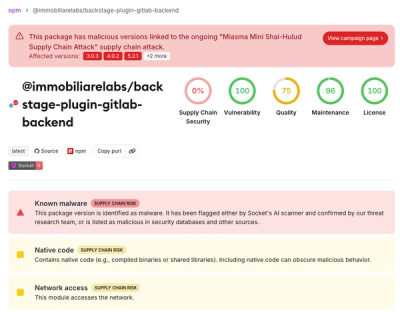
Miasma Mini Shai-Hulud Hits ImmobiliareLabs npm Packages
Miasma Mini Shai-Hulud hits @immobiliarelabs Backstage plugins, targeting GitLab and LDAP auth packages on npm.
By Socket Research Team - Jun 26, 2026
@mkrause/match
Advanced tools
JavaScript matching utility. Allows you to branch on a value using a list of different possible cases.
The match function takes a value, and a list of cases, and returns either the first case that matches, or an exception otherwise.
    import match from '@mkrause/match'; // If using ES6 modules
    const { match } = require('@mkrause/match'); // If using ES5

    match(<value>, <case-list>);
The case list can be specified in one of two ways. If the value is a string (or if we're using a custom matcher, see below) then we can use an object where the value is matched against each property name.
    const result = match('foo', {
        foo: 42,
        bar: 43,
    });
    result === 42;
Alternatively, we can specify a list of predicates (functions) using match.case(<predicate>, <result>). Each predicate is given the value and should return a boolean indicating whether there is a match.
    const result = match({ position: 42 }, [
        match.case(x => x.position > 0, +1),
        match.case(x => x.position == 0, 0),
        match.case(x => x.position < 0, -1),
    ]);
    result === 1;
A case result can be either a plain value, or a function:
    const result = match('apple', {
        apple: () => processApple(),
        orange: () => processOrange(),
    });
A default case can be specified as fallback. With an object as case list, a special symbol match.default is available which can be used as unambiguous property name. With a case list, use match.otherwise.
    const result = match('pear', {
        apple: () => processApple(),
        orange: () => processOrange(),
        [match.default]: fruitType => processOther(fruitType),
    });

    const result = match({ color: 'yellow' }, [
        match.case(({ color }) => color === 'red', 0xff0000),
        match.case(({ color }) => color === 'green', 0x00ff00),
        match.case(({ color }) => color === 'blue', 0x0000ff),
        match.otherwise('unknown color!'),
    ]);
If no case matches, and no fallback is given, an exception is thrown.
You can create your own custom match function. For example, let's say our React/Redux/Flux application makes use of actions that conform to the Flux Standard Action (FSA) protocol. We could create a matcher as follows:
    import { matcher } from '@mkrause/match';

    const match = matcher(subject => {
        return { discriminator: subject.type, body: subject };
    });

    const action = { type: 'CREATE_USER', error: false, payload: { name: 'John' } };
    const result = match(action, {
        CREATE_USER: ({ error, payload }) => doSomethingWith(payload),
    });
We supply a couple of common matchers out of the box:
match: generic matchermatchType: match on objects with a type propertymatchSingleKey: match on objects with a single property, e.g. { MY_TYPE: { value: 42 } } import { matchType, matchSingleKey } from '@mkrause/match';
const action = { type: 'CREATE_USER', error: false, payload: { name: 'John' } };
matchType(action, {
CREATE_USER: ({ error, payload }) => doSomethingWith(payload),
});
matchSingleKey({ CREATE_USER: { name: 'John' } }, {
CREATE_USER: user => doSomethingWith(user),
});
FAQs
JavaScript case matching library.
The npm package @mkrause/match receives a total of 25 weekly downloads. As such, @mkrause/match popularity was classified as not popular.
We found that @mkrause/match demonstrated a not healthy version release cadence and project activity because the last version was released a year ago. It has 1 open source maintainer collaborating on the project.
Did you know?

Socket for GitHub automatically highlights issues in each pull request and monitors the health of all your open source dependencies. Discover the contents of your packages and block harmful activity before you install or update your dependencies.
Research
/Security News
Miasma Mini Shai-Hulud hits @immobiliarelabs Backstage plugins, targeting GitLab and LDAP auth packages on npm.

Security News
Rolldown paused Rust React Compiler integration after a 5MB binary size increase raised concerns about shipping React-specific code to all Vite users.

Security News
/Research
Mini Shai-Hulud expands into the Go ecosystem after hitting LeoPlatform npm packages and targeting GitHub Actions workflows.