
Product
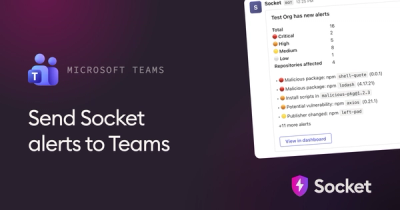
Microsoft Teams Notifications Are Now Available in Socket
Socket can now send alerts and supply chain attack notifications to Microsoft Teams, with filters that route the right updates to each channel.
By Jeppe Hasseriis - Sep 01, 2026
@mnemoscope/mcp-server
Advanced tools
MCP server exposing Mnemoscope's predict_rot, get_tiered_read, and journal tools to any MCP-compatible client.
MCP server exposing Mnemoscope's context-rot scoring, tiered reading, and signed journal tools to any Model Context Protocol–compatible client (Claude Code, Cursor, ChatGPT desktop, anything that speaks MCP over stdio).
100% local. No cloud. No telemetry. Apache-2.0.
npm install -g @mnemoscope/mcp-server
# the `mnemoscope-mcp` binary is now on your PATH
Or run via npx without a global install:
npx -y @mnemoscope/mcp-server
// ~/.claude/settings.json
{
  "mcpServers": {
    "mnemoscope": {
      "command": "npx",
      "args": ["-y", "@mnemoscope/mcp-server"]
    }
  }
}
Restart Claude Code. The four tools below are discovered automatically.
| Tool | Input | What it returns |
|---|---|---|
predict_rot | vault_path | 0–100 risk score, dominant factor, full factor breakdown, top-5 risk notes, vault stats |
get_tiered_read | vault_path, optional working_max_age_days, episodic_max_age_days | Working / episodic / semantic split of the vault by freshness |
record_journal | vault_path, session_id, op (read/write/create/delete), target_path, optional content | The signed entry, including its sig, keyFingerprint, and prevHash |
read_journal | vault_path, optional session_id | All journal entries, or a single session's |
predict_rot{
"rot_risk": 41,
"dominant_factor": "tokenVolume",
"factors": {
"tokenVolume": 100, "semanticRedundancy": 0,
"distractorDensity": 2.65, "structuralCoherence": 100, "freshnessSpread": 0
},
"top_risk_notes": [
{ "relPath": "brainstorms/.../transcript.md", "approxTokens": 13439, "reason": "very large note" }
],
"vault_stats": { "noteCount": 113, "approxTokens": 506823 },
"baseline_model": "v0-heuristic",
"version": "0.1.0"
}
Before the journal tools work the vault needs an Ed25519 keypair. The companion @mnemoscope/cli ships mnemoscope-init for that:
npx -p @mnemoscope/cli mnemoscope-init /path/to/your/vault
The auto-onboarding modal in the Obsidian plugin does the same on first launch.
npx -p @mnemoscope/cli mnemoscope-verify /path/to/your/vault
Exits non-zero on field tampering, hash-chain break, or entries signed by a key the current vault does not own.
mnemoscope-timestamp CLI in @mnemoscope/cli POSTs only a SHA-256 digest of each journal entry's signature to a public OpenTimestamps calendar — never any vault content.)FAQs
MCP server exposing Mnemoscope's predict_rot, get_tiered_read, and journal tools to any MCP-compatible client.
We found that @mnemoscope/mcp-server demonstrated a healthy version release cadence and project activity because the last version was released less than a year ago. It has 1 open source maintainer collaborating on the project.
Product
Socket can now send alerts and supply chain attack notifications to Microsoft Teams, with filters that route the right updates to each channel.

Security News
pnpm 12 rewrites the package manager in Rust, cutting install times by up to 90% while preserving pnpm 11 workflows and lockfiles.

Security News
Socket CTO Ahmad Nassri joins AppSec leaders at Black Hat to discuss active malware, package manager risks, and software supply chain defense.