

Product
PHP and Composer Support Is Now in Beta
Socket’s PHP and Composer support is now in Beta for all customers, with PHP reachability analysis generally available.
By Trevor Norris, Benjamin Barslev - Aug 21, 2026
@monlite/core
Advanced tools
An embedded document database for TypeScript apps. MongoDB-like API, Prisma-like DX, SQLite under the hood. Zero config, zero migrations, zero server.
An embedded document database for TypeScript apps. MongoDB-like API. Prisma-like DX. SQLite under the hood. Zero config.
monlite is a local-first document database that lives inside your app as a
single .db file. No server to run, no schema to define, no migrations to
manage. You get the flexibility of MongoDB, the familiarity of a Prisma-style
API, and the reliability of SQLite — all in one npm install.
import { createDb } from "@monlite/core";

const db = createDb("./app.db");
const users = db.collection("users");

await users.create({ data: { name: "Ali", age: 28 } });
await users.findMany({ where: { age: { gte: 18 } } });
That's it. No setup. No config. Your data is in app.db.
npm install @monlite/core
monlite has zero required dependencies. On Node 22.5+ it uses the
built-in node:sqlite engine out of the
box. To run on Node 18/20 — or to avoid node:sqlite's experimental warning —
also install the (optional) native driver:
npm install @monlite/core better-sqlite3
See Drivers & zero dependencies below.
| Situation | Use |
|---|---|
| Desktop / Electron / Tauri app needing local data | ✅ monlite |
| CLI tool with persistent state | ✅ monlite |
| Local-first app syncing with a cloud MongoDB | ✅ monlite |
| Prototype / MVP needing fast iteration, flexible schema | ✅ monlite |
| Server app with Postgres/MySQL | ❌ use your DB directly |
| Strictly relational, known, stable schema | ❌ use SQLite directly |
| Production cloud database | ❌ use MongoDB / a managed DB |
If your data is structured and you already know your schema, plain SQLite adds nothing on top of monlite — use it directly. monlite earns its keep when your documents are dynamic, schema-free, or mirror a cloud NoSQL store.
import { createDb } from "@monlite/core";

const db = createDb("./app.db");      // creates the file if missing
const mem = createDb(":memory:");      // in-memory database
const db = createDb("./app.db", {
  driver: "auto",       // "auto" | "better-sqlite3" | "node:sqlite" (default: "auto")
  autoIndex: true,      // auto-create indexes on hot JSON paths (default: true)
  autoIndexAfter: 10,   // create an index after a path is queried N times (default: 10)
  readonly: false,      // open read-only (default: false)
  wal: true,            // use WAL journal mode (default: true)
  verbose: (sql) => console.log(sql), // log every executed SQL statement
});
Collections are created automatically on first access — no schema, no migration, no definition needed. Pass a type for full inference.
interface User {
  name: string;
  age?: number;
  address?: { city: string };
  tags?: string[];
}

const users = db.collection<User>("users");
Every stored document gains three system fields:
| Field | Type | Notes |
|---|---|---|
_id | string | Auto-generated, ObjectId-compatible (24 hex chars), time-sortable. Provide your own to override. |
created_at | number | Unix epoch milliseconds, set on insert. |
updated_at | number | Unix epoch milliseconds, bumped on every update. |
// create
const user = await users.create({
  data: { name: "Ali", age: 28, address: { city: "Riyadh" } },
});
// user._id, user.created_at, user.updated_at are populated

// createMany (single transaction)
await users.createMany({ data: [{ name: "Sara" }, { name: "Omar" }] });

// read
await users.findById("…");                                  // doc | null
await users.findFirst({ where: { name: "Ali" } });          // doc | null
await users.findMany({
  where: { age: { gte: 18 } },
  orderBy: { age: "desc" },
  select: { name: true, age: true },
  skip: 0,
  take: 10,
});

// update (first match) — returns the updated doc or null
await users.update({ where: { _id: "…" }, data: { age: 29 } });
await users.updateMany({ where: { role: "admin" }, data: { active: true } }); // { count }

// upsert
await users.upsert({
  where: { name: "Ali" },
  create: { name: "Ali", age: 1 },
  update: { age: 2 },
});

// delete — returns the deleted doc or null
await users.delete({ where: { _id: "…" } });
await users.deleteMany({ where: { active: false } });       // { count }
await users.deleteMany();                                    // delete all → { count }

// count
await users.count({ where: { role: "admin" } });
Prisma-style, no $ prefix. A bare value is shorthand for equals.
// Comparison
where: { age: 28 }                       // shorthand equals
where: { age: { equals: 28 } }
where: { age: { not: 28 } }              // also matches docs missing the field
where: { age: { gt: 18 } }               // gt, gte, lt, lte
where: { role: { in: ["admin", "editor"] } }
where: { role: { notIn: ["guest"] } }

// String (case-sensitive; wildcards are matched literally)
where: { name: { contains: "li" } }
where: { name: { startsWith: "A" } }
where: { name: { endsWith: "i" } }

// Arrays
where: { tags: { contains: "admin" } }   // element membership
where: { tags: { has: "admin" } }        // explicit element membership

// Existence
where: { phone: { exists: true } }       // field present (even if null)
where: { phone: { exists: false } }

// Nested paths (dot notation)
where: { "address.city": { equals: "Riyadh" } }
where: { "meta.score": { gte: 9 } }

// Logical
where: { AND: [{ age: { gte: 18 } }, { active: true }] }
where: { OR:  [{ role: "admin" }, { role: "editor" }] }
where: { NOT: { role: "guest" } }
where: { role: "admin", age: { gt: 30 } } // multiple fields => implicit AND
contains/startsWith/endsWithare case-sensitive (implemented with SQLite'sinstr/substr, so%and_are literal). On an array field,containschecks element membership.
The data payload is either a plain object (shallow-merged) or update operators.
The two forms cannot be mixed.
// Default — shallow merge
await c.update({ where: { _id }, data: { age: 29, name: "Ali Updated" } });

// $set — set fields, including nested dot paths
await c.update({ where: { _id }, data: { $set: { "address.city": "Jeddah" } } });

// $inc — increment (missing field starts at 0)
await c.update({ where: { _id }, data: { $inc: { score: 1 } } });

// $push — append to an array ($each pushes many)
await c.update({ where: { _id }, data: { $push: { tags: "moderator" } } });
await c.update({ where: { _id }, data: { $push: { tags: { $each: ["a", "b"] } } } });

// $pull — remove matching elements from an array
await c.update({ where: { _id }, data: { $pull: { tags: "guest" } } });

// $unset — remove a field
await c.update({ where: { _id }, data: { $unset: { temporaryField: true } } });
_id is immutable — attempts to set it via update data are ignored.
// aggregate
const stats = await users.aggregate({
  where: { active: true },
  _count: true,
  _sum: { age: true },
  _avg: { age: true },
  _min: { age: true },
  _max: { age: true },
});
// { _count: 42, _sum: { age: 1200 }, _avg: { age: 28.5 }, _min: { age: 18 }, _max: { age: 64 } }

// groupBy
const grouped = await users.groupBy({
  by: ["role"],
  where: { active: true },
  _count: true,
  _sum: { age: true },
  orderBy: { _count: "desc" },
});
// [ { role: "admin", _count: 5, _sum: { age: 140 } }, … ]
When you need full SQL power — complex joins, analytics, cross-collection
queries — drop to raw SQL. Documents live in a data JSON column, queryable
with SQLite's json_extract.
// Tagged template — values are safely parameterized
const report = await db.$queryRaw`
  SELECT json_extract(u.data, '$.name')        AS customer,
         SUM(json_extract(o.data, '$.amount')) AS revenue
  FROM users u
  JOIN orders o ON json_extract(o.data, '$.userId') = u._id
  WHERE json_extract(u.data, '$.role') = 'admin'
  GROUP BY u._id
`;

// Execute (returns affected row count)
await db.$executeRaw`UPDATE users SET updated_at = ${Date.now()} WHERE _id = ${id}`;

// String form with positional params
await db.$queryRawUnsafe(`SELECT * FROM users WHERE _id = ?`, id);
await db.$executeRawUnsafe(`DELETE FROM users WHERE _id = ?`, id);

// Synchronous transaction (the callback must not be async)
await db.$transaction((tx) => {
  // ...use tx.collection(...) or tx.sqlite...
});
Need the raw driver? db.sqlite is the underlying native handle (a
better-sqlite3 Database or a node:sqlite DatabaseSync, depending on the
active backend), and db.driverName tells you which one is in use.
monlite tracks which JSON paths your where/orderBy/aggregation clauses touch.
Once a path crosses the threshold (default 10 queries), an expression index is
created silently:
CREATE INDEX IF NOT EXISTS idx_users_address_city
ON users(json_extract(data, '$.address.city'));
You never think about indexes. Disable with createDb("./app.db", { autoIndex: false }).
await db.$collections();   // string[] of collection names
await db.$drop("users");   // drop a collection and its data
await db.$dropAll();       // drop everything
await db.$disconnect();    // close the connection
db.sqlite;                 // the underlying native driver handle
db.driverName;             // "better-sqlite3" | "node:sqlite"
monlite talks to SQLite through a tiny driver adapter, so it runs on two interchangeable backends:
| Backend | When it's used | Notes |
|---|---|---|
node:sqlite | Built into Node 22.5+ | Zero dependencies. Still flagged experimental by Node, so it prints a one-time ExperimentalWarning. |
better-sqlite3 | When the package is installed | Battle-tested native driver. Works on Node 18/20/22, no warning. Install it yourself: npm i better-sqlite3. |
By default (driver: "auto") monlite uses better-sqlite3 if it's installed,
otherwise falls back to the built-in node:sqlite. Force one explicitly:
createDb("./app.db", { driver: "node:sqlite" });    // zero-dep (Node 22.5+)
createDb("./app.db", { driver: "better-sqlite3" }); // native, no warning
Both backends pass the exact same test suite, so behavior is identical — pick based on your Node version and whether you want the extra dependency.
Want truly zero dependencies on Node 22.5+? Just
npm install @monlite/coreand don't installbetter-sqlite3. To silence the experimental warning, either installbetter-sqlite3or run Node with--no-warnings.
Every collection is a single SQLite table:
CREATE TABLE IF NOT EXISTS "users" (
  _id        TEXT    PRIMARY KEY,
  data       TEXT    NOT NULL,   -- your document as JSON
  created_at INTEGER NOT NULL,
  updated_at INTEGER NOT NULL
);
Your entire document lives in the data column as JSON; _id, created_at
and updated_at are real columns. SQLite's built-in json_extract /
json_each power all document queries. No columns are added per field, so
there is no schema and no migration — ever.
All operations are synchronous under the hood (both SQLite backends are sync)
but are exposed as async (they return Promises) for API consistency and
future-proofing.
_id, created_at, updated_at are reserved; document fields with those
names are managed by monlite and won't round-trip as ordinary data.contains/startsWith/endsWith are case-sensitive (see above).$transaction callbacks run synchronously and must not be async.[A-Za-z_][A-Za-z0-9_]*).MIT 🌙
FAQs
An embedded document database for TypeScript apps. MongoDB-like API, Prisma-like DX, SQLite under the hood. Zero config, zero migrations, zero server.
The npm package @monlite/core receives a total of 63 weekly downloads. As such, @monlite/core popularity was classified as not popular.
We found that @monlite/core demonstrated a healthy version release cadence and project activity because the last version was released less than a year ago. It has 1 open source maintainer collaborating on the project.
Product
Socket’s PHP and Composer support is now in Beta for all customers, with PHP reachability analysis generally available.
Product
Socket is bringing experimental protection to Firefox, scanning 97,000+ extensions in Mozilla's official directory for malware and risky updates.
Research
/Security News
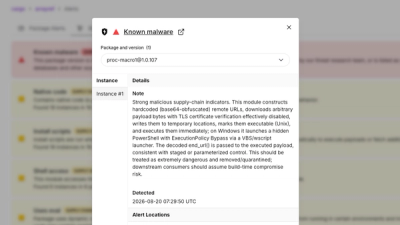
Three compromised Rust crates pulled in a malicious dependency that downloaded and executed cross-platform malware during Cargo builds.