

Product
PHP and Composer Support Is Now in Beta
Socket’s PHP and Composer support is now in Beta for all customers, with PHP reachability analysis generally available.
By Trevor Norris, Benjamin Barslev - Aug 21, 2026
@monlite/vector
Advanced tools
Local vector / semantic search for @monlite/core, powered by sqlite-vec. Adds collection.findSimilar().
Local vector / semantic search for @monlite/core,
powered by sqlite-vec. Adds collection.findSimilar()
— RAG and AI-agent memory, all in your local .db.
A monlite plugin. Store documents with an embedding field, and search by nearest neighbour. The
index is maintained automatically on every write, including changes applied by @monlite/sync.
import { createDb } from "@monlite/core";
import { vector } from "@monlite/vector";

const db = createDb("./app.db", {
  allowExtensions: true, // required: loads the sqlite-vec extension
  plugins: [vector({ docs: { field: "embedding", dimensions: 384 } })],
});

await db.collection("docs").create({
  data: { title: "Black holes", embedding: await embed("Black holes …") },
});

const hits = await db.collection("docs").findSimilar({
  vector: await embed("astrophysics"),
  topK: 5,
  where: { published: true }, // optional structured filter
});
// [ { _id, title, _distance, … } ]  — nearest first
You bring the embeddings (from any model — OpenAI, local, etc.); monlite stores and searches them.
npm install @monlite/core @monlite/vector
@monlite/vector depends on sqlite-vec, which ships prebuilt native binaries. It works on
both monlite backends (better-sqlite3 and node:sqlite), but the database must be opened with
{ allowExtensions: true }.
vector(spec: Record<string, {
  field: string;               // document field holding the embedding (number[])
  dimensions: number;          // must match your embedding model's output size
  distance?: "l2" | "cosine"; // default "l2"
}>): MonlitePlugin
findSimilarcollection.findSimilar({
vector: number[], // query embedding (length must equal dimensions)
topK?: number, // number of results (default 10)
where?: WhereInput<T>, // combine with a normal monlite filter
}): Promise<Array<WithId<T> & { _distance: number }>>
Results are ordered nearest-first; _distance is the raw metric (smaller = closer). Documents
without a valid embedding field are not indexed.
import { reindex } from "@monlite/vector";
reindex(db, "docs", { field: "embedding", dimensions: 384 });
createVectorStore(db)The vector() plugin attaches semantic search to a collection with a static spec. For a
programmatic store over collections created at runtime — RAG corpora, per-tenant indexes,
"give me a vector table for this id" — use createVectorStore(db):
import { createDb } from "@monlite/core";
import { createVectorStore } from "@monlite/vector";

const db = createDb("./rag.db", { allowExtensions: true });
const store = createVectorStore(db);

store.ensureCollection("docs", { dimensions: 384, indexedFields: ["docId"] });
store.upsert("docs", [{ id: "c1", vector: emb, metadata: { docId: "d1", text } }]);

// where on an indexed field is applied inside the KNN — exact pre-filtered recall
store.search("docs", { vector: q, topK: 5, where: { docId: "d1" } });
store.delete("docs", { where: { docId: "d1" } });
Synchronous (raw SQLite). Each collection maps to its own vec0 table; indexedFields become
filterable metadata columns, and the rest of metadata rides in a +payload column. Scales
well to ~1M vectors locally; beyond that use a dedicated vector database.
For each configured collection, the plugin creates a sqlite-vec vec0 virtual table keyed by
the document _id, backfills existing documents on init, and keeps the index current via the
plugin afterWrite hook. findSimilar runs a KNN query and returns the live documents in
distance order.
afterWrite only sees writes from its own connection. If a separate process ingests vectors
(the common agent pattern), call collection.catchUp() in the searching process to
incrementally index new vectors and reconcile cross-process deletes before querying — no full
reindex needed:
db.collection("memories").catchUp(); // → { indexed, removed }; call periodically
await db.collection("memories").findSimilar({ vector, topK: 5 });
Combine keyword (FTS) and semantic (vector) results for the best retrieval quality.
hybridSearch runs both and fuses the rankings with Reciprocal Rank Fusion — no score
normalization needed.
import { createDb } from "@monlite/core";
import { fts } from "@monlite/fts";
import { vector, hybridSearch } from "@monlite/vector";

const db = createDb("./app.db", {
  allowExtensions: true,
  plugins: [
    fts({ docs: ["title", "body"] }),
    vector({ docs: { field: "embedding", dimensions: 384 } }),
  ],
});

const hits = await hybridSearch(db.collection("docs"), {
  text: "black holes",              // keyword arm (FTS)
  vector: await embed("black holes"), // semantic arm (vector)
  topK: 10,
  where: { published: true },       // applied to both arms
});
// [ { _id, title, …, _rrf } ]  — fused, best first
If @monlite/fts is not configured on the collection, it falls back to vector-only.
MIT
FAQs
Vector / semantic search for monlite — sqlite-vec on @monlite/core, native pgvector on @monlite/postgres. Adds collection.findSimilar().
The npm package @monlite/vector receives a total of 50 weekly downloads. As such, @monlite/vector popularity was classified as not popular.
We found that @monlite/vector demonstrated a healthy version release cadence and project activity because the last version was released less than a year ago. It has 1 open source maintainer collaborating on the project.
Product
Socket’s PHP and Composer support is now in Beta for all customers, with PHP reachability analysis generally available.
Product
Socket is bringing experimental protection to Firefox, scanning 97,000+ extensions in Mozilla's official directory for malware and risky updates.
Research
/Security News
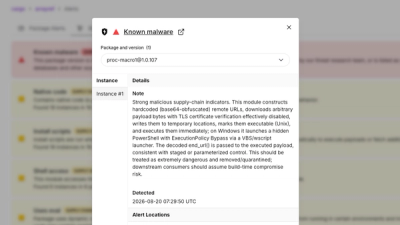
Three compromised Rust crates pulled in a malicious dependency that downloaded and executed cross-platform malware during Cargo builds.