
Product
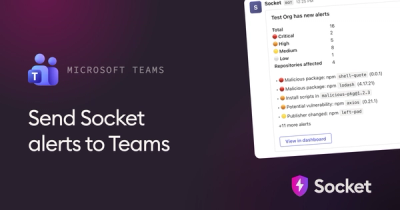
Microsoft Teams Notifications Are Now Available in Socket
Socket can now send alerts and supply chain attack notifications to Microsoft Teams, with filters that route the right updates to each channel.
By Jeppe Hasseriis - Sep 01, 2026
@morluto/rea
Advanced tools
Reverse-engineering automation for Hopper Disassembler through one CLI and MCP server.
npm package · Issues · Hopper Disassembler
REA gives coding agents access to Hopper Disassembler through one rea command. It exposes 42 MCP tools: 31 direct Hopper operations, 8 composed analysis workflows, and 3 target-session tools.
REA uses Hopper's public Python API through its own authenticated local bridge. It does not use Hopper's bundled MCP server.
REA is not a disassembler. Hopper Disassembler is a separate macOS dependency that must be installed and licensed independently. REA launches and controls Hopper underneath through its public Python API.
REA does not bundle Hopper. rea setup --yes can install Homebrew when absent, install Hopper with the hopper-disassembler Homebrew cask, configure detected MCP clients, and install the REA agent skill. Setup is idempotent and returns structured remediation when an installer needs human attention.
Quick start:
npx -y @morluto/rea setup --yes
npx -y @morluto/rea doctor
npx -y @morluto/rea mcp
The final command starts the stdio MCP server for clients that launch it directly. setup can write the equivalent persistent client registration automatically.
For source-checkout development:
npm ci
npm run build
npm link
rea setup --yes
The CLI and MCP adapter call the same binary-session runtime directly; neither invokes the other. One-shot analyze and decompile commands close their bridge session before returning. MCP mode keeps one session alive so an agent can switch targets.
rea --help
rea --llms
rea doctor --target /path/to/binary
rea mcp add
Start the MCP adapter with rea mcp (or rea --mcp) with no target. In the connected agent:
open_binary with any readable local binary or .hop path.binary_overview, then use decompilation, strings, symbols, and xrefs tools.open_binary again to switch targets. If the new target fails, REA attempts to reopen the previous target.close_binary when finished. binary_session reports current state.Relative target paths resolve against the MCP server's working directory. Mach-O/FAT, ELF, PE, and Hopper databases are detected automatically. FAT loading selects the host-compatible architecture.
HOPPER_TARGET_PATH is optional and opens an initial target at server startup. HOPPER_LAUNCHER_PATH overrides the Hopper launcher. HOPPER_TARGET_KIND selects executable or database for an initial target. HOPPER_LOADER_ARGS_JSON overrides REA's derived Hopper loader arguments for supported executable formats.
Manual target-free MCP configuration:
{
  "mcpServers": {
    "rea": {
      "command": "npx",
      "args": ["-y", "@morluto/rea", "mcp"]
    }
  }
}
The first open_binary can take time while Hopper analyzes the file. Analysis calls made without an open target return an actionable NoBinaryOpenError.
REA starts Hopper when needed; Hopper does not have to be running first. Hopper's launcher internally activates the application, so opening a target may bring Hopper to the foreground. REA asks macOS to start Hopper hidden and in the background when possible, but cannot guarantee that Hopper will remain behind the current application.
Explicit format and architecture loader arguments prevent Hopper's common FAT/ARM selection dialogs. Other Hopper or macOS dialogs can still require a person. REA reports timeouts and setup remediation through the CLI or MCP result instead of trying to answer UI prompts.
Closing a REA session shuts down its bridge and removes its private socket directory. It does not quit a Hopper application the user may be using.
Each bridge session uses a random capability token and a Unix socket restricted to the current user. This rejects unauthenticated connections and access from other local user accounts, but it does not defend against a malicious process already running as the same user. REA bounds protocol messages and exposes sanitized error messages instead of launcher stderr or internal exception causes.
This boundary prevents unrelated local processes from accidentally using a bridge session; it is not a sandbox. Opening an untrusted binary still delegates parsing and analysis to Hopper under the current macOS user account.
npm run check
npm pack --dry-run
npm run verify:package
HOPPER_TARGET_PATH=/path/to/target-a \
HOPPER_SECOND_TARGET_PATH=/path/to/distinct-target-b \
npm run verify:hopper
Real-Hopper verification requires Hopper and two distinct binaries. It checks target-free startup, all 42 tools, analysis, bounded decompilation, target switching, bridge cleanup, and server shutdown. The verifier terminates only Hopper bundle processes that appeared during its run; it preserves Hopper processes that were already running.
The npm package is named @morluto/rea, while the product and installed executable remain REA and rea. Setup writes a floating MCP registration using npx -y @morluto/rea mcp. See CONTRIBUTING.md for the release checklist and local-tarball verification workflow.
Security reports should follow SECURITY.md.
MIT, see LICENSE.
FAQs
Reverse-engineering automation for Hopper Disassembler through one CLI and MCP server.
The npm package @morluto/rea receives a total of 20 weekly downloads. As such, @morluto/rea popularity was classified as not popular.
We found that @morluto/rea demonstrated a healthy version release cadence and project activity because the last version was released less than a year ago. It has 1 open source maintainer collaborating on the project.
Product
Socket can now send alerts and supply chain attack notifications to Microsoft Teams, with filters that route the right updates to each channel.

Security News
pnpm 12 rewrites the package manager in Rust, cutting install times by up to 90% while preserving pnpm 11 workflows and lockfiles.
Security News
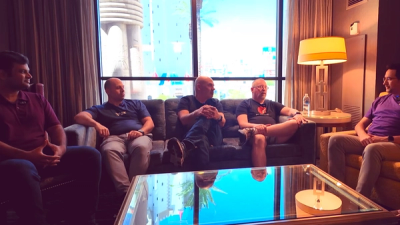
Socket CTO Ahmad Nassri joins AppSec leaders at Black Hat to discuss active malware, package manager risks, and software supply chain defense.