
Product
PHP and Composer Support Is Now in Beta
Socket’s PHP and Composer support is now in Beta for all customers, with PHP reachability analysis generally available.
By Trevor Norris, Benjamin Barslev - Aug 21, 2026
@msgmesh/sdk
Advanced tools
English | 繁體中文
The TypeScript SDK for MsgMesh — a publish / consume / realtime (SSE / WebSocket) /
governance client for the multi-tenant event bus, universal across Node and the browser
(built on fetch). It is the single source of truth for the entire frontend ecosystem's HTTP
contract: both the MCP server and the panel build on it.
Also available for Python: msgmesh — the same API surface in snake_case.
Register an account in the panel and issue an API key (shown in plaintext only once), then:
import { MsgMesh } from "@msgmesh/sdk";

const mq = new MsgMesh({
  apiKey: process.env.MSGMESH_KEY,          // long-lived key, server-side only
  controlPlaneUrl: "https://cp.example.com",
  gatewayUrl: "https://gw.example.com",
  realtimeUrl: "https://rt.example.com",
});

await mq.createTopic("orders");
await mq.publish("orders", { hello: 1 });
const msgs = await mq.poll("orders", { group: "g1" });
getToken, never embed an API keyAnything in the browser leaks — never put a long-lived API key in the frontend. Use a
token-broker instead: your backend (which holds the key) calls POST /v1/tokens to exchange it
for a short-lived dp token, and the frontend only ever holds the token. The SDK caches it,
refetches before expiry, and rotates it on SSE reconnect.
const mq = new MsgMesh({
  // no apiKey; provide a function that fetches a short-lived token from your backend
  getToken: async () => (await fetch("/api/mm-token")).then((r) => r.json()), // { token, expires_in }
  gatewayUrl: "https://gw.example.com",
  realtimeUrl: "https://rt.example.com",
});
mq.stream("room.42", (data) => console.log(data));   // SSE; auto-rotates the token on expiry and reconnects
mq.streamWs("room.42", (data) => console.log(data)); // WebSocket; same interface, SDK-managed reconnect
Two options for realtime receive, with the same interface, each returning a stop function:
stream (SSE): backed by the browser-native EventSource (which auto-reconnects), over
/…/sse. Browser only.streamWs (WebSocket): the global WebSocket (browser-native; built into Node ≥ 22),
over /…/ws. WebSocket has no native reconnect, so the SDK takes it over: reconnect with a
1s backoff after each drop, reset the failure counter on a successful connect, and stop once
consecutive failures (never having connected) reach the limit — avoiding infinite
reconnect to a revoked credential or a persistently unavailable endpoint; in getToken mode
it also rotates the token before reconnecting. Revocation mid-connection is CLOSE 1008
authorization revoked (stops immediately); during the handshake (HTTP 401 → CloseEvent 1006)
it is bounded by the failure limit. Good when SSE is blocked by a middlebox, or when you
already have WebSocket infrastructure. Node < 22 has no global WebSocket and will throw — use
subscribe (long-polling) instead.Resume on reconnect (at-least-once, no gaps). Both stream (SSE) and streamWs (WebSocket)
resume across reconnects: each message carries a <partition>-<offset> cursor, the SDK tracks the
last one seen, and on reconnect it asks the server to replay from there — so messages dropped
during a disconnect are backfilled, not lost. Delivery is at-least-once: the SDK dedupes
per-partition by cursor, so a rare overlap is suppressed rather than delivered twice. If the
server can't cover the gap (older than the replay window), it emits a resync signal — pass
onResync to be told to re-fetch a snapshot. All of this is transparent: onMessage still
receives the raw value string, no API change. (Resume requires the platform's realtime resume
tier; against an older server the stream degrades gracefully to live-tail.)
A single topic can be split into multiple rooms (room = Kafka record key), decoupling "number of rooms" from "number of topics". Two layers:
① Routing — publish with publish(topic, body, { key: roomId }) to target a room, and
subscribe with the optional room (the fourth argument opts, same for stream / streamWs)
to receive only that room:
mq.stream("chat", (data) => console.log(data), undefined, { room: "room-42" });   // only room-42
mq.streamWs("chat", (data) => console.log(data), undefined, { room: "room-42" });
await mq.publish("chat", { text: "hi" }, { key: "room-42" });                     // publish to room-42
Omitting room = receive all messages on the topic (backward compatible). Routing only filters
— it does not enforce isolation; a malicious client can switch to someone else's room and
eavesdrop on other rooms in the same topic. For real isolation, see ②.
② Isolation (platform-enforced) — add the optional rooms to a credential's capabilities
and the platform enforces that the credential can only send/receive the named rooms (403 on
overreach). rooms omitted/empty = all rooms (backward compatible); non-empty = only these. The
typical approach: the backend holds an all-rooms key and downscopes it via POST /v1/tokens
to mint a short-lived "this room only" token for the frontend (a downscope may only narrow, must
be a subset of the key's capabilities, 403 on overreach):
// Backend token-broker: downscope an all-rooms key to a short-lived "chat / room-42 only"
// token, returned to the frontend as getToken
const r = await fetch(`${controlPlaneUrl}/v1/tokens`, {
  method: "POST",
  headers: { Authorization: `Bearer ${process.env.MSGMESH_KEY}`, "Content-Type": "application/json" },
  body: JSON.stringify({
    ttl_seconds: 600,
    capabilities: [{ ops: ["subscribe", "publish"], topics: ["chat"], rooms: ["room-42"] }],
  }),
});
const { token, expires_in } = await r.json();   // return to the frontend; it connects SSE/WS via getToken
You can also mint a persistent room-scoped key with
createKey("key", { capabilities: [{ ops, topics, rooms }] }). Platform enforcement points:
subscribe (SSE/WS) must carry a ?room within the allowed set (omitting it = wanting all rooms,
also 403); publish ?key must be within the allowed set.
⚠️ A room-scoped credential can only use realtime (SSE/WS) +
publishto its rooms; it cannotpoll/consume/ DLQ. Those are a whole-topic firehose (the consumer-group offset would consume other rooms; one group per room = read amplification) and can't be cleanly per-room filtered, so a room-restricted credential always gets 403 (use realtime SSE/WS ?room=). Use an unrestricted credential when you need poll/consume.
rooms) into the frontend /
untrusted clients — that lets anyone change room and see all rooms, so isolation is
meaningless.presence (online count) is currently per-topic, not per-room (only leaks an aggregate
number); short-lived tokens are bearer tokens — leaking one = usable for that room until TTL
expires (so keep the TTL short and don't log it).controlPlaneUrl (governance API), gatewayUrl
(send/receive), realtimeUrl (SSE/WS/presence). When unset, the SDK falls back to local-dev
defaults (http://localhost:8080/8081/8082), which are for local use only; when a production
call can't connect, the error message appends a "set controlPlaneUrl/gatewayUrl/realtimeUrl"
hint.getToken
instead.producer, consuming needs consumer, administration needs
admin (which covers everything); a data-plane key that both publishes and consumes, or needs
fine-grained access, can use the neutral key scope (which requires capabilities). getToken
mode is data-plane only (send/receive); calling governance endpoints returns 401/403.Non-2xx responses throw a typed error by status code (all inherit MsgMeshError and carry
status/code/path):
import { ValidationError, AuthError, NotFoundError, RateLimitError } from "@msgmesh/sdk";

try {
  await mq.createTopic("Bad Name!");
} catch (e) {
  if (e instanceof ValidationError) console.error("invalid argument:", e.message);
  else if (e instanceof RateLimitError) console.error("rate limited, retry later");
  else throw e;
}
| Status | Type | code |
|---|---|---|
| 400 / 422 | ValidationError | validation |
| 401 / 403 | AuthError | auth |
| 404 | NotFoundError | not_found |
| 429 | RateLimitError | rate_limit |
| other | MsgMeshError | server |
createTopic / listTopics / deleteTopicpublish / poll / subscribe (polling) / stream (SSE, browser) / streamWs
(WebSocket, browser + Node ≥ 22) / getPresencelistKeys (returns capabilities / name) / createKey (accepts scope +
capabilities) / deleteKeylistWebhooks / createWebhook / deleteWebhook / reactivateWebhookregisterSchema / listSchemas / getLatestSchema / deleteSchemaregisterFunction / getFunction / deleteFunction (JavaScript / WASM)getPlan / setPlan; usage: getUsagegetSettings / setStrictTopics (data-plane topic gate toggle)getBilling / getDepositAddresses / getDeposits /
getLedger / getUsageDebits / getDepositStatusgetSnippet / getDocs / getAudit, DLQ dlqPeek / dlqReplayRegistration and admin (finance / tenant governance) go through panel sessions, not this SDK.
npm test -w @msgmesh/sdk && npm run build -w @msgmesh/sdk
English | 繁體中文
MsgMesh 的 TypeScript SDK(Node / 瀏覽器通用,基於 fetch)。是整個前端生態的唯一 HTTP 真相源——MCP server 與面板都複用它。
也有 Python 版:msgmesh(相同 API 面、snake_case)。
先在面板註冊帳號、簽發一把 API key(明文僅顯示一次),再:
import { MsgMesh } from "@msgmesh/sdk";

const mq = new MsgMesh({
  apiKey: process.env.MSGMESH_KEY,          // 伺服器端用長期 key
  controlPlaneUrl: "https://cp.example.com",
  gatewayUrl: "https://gw.example.com",
  realtimeUrl: "https://rt.example.com",
});

await mq.createTopic("orders");
await mq.publish("orders", { hello: 1 });
const msgs = await mq.poll("orders", { group: "g1" });
getToken,不要放 API key瀏覽器裡的東西都會外洩,不要把長期 API key 放進前端。改採 token-broker:後端(持 key)呼叫
POST /v1/tokens 換一張短期 dp token,前端只拿 token;SDK 會自動快取、將過期前重取,SSE 重連時亦換新。
const mq = new MsgMesh({
  // 不放 apiKey;給一個「去我後端拿短期 token」的函式
  getToken: async () => (await fetch("/api/mm-token")).then((r) => r.json()), // { token, expires_in }
  gatewayUrl: "https://gw.example.com",
  realtimeUrl: "https://rt.example.com",
});
mq.stream("room.42", (data) => console.log(data));   // SSE;token 過期自動換新後重連
mq.streamWs("room.42", (data) => console.log(data)); // WebSocket;同介面,SDK 自管重連
即時接收兩種選擇,介面一致、皆回傳停止函式:
stream(SSE):靠瀏覽器原生 EventSource(有原生自動重連),走 /…/sse。僅瀏覽器。streamWs(WebSocket):全域 WebSocket(瀏覽器原生;Node ≥ 22 內建),走 /…/ws。WebSocket 無原生重連,故由 SDK 接管:每次斷線退避 1s 重連,成功連上即重置失敗計數;連續失敗達上限(未曾連上)即停止(避免對已撤銷的憑證或持續不可用的端點無限重連),getToken 模式另在重連前換新 token。撤權若在連線中發生為 CLOSE 1008 authorization revoked(立即停);若在握手期(HTTP 401→CloseEvent 1006)則由上限收口。適合 SSE 被中間層擋掉、或已有 WS 基礎設施的場景。Node < 22 無全域 WebSocket 會拋錯,改用 subscribe(長輪詢)。一個 topic 內可再切多個房間(room = Kafka record key),脫鉤「房間數」與「topic 數」。分兩層:
① 路由——發佈時用 publish(topic, body, { key: roomId }) 指定房間,訂閱時傳選用 room(第四參數 opts,stream/streamWs 皆同)只收該房間:
mq.stream("chat", (data) => console.log(data), undefined, { room: "room-42" });   // 只收 room-42
mq.streamWs("chat", (data) => console.log(data), undefined, { room: "room-42" });
await mq.publish("chat", { text: "hi" }, { key: "room-42" });                     // 發到 room-42
省略 room=收該 topic 全部訊息(向後相容)。路由本身只做過濾、無強制隔離——惡意 client 可改成別人的 room 偷聽同 topic 其他房間。要真隔離看 ②。
② 隔離(平台強制)——把憑證的 capabilities 加上選用 rooms,平台即強制該憑證只能收發指定房間(逾越 403)。rooms 省略/空 = 所有房間(向後相容);非空 = 僅限這些。典型作法是後端持一把全房間金鑰,向 POST /v1/tokens 降權簽出「只准某房間」的短期 token 給前端(降權只准更窄、須為金鑰能力子集,逾越 403):
// 後端 token-broker:用全房間 key 降權鑄「只准 chat / room-42」的短期 token,回給前端當 getToken
const r = await fetch(`${controlPlaneUrl}/v1/tokens`, {
  method: "POST",
  headers: { Authorization: `Bearer ${process.env.MSGMESH_KEY}`, "Content-Type": "application/json" },
  body: JSON.stringify({
    ttl_seconds: 600,
    capabilities: [{ ops: ["subscribe", "publish"], topics: ["chat"], rooms: ["room-42"] }],
  }),
});
const { token, expires_in } = await r.json();   // 回給前端;前端以 getToken 用它連 SSE/WS
也可用 createKey("key", { capabilities: [{ ops, topics, rooms }] }) 簽一把常駐 room-scoped 鍵。平台強制點:訂閱(SSE/WS)必須帶允許集內的 ?room(不帶=想收全部房間,一樣 403);發佈的 ?key 必須 ∈ 允許集。
⚠️ room-scoped 憑證只能走即時(SSE/WS)+ 對其房間 publish;不能
poll/consume/ DLQ。後者是整個 topic 的 firehose(consumer-group offset 會吃掉別房間、每房一 group = 讀取放大),無法乾淨 per-room 過濾,受限房間憑證一律 403(use realtime SSE/WS ?room=)。需要 poll/consume 時請改用不限房間的憑證。
rooms 的 token)放進前端——那樣 client 改個 room 就能看到所有房間,隔離形同虛設。presence(在線數)目前是 per-topic 非 per-room(只洩漏聚合數字);短期 token 為 bearer,洩漏 = 該房 ≤TTL 可用(故 TTL 短、勿記進 log)。controlPlaneUrl(治理 API)、gatewayUrl(收發)、realtimeUrl(SSE/WS/presence)。
未指定時 SDK 退回本機開發預設值(http://localhost:8080/8081/8082),只適合本機;
生產環境連不上時錯誤訊息會附「請指定 controlPlaneUrl/gatewayUrl/realtimeUrl」提示。getToken。producer、收訊需 consumer、管理需 admin(通吃);又推又收/細粒度的資料面鍵可用中性
key scope(強制附 capabilities)。getToken 模式僅供資料面(收發),呼叫治理端點會 401/403。非 2xx 回應會依狀態碼拋型別化錯誤(都繼承 MsgMeshError,帶 status/code/path):
import { ValidationError, AuthError, NotFoundError, RateLimitError } from "@msgmesh/sdk";

try {
  await mq.createTopic("Bad Name!");
} catch (e) {
  if (e instanceof ValidationError) console.error("參數不合法:", e.message);
  else if (e instanceof RateLimitError) console.error("被限流,稍後重試");
  else throw e;
}
| 狀態碼 | 型別 | code |
|---|---|---|
| 400 / 422 | ValidationError | validation |
| 401 / 403 | AuthError | auth |
| 404 | NotFoundError | not_found |
| 429 | RateLimitError | rate_limit |
| 其他 | MsgMeshError | server |
createTopic / listTopics / deleteTopicpublish / poll / subscribe(輪詢)/ stream(SSE,瀏覽器)/ streamWs(WebSocket,瀏覽器 + Node ≥ 22)/ getPresencelistKeys(回傳含 capabilities/name)/ createKey(可帶 scope+capabilities)/ deleteKeylistWebhooks / createWebhook / deleteWebhook / reactivateWebhookregisterSchema / listSchemas / getLatestSchema / deleteSchemaregisterFunction / getFunction / deleteFunction(JavaScript / WASM)getPlan / setPlan;用量:getUsagegetSettings / setStrictTopics(資料面 topic 閘門開關)getBilling / getDepositAddresses / getDeposits / getLedger / getUsageDebits / getDepositStatusgetSnippet / getDocs / getAudit、DLQ dlqPeek / dlqReplay註冊、超管(finance/租戶治理)走面板 session,不在本 SDK。
npm test -w @msgmesh/sdk && npm run build -w @msgmesh/sdk
FAQs
MsgMesh TypeScript SDK — publish / consume / realtime (SSE / WebSocket) / governance client for the multi-tenant event bus, universal across Node and the browser.
The npm package @msgmesh/sdk receives a total of 67 weekly downloads. As such, @msgmesh/sdk popularity was classified as not popular.
We found that @msgmesh/sdk demonstrated a healthy version release cadence and project activity because the last version was released less than a year ago. It has 1 open source maintainer collaborating on the project.
Product
Socket’s PHP and Composer support is now in Beta for all customers, with PHP reachability analysis generally available.
Product
Socket is bringing experimental protection to Firefox, scanning 97,000+ extensions in Mozilla's official directory for malware and risky updates.
Research
/Security News
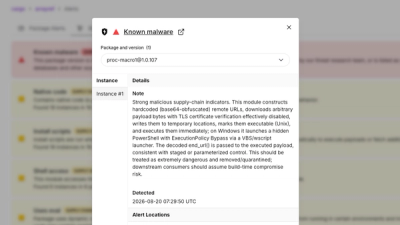
Three compromised Rust crates pulled in a malicious dependency that downloaded and executed cross-platform malware during Cargo builds.