

Research
/Security News
Popular npm Packages in the keyv and Cacheable Namespaces Compromised in Active Supply Chain Attack
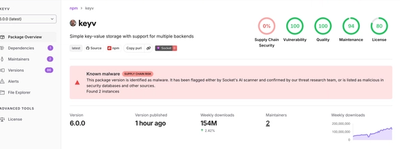
Popular npm packages keyv and cacheable compromised.
By Socket Research Team - Aug 04, 2026
@mushi-mushi/mcp
Advanced tools
MCP server for Mushi Mushi — triage user-felt bugs, pull evidence (screenshots, console logs, network requests), check blast radius, and dispatch fix PRs, all from your AI coding agent
Your AI wrote it. Mushi tells you why it broke.



Model Context Protocol server that wires Mushi into Cursor, Claude Code, and any MCP client. Pull fix context, review bugs, and dispatch fixes without a second LLM vendor key.
Wire it into Cursor, Claude Code, or any MCP client in one command:
npx mushi-mushi setup --ide cursor
# or: npx mushi-mushi setup --ide claude
That command reads CLI config at ~/.config/mushi/config.json (legacy ~/.mushirc auto-migrates), writes .cursor/mcp.json with the mushi-<slug> server block, and prints "Done; restart Cursor and ask: list mushi tools". No copy-pasting environment variables.
When codebase indexing is enabled on a project, these MCP tools ground on project_codebase_files (+ wiki chunks when configured):
| Tool | Scope | Purpose |
|---|---|---|
ask_codebase | write | Plain-English Q&A with file:line citations |
get_file_summary | read | Lazy plain-English file/symbol summary |
get_codebase_tour | read | Dependency-ordered onboarding tour |
search_codebase | read | Semantic (or scoped) embedding search |
get_codebase_domains | read | Business domain / flow map |
analyze_codebase_impact | read | Diff impact (paths, last push, compare, fix PR) |
analyze_wiki_knowledge | read | Wiki/docs knowledge graph |
What this is, and what it isn't
- This package (
@mushi-mushi/mcp) is the MCP server; runs locally next to your editor, talks to the Mushi API, and presents bug reports as MCP tools/resources to your coding agent. Always install it by its scoped name (npx -y @mushi-mushi/mcp@latest); the baremushi-mcpname was never published to npm.@mushi-mushi/agentsships the MCP client adapter; used by the autofix orchestrator when your project'sautofix_agent = 'mcp'. Seepackages/agents/src/adapters/mcp.ts.- The
generic_mcpadapter shipped before V5.3 was a misnomer (it spoke plain REST). It is nowRestFixWorkerAgent; the old export is kept as a deprecated alias for one more minor.
The Mushi admin console (Admin → MCP → Setup tab) generates a one-click deeplink that opens Cursor's "Install MCP server?" dialog with your project ID and a freshly-minted mcp:write key already embedded:
cursor://anysphere.cursor-deeplink/mcp/install?name=mushi-<project>&config=<base64>
Click "⚡ Add to Cursor" (or "Add to VS Code"); Cursor prompts you to confirm, then writes the server block into your global mcp.json automatically. No copy-pasting.
Security note: The deeplink mints a dedicated
mcp:writekey (ormcp:readfor read-only), separate from your app's SDK key. Your SDK key (thereport:write-scoped key your app sends bug reports with) should never carrymcp:write; it would expose admin-level triage and fix dispatch to anyone who extracted it from your browser bundle. The deeplink mint enforces this separation automatically. See API key scopes below.
# First: make sure you've logged in
npx mushi-mushi login --api-key mushi_xxx --endpoint https://<ref>.supabase.co/functions/v1/api

# Then wire your IDE
npx mushi-mushi setup --ide cursor          # Cursor
npx mushi-mushi setup --ide claude          # Claude Code / Claude Desktop
npx mushi-mushi setup --ide cursor --with-rules  # also write .cursorrules
Add to ~/Library/Application Support/Claude/claude_desktop_config.json (macOS) or %APPDATA%\Claude\claude_desktop_config.json (Windows):
{
  "mcpServers": {
    "mushi-mushi": {
      "command": "npx",
      "args": ["-y", "@mushi-mushi/mcp@latest"],
      "env": {
        "MUSHI_API_KEY": "mushi_xxxxxxxxxxxxxxxxxxxx",
        "MUSHI_PROJECT_ID": "xxxxxxxx-xxxx-xxxx-xxxx-xxxxxxxxxxxx",
        "MUSHI_API_ENDPOINT": "https://<your-ref>.supabase.co/functions/v1/api"
      }
    }
  }
}
Restart Claude Desktop. You should see a hammer icon in the chat input; click it to see the Mushi Mushi tools.
Where do I find these values?
MUSHI_API_KEY: Admin → Connect or MCP setup; mint anmcp:read/mcp:writekey. This is not the SDK ingest key from Setup → Verify (report:write) and not a BYOK key from Settings → API Keys.MUSHI_PROJECT_ID: Admin console → click your project → copy the UUID below the project name (e.g.542b34e0-019e-41fe-b900-7b637717bb86)MUSHI_API_ENDPOINT: Shown when you mint the MCP key, or use your project's API base (https://<ref>.supabase.co/functions/v1/api)Or visit Admin → MCP in the console for a one-click pre-filled config snippet.
In Cursor settings, open MCP → Add new MCP server and paste:
npx -y @mushi-mushi/mcp@latest
Then set the same three environment variables:
| Variable | Where to find it |
|---|---|
MUSHI_API_KEY | Connect or MCP tab: mint mcp:read / mcp:write (not Setup → Verify ingest key; not Settings → BYOK) |
MUSHI_PROJECT_ID | Admin console → Projects → click project → UUID below the name |
MUSHI_API_ENDPOINT | Shown at key mint, or your Supabase .../functions/v1/api base |
Without MUSHI_PROJECT_ID the server starts but scoped tools return an empty result with a message pointing you here.
MUSHI_API_KEY=mushi_xxxxxxxxxxxxxxxxxxxx \
MUSHI_PROJECT_ID=xxxxxxxx-xxxx-xxxx-xxxx-xxxxxxxxxxxx \
npx -y @mushi-mushi/mcp@latest
The server speaks stdio MCP transport by default; your client launches it as a subprocess.
The Mushi backend now exposes the same tool catalog over the Streamable HTTP transport from the MCP 2025-03-26 spec at /functions/v1/mcp. Use this when you want to skip the local subprocess; typical for OpenAI Agents SDK, ChatGPT Agent, hosted CrewAI, or any orchestrator that talks remote MCP:
// .cursor/mcp.json — example (hosted HTTP)
{
  "mcpServers": {
    "mushi-mushi-hosted": {
      "type": "http",
      "url": "https://<your-ref>.supabase.co/functions/v1/mcp",
      "headers": {
        "Authorization": "Bearer mushi_xxxxxxxxxxxxxxxxxxxx",
        "X-Mushi-Api-Key": "mushi_xxxxxxxxxxxxxxxxxxxx",
        "X-Mushi-Project-Id": "xxxxxxxx-xxxx-xxxx-xxxx-xxxxxxxxxxxx"
      }
    }
  }
}
Cursor icon: HTTP MCP URLs on
*.supabase.cooften show the Supabase favicon in Cursor settings; not a Mushi bug. Use stdio (command+npx @mushi-mushi/mcp) for the red 虫 stamp, or set"icon": "https://kensaur.us/mushi-mushi/integrations/mushi-mark-512.png"in your server block. The hosted endpoint also emits MCPserverInfo.iconsand serves inline SVG at?icon=1.
?features= / MUSHI_FEATURES)Full catalog is 69 tools (stdio / MUSHI_FEATURES=all). The hosted HTTP
endpoint exposes a leaner subset filtered by feature groups (see
mcp-hosted-tool-manifest.json). New installs now default to the lean
triage,fixes,inventory,setup,docs set automatically (stdio: when
MUSHI_FEATURES is unset; HTTP: pass the same ?features= on the URL). To
change the surface:
MUSHI_FEATURES=all for the full catalog, or a CSV like MUSHI_FEATURES=triage,qa,skills?features=all or ?features=triage,qa,skills on the MCP URLRenamed tools (inventory_get → get_inventory, inventory_diff →
diff_inventory, inventory_findings → list_gate_findings, fix_suggest →
suggest_fix, graph_neighborhood → get_graph_neighborhood,
graph_node_status → get_graph_node) and the consolidated setup tooling
(setup_check / ingest_setup_check / diagnose_connection → diagnose_setup;
get_activation_status → activation_status; get_reporter_thread →
get_report_timeline) are documented in the changelog; update calls to the new
names.
New unified tools: diagnose_setup (replaces the setup trilogy), search_mushi_docs (keyword doc search).
Append ?read_only=1 to the URL to hide write tools (Supabase-parity mode).
For custom MCP hosts or tests:
| Subpath | Exports |
|---|---|
@mushi-mushi/mcp/catalog | TOOL_CATALOG, scopes, tool specs |
@mushi-mushi/mcp/server | createMushiServer() |
@mushi-mushi/mcp/branding | Icons and server metadata |
@mushi-mushi/mcp/feature-groups | MUSHI_FEATURES filtering |
mushi in ~/.cursor/mcp.json only. Do not duplicate mushi / mushi-stdio in per-project .cursor/mcp.json (prevents connection storms). Project repos may ship {} or a comment pointing to the global file.C:/Users/...) or escaped backslashes (C:\\Users\\...). Raw \f, \n, \t in paths corrupt JSON.X-Mushi-Project-Id) or one stdio server and pass project_id on each tool call.| Header | Role |
|---|---|
Authorization: Bearer <key> | Auth (optional duplicate of API key) |
X-Mushi-Api-Key | Auth (preferred for MCP clients) |
X-Mushi-Project-Id | Project scope: required for API-key callers |
X-Mushi-Project
The endpoint accepts JSON-RPC 2.0 over POST (returns application/json or text/event-stream per content negotiation), opens an SSE stream on GET for server-pushed notifications, and accepts DELETE for session termination. Auth is the same dual-mode API-key / JWT used everywhere else on /v1/admin/*.
| Tool | What it does |
|---|---|
get_recent_reports | Fetch the N most recent reports, with optional status / category / severity filters |
get_report_detail | Full payload for a single report: description, console logs, network requests, screenshot URL, classification result, fix history |
search_reports | Semantic + keyword search (server-side pgvector; falls back to keyword match when embeddings aren't available) |
get_similar_bugs | Embedding-nearest neighbours for a component, page, or description |
get_fix_context | One-shot brief for a coding agent: report + repro + root-cause + ontology tags |
get_fix_timeline | Ordered timeline of a fix attempt (dispatched → started → branch → commit → PR → CI → completed/failed) |
get_blast_radius | Graph traversal showing other components a bug group touches |
get_knowledge_graph | Traverse the knowledge graph from a seed component or page |
diagnose_setup | Setup health in one call: mode=full (default) runs ingest + dispatch preflight, mode=ingest / mode=dispatch narrow it. Returns the single best next action. Run first when a user says setup is broken |
activation_status | Unified activation posture for the active project: required steps, SDK heartbeat, dispatch preflight, and the next best action |
get_report_timeline | Ordered report timeline: the reporter/admin comment thread (including verify/reopen signals) plus fix, QA, and status lanes. Use when triaging whether an end user still sees a bug as unfixed |
list_projects | Discover all Mushi projects accessible to this API key. Returns project id, name, and created date |
get_project_context | Rich context snapshot: SDK heartbeat, ingest status, autofix readiness, and open report counts |
get_pipeline_logs | Recent log entries from fix-worker, pipeline, and QA story runner: filterable by service, level, time, and limit |
get_report_evidence | Focused evidence package for a report: screenshot URL, console logs, network excerpts, environment, and user comments (lighter than get_report_detail) |
triage_issue | Primary triage entry point: combines report detail, evidence, similar bugs, fix context, blast radius, pipeline logs, and recommended next actions in one packet |
query_lessons | Token-budget retrieval of relevant learning rules for a code diff |
list_lessons | List promoted learning rules (lessons) for the current project |
| Tool | What it does |
|---|---|
submit_fix_result | Record a fix outcome (branch, PR, files, lines) from an external agent |
dispatch_fix | Kick off the agentic fix orchestrator for a report: returns a fix_attempt id |
trigger_judge | Run the Sonnet-as-Judge over a batch of classified reports |
transition_status | Move a report between workflow states (enforces the same rules as the UI) |
run_nl_query | Natural-language → read-only SQL against your project data (60/hour rate-limited) |
Need a tool that isn't here? Open an issue at github.com/kensaurus/mushi-mushi/issues and tag it
mcp.
Every tool is registered via server.registerTool() with MCP 2025-10 tool annotations so clients (Cursor, Claude Desktop, Continue, Cline, Zed) can render a proper "is this safe to auto-invoke?" UI without calling the tool first. The annotations come from a single source of truth; src/catalog.ts; mirrored into the admin console (apps/admin/src/lib/mcpCatalog.ts) and guarded against drift by scripts/check-mcp-catalog-sync.mjs.
| Annotation | Meaning | Example |
|---|---|---|
readOnlyHint: true | Safe to loop on: never mutates state | get_recent_reports, every project:// resource |
destructiveHint: true | Mutates project state; client should confirm | dispatch_fix, transition_status |
idempotentHint: true | Repeated calls produce the same effect | transition_status, submit_fix_result |
openWorldHint: true | Reaches out to your Mushi deployment (not a pure local function) | Every tool in this server |
The same catalog entries power the /mcp beginner console in the admin app; so the tool catalog the agent sees and the tool catalog the human operator reads can never disagree.
dispatch_fix emits an MCP notifications/progress event the moment the orchestrator accepts the request, so clients that support progress (Cursor, Claude Desktop) can render a live "Dispatching fix…" indicator instead of freezing until the HTTP round-trip returns. The notification mirrors the ProgressToken the client passed in _meta.progressToken; clients that don't pass one get the normal non-streaming response, unchanged.
Full list (8). See also the generated catalog at
apps/docs/content/sdks/mcp-tools.generated.mdx.
| URI | Returns |
|---|---|
project://stats | Counts of new / classified / fixed reports + last 7-day trend |
project://settings | Project config: autofix agent, plugins enabled, ontology, LLM budgets |
project://dashboard | PDCA health snapshot: stage counts, bottleneck, recent activity (the same payload the admin console polls every 15 s) |
privacy://status | Privacy / PII scrubber status for the project |
evolution://history | Evolution / PDCA history snapshot |
mushi://activation | Activation / connection status for the project |
project://integration-health | Integration health probes (Slack, Sentry, GitHub, …) |
inventory://current | Current inventory snapshot |
Named templates the MCP client surfaces in its slash-menu. Each one bakes in the house voice ("lead with the fix, skip the preamble") so agents produce consistent outputs across editors.
| Prompt | When to use |
|---|---|
summarize_report_for_fix | Before asking the agent to write the patch: produces a one-line root cause, smallest file set, repro steps, and blast-radius warnings |
explain_judge_result | After the judge scores a fix: turns the raw scores into ship / iterate / dismiss guidance |
triage_next_steps | "What should I focus on right now?": five-item markdown list drawn from the dashboard + recent classified queue |
mushi_setup | Guided first-time MCP / SDK setup checklist |
| Variable | Required | Default | Notes |
|---|---|---|---|
MUSHI_API_KEY | yes | — | Project API key with mcp:read or mcp:write scope. Mint one in the admin console → Projects (the one-time reveal card has a Copy as .env.local tab). |
MUSHI_PROJECT_ID | yes | — | UUID from the admin console URL (/projects/<uuid>/...) or the reveal card. |
MUSHI_API_ENDPOINT | no | https://dxptnwrhwsqckaftyymj.supabase.co/functions/v1/api | Override only if you self-host. Localhost: http://localhost:54321/functions/v1/api. |
.env.localThe MCP binary reads these three vars from process.env on spawn; that means anywhere you normally put env vars works. The zero-friction path:
In the admin console, mint a key and pick Copy as .env.local on the reveal card. You get a pre-formatted block:
# Mushi MCP; drop into .env.local (gitignored). The MCP binary picks these up on spawn.
MUSHI_API_ENDPOINT=https://dxptnwrhwsqckaftyymj.supabase.co/functions/v1/api
MUSHI_PROJECT_ID=<your-uuid>
MUSHI_API_KEY=mushi_live_…
Paste it into your repo's .env.local (already gitignored by every Vite / Next.js / Node project scaffold). Confirm .env.local is in .gitignore if you're in an unusual setup.
Tell your MCP client to inherit the shell env. For Cursor, the simplest form:
{
  "mcpServers": {
    "mushi-mushi": {
      "command": "npx",
      "args": ["-y", "@mushi-mushi/mcp@latest"]
    }
  }
}
Cursor spawns the subprocess with the parent shell's env, so as long as you ran Cursor from a terminal that has .env.local sourced (or you're using direnv / dotenv-cli), the three vars are already in place. If you prefer to inline them; Cursor / Claude Desktop both support an env block in mcp.json; use the Copy as .cursor/mcp.json tab on the reveal card, which hard-codes the three values into the JSON for you.
Never commit .env.local, and never paste a key into a repo-tracked .cursor/mcp.json. If you accidentally do, rotate the key from the admin console; the denormalised owner binding is rebuilt automatically on rotation.
The admin routes the MCP server hits enforce per-key scopes. When you mint a key, pick the smallest scope that works for your agent workflow:
| Scope | Grants | Use for |
|---|---|---|
report:write | SDK ingest only (/v1/reports, /v1/notifications). No admin access. | Your app's runtime Mushi SDK: never give this to an MCP client. |
mcp:read | Every MCP read tool (get_recent_reports, search_reports, get_fix_context, get_fix_timeline, get_blast_radius, get_knowledge_graph) and every project://* resource. | Safe default for agents that only read from Mushi. |
mcp:write | Everything mcp:read grants plus mutating tools (dispatch_fix, submit_fix_result, trigger_judge, transition_status, run_nl_query). | Agents that should act on bugs (open PRs, judge, transition status). |
The middleware replies 403 INSUFFICIENT_SCOPE with a human-readable message if your key is missing a required scope; no silent failures.
Useful if you already fix bugs in an AI-augmented editor. If your team still opens bugs exclusively in Jira and writes patches longhand, this server is solving a problem you don't have yet; use the SDK + Discord webhook and come back later.
For teams that live in Cursor / Claude Code / Continue / Cline / Zed / Windsurf:
| Use case | What it replaces | Why MCP wins |
|---|---|---|
| "What should I triage right now?" | Flipping to the admin tab, squinting at the dashboard, copying a report URL into chat | triage_next_steps prompt reads the live dashboard and gives the agent a five-item plan grounded in today's numbers: zero context-switch |
| "Fix this bug" (from an agent) | Copy-pasting the Sentry issue body, guessing at the blast radius, hoping the agent knows which files to touch | get_fix_context returns a pre-baked brief (root cause + smallest file set + repro + ontology tags) over a standardised MCP transport every client supports |
| Cross-IDE parity | Shipping a Cursor plugin AND a VS Code extension AND a JetBrains plugin | Ship one MCP server; every MCP-compatible editor picks it up. Cursor, Claude Desktop, Continue, Cline, Zed, Windsurf all already speak the protocol |
| Scoped automation | Giving the agent a full admin token or writing a brittle REST wrapper | mcp:read vs mcp:write scopes are enforced at the edge function. The agent can safely loop on reads; writes require the stricter key. No bespoke ACLs |
| Natural-language data questions | Opening the admin /query page, writing SQL by hand | run_nl_query: ask the agent "how many critical reports landed this week by component?" and it goes through the same NL→SQL pipeline the admin UI uses, rate-limited to 60/hour |
| Ad-hoc dashboards inside chat | Refreshing the admin tab every 15 s during a release | project://dashboard resource returns the live PDCA snapshot; clients can re-read the URI whenever the conversation needs fresh numbers |
| Status | Capability |
|---|---|
| Shipped | Tools, resources, prompts; tool annotations; progress on dispatch_fix; scope-aware errors; stdio + Streamable HTTP; outputSchema / structuredContent on key tools; inventory action anchors on dispatch_fix / get_fix_context |
| Waiting on clients | Resource subscriptions / list_changed push; sampling / elicitation |
Detail and tool tables: docs /sdks/mcp and the generated MCP tools page. Open an issue for a waiting-on-clients row once ≥2 major clients ship support.
/mcp pageThe admin app ships an /mcp page (sidebar → Act → MCP) with connection status, install snippets, the use-case table above (clickable into the catalog), and the full tool / resource / prompt list from the same catalog.ts the server registers.
The page is the recommended first stop for a new team member; it takes about 60 seconds to go from "I have a Mushi account" to "Cursor is calling get_recent_reports for me". The source of truth lives at apps/admin/src/pages/McpPage.tsx.
MUSHI_API_ENDPOINT.mcp:read is fine for 90% of agent loops.report:write) separate from your MCP key. Your app's Mushi SDK key is embedded in client-side code (e.g. NEXT_PUBLIC_MUSHI_API_KEY) and should carry only report:write scope. This scope is intentionally rejected by every admin route; so even if extracted from a browser bundle, it cannot triage, dispatch fixes, or mutate report status. Mint a dedicated mcp:write key for Cursor/Claude (use the "⚡ Add to Cursor" deeplink on the /mcp console page; it mints one automatically). If you discover your public SDK key carries mcp:write, rotate it immediately.Three layers of testing, each solving a different problem.
Real Client ↔ Server handshake over InMemoryTransport with a mocked fetch. Catches protocol regressions in under a second.
pnpm --filter @mushi-mushi/mcp test
# 49/49 pass; handshake, tool contracts, envelope unwrapping, scope errors, annotation contract, outputSchema, catalog parity
Spawns dist/index.js with a dummy unreachable endpoint and confirms it advertises the expected tools/resources/prompts over stdio. Good CI gate before publishing.
pnpm --filter @mushi-mushi/mcp build
pnpm --filter @mushi-mushi/mcp test:smoke
# OK; prints live tool/resource/prompt counts from the catalog
# (see packages/mcp/src/catalog.ts — currently 69 tools / 8 resources / 4 prompts)
Boots a tiny node:http mock of /v1/admin/*, spawns the real MCP binary pointed at it, and runs a real StdioClientTransport client through every tool + resource + a scope-denial path. This is the closest you can get to a production handshake without running Supabase Edge Functions.
pnpm --filter @mushi-mushi/mcp build
node packages/mcp/scripts/localhost-e2e.mjs
# 27/27 assertions; every tool, every resource, scope denial surfaced correctly
The harness is also the quickest way to iterate on new tools: extend the FIXTURES + the route switch in scripts/localhost-e2e.mjs, rebuild, rerun. No migrations, no Supabase boot time, no DB state.
When you're ready to wire the MCP into your local Mushi Mushi stack (i.e. pnpm dev is running the admin console + local Supabase), use these endpoints:
| Env var | Localhost value | Notes |
|---|---|---|
MUSHI_API_ENDPOINT | http://localhost:54321/functions/v1/api | Default Supabase CLI port; the /api suffix is the Hono basePath. |
MUSHI_API_KEY | the key you minted (see below) | Must have mcp:read or mcp:write scope. |
MUSHI_PROJECT_ID | the UUID from the admin URL | /projects/<uuid> in the admin console. |
pnpm dev (admin on :6464, Supabase on :54321).http://localhost:6464/projects/<uuid>/...; the <uuid> is your MUSHI_PROJECT_ID.Replace the public endpoint block in your client's MCP config with the three env vars above. For Cursor, this lives in .cursor/mcp.json at your repo root:
{
  "mcpServers": {
    "mushi-mushi-local": {
      "command": "node",
      "args": ["/absolute/path/to/mushi-mushi/packages/mcp/dist/index.js"],
      "env": {
        "MUSHI_API_ENDPOINT": "http://localhost:54321/functions/v1/api",
        "MUSHI_API_KEY": "mushi_live_abc…",
        "MUSHI_PROJECT_ID": "00000000-0000-0000-0000-000000000000"
      }
    }
  }
}
Rebuild the package (pnpm --filter @mushi-mushi/mcp build) after any MCP source change; Cursor re-spawns the subprocess on config reload but doesn't recompile for you.
In Cursor chat, type /; you should see the Mushi Mushi slash-prompts (/summarize_report_for_fix, /explain_judge_result, /triage_next_steps). Or ask the agent directly: "Use the Mushi MCP to list my recent reports". If scope is wrong you'll see the [INSUFFICIENT_SCOPE] error text verbatim; rotate the key with the right scope and retry.
If tools are not showing up or returning unexpected errors:
mushi.INSUFFICIENT_SCOPE response means your API key lacks the required scope; mint a new key with mcp:read (or mcp:write for mutating tools)./test-mushi-mcp command or call list_projects; a clean response confirms auth is working.mcp.json, restart Cursor to pick up the new config.| Sentry MCP | Mushi MCP | |
|---|---|---|
| Signal source | Thrown exceptions | User-felt bugs (rage-click, console errors, network failures flagged by real users) |
| Evidence | Stack traces, breadcrumbs | Screenshots, console logs, network excerpts, user comments, replay pointers |
| Triage tool | sentry_get_issue | triage_issue (evidence + similar bugs + blast radius + logs + recommended actions) |
| Fix dispatch | — | dispatch_fix → draft GitHub PR → human review |
| QA coverage | — | QA story runner, PDCA improvement loop |
Both are complementary; use Sentry for exception noise, Mushi for "the user says it's broken" signal.
@mushi-mushi/agents; orchestrator that consumes MCP-exposed fix workers.MIT
Monorepo scale (July 2026): 55 edge functions · 328 SQL migrations · 13 outbound plugins · 11 inbound adapters · 19 pipeline agents. Canonical counts: docs/stats.md · pnpm docs-stats
FAQs
MCP server for Mushi Mushi — triage user-felt bugs, pull evidence (screenshots, console logs, network requests), check blast radius, and dispatch fix PRs, all from your AI coding agent
We found that @mushi-mushi/mcp demonstrated a healthy version release cadence and project activity because the last version was released less than a year ago. It has 1 open source maintainer collaborating on the project.
Did you know?

Socket for GitHub automatically highlights issues in each pull request and monitors the health of all your open source dependencies. Discover the contents of your packages and block harmful activity before you install or update your dependencies.
Research
/Security News
Popular npm packages keyv and cacheable compromised.

Security News
A misconfiguration gave three Anthropic models internet access, and one, believing it was in a simulation, shipped a credential-stealing package to PyPI.

Security News
/Company News
Socket has joined the new Composer and Packagist sponsorship program as a launch sponsor, supporting the team that keeps PHP's package ecosystem secure.