
Product
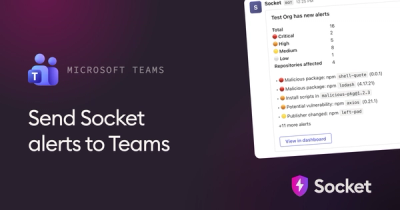
Microsoft Teams Notifications Are Now Available in Socket
Socket can now send alerts and supply chain attack notifications to Microsoft Teams, with filters that route the right updates to each channel.
By Jeppe Hasseriis - Sep 01, 2026
@n8n/backend-network
Advanced tools
The single home for n8n's backend outbound-network concerns.
Today network behavior is scattered across packages/core and several @n8n/* packages.
This package consolidates into one place behind a single factory contract: SSRF/DNS guarding, proxy handling, and the HTTP client plumbing. The eventual goal is to make backend network behavior reviewable and controllable from a single entry point.
OutboundHttpOutboundHttp is the single entry point for outbound HTTP in the backend. It is
injectable via @n8n/di, so depend on it from a constructor rather than
constructing it yourself:
import { OutboundHttp } from '@n8n/backend-network';
import { Service } from '@n8n/di';

@Service()
class MyProvider {
	constructor(private readonly outboundHttp: OutboundHttp) {}
}
Pick the method by intent, not by transport library:
requests() — you make the callUse when your code drives the request and consumes the response (the n8n request
pipeline). Returns a HttpRequestClient:
const client = this.outboundHttp.requests();
const data = await client.request({ method: 'GET', url: 'https://api.example.com/v1/data' });
HttpRequestClientOptions carry policy that applies to every call on the
client — the useDefaultSsrfPolicy, a baseURL, and default headers. Set them once at
creation instead of repeating them per request:
const client = this.outboundHttp.requests({
	baseURL: 'https://api.example.com',
	headers: () => ({ Authorization: `Bearer ${this.token}` }),
});
transport() — a third-party SDK makes the callUse when you hand transport primitives to a library you do not drive yourself
(an OpenAI/Anthropic SDK, the AWS SDK, an OIDC client). HttpTransport exposes
asCustomFetch(), getDispatcher(), and getNodeAgent(); which one you use is
dictated by what the consuming library accepts.
Both requests() and transport() guard every call — and every redirect hop —
by default. You do not pass a bridge, a service, or a config flag; the default
useDefaultSsrfPolicy: 'safe' is applied for you. The only way to skip the guard is to
opt out explicitly with useDefaultSsrfPolicy: 'unsafe'.
This default is deliberate. Outbound HTTP in n8n is frequently driven by
user-controlled input — credential URLs, workflow parameters, redirect targets
returned by a remote server. Without guarding, that input can be pointed at
internal-only addresses (cloud metadata endpoints, localhost, private ranges),
turning the n8n backend into a confused deputy (a Server-Side Request Forgery,
or SSRF). Because the secure default lives in the factory rather than at each
call site, forgetting to add protection cannot silently introduce a
vulnerability — the unsafe choice is the explicit one, and a new call site is
safe unless someone consciously writes useDefaultSsrfPolicy: 'unsafe'.
enabled is resolved inside OutboundHttp, not by callersuseDefaultSsrfPolicy answers one question: is this destination trusted enough to skip
the guard? Only the calling code knows that, so it is decided per call. Whether
the guard actually runs for a 'safe' call is a separate, instance-wide
decision that OutboundHttp resolves internally from
SsrfProtectionConfig.enabled (N8N_SSRF_PROTECTION_ENABLED). Callers neither
read that flag nor inject the SsrfProtectionService — passing 'safe' (or
nothing) is enough.
Concretely, a 'safe' call is guarded when the instance enables protection and
passes through untouched when it does not; an 'enforced' call is always
guarded and an 'unsafe' call is never guarded, regardless of the flag.
SsrfProtectionConfig (env-driven) also configures how the guard behaves once
it runs — the blocked/allowed IP ranges (N8N_SSRF_BLOCKED_IP_RANGES,
N8N_SSRF_ALLOWED_IP_RANGES), the allowed and blocked hostnames
(N8N_SSRF_ALLOWED_HOSTNAMES, N8N_SSRF_BLOCKED_HOSTNAMES), and the DNS-cache
size.
Leave the default 'safe' unless the destination genuinely cannot be
user-controlled. Classify the destination, then pick:
| Destination | Risk | What to pass |
|---|---|---|
| User- or remote-controlled URL (workflow import URL, credential/OAuth URLs, a discovery document's second hop, a user-supplied registry) | High — attacker-influenceable | nothing — the default 'safe' guards it when the instance enables protection |
| URL an autonomous component picks on its own (an LLM/web-research target) | High — attacker-influenceable, and the operator never sees the URL | useDefaultSsrfPolicy: 'enforced' — guarded even when the instance leaves protection off |
| Fixed n8n-owned host, or a fixed public vendor API (Slack, Linear, npm registry default, AWS service endpoint) | Low — not user-controllable | useDefaultSsrfPolicy: 'unsafe' + a one-line "fixed host" comment |
| Admin-configured infrastructure that may legitimately be internal (SAML/OIDC IdP, OTLP collector, log-streaming destination, external-secrets manager) | Low–medium — operator-trusted | useDefaultSsrfPolicy: 'unsafe' + a "may point at internal X" comment. The N8N_SSRF_ALLOWED_* allowlists are the alternative when the instance runs with protection globally on. |
// HIGH risk — `url` comes from user input. Guarded by default.
const client = this.outboundHttp.requests();

// LOW risk — fixed, n8n-owned host. Opt out explicitly.
const client = this.outboundHttp.requests({ useDefaultSsrfPolicy: 'unsafe' });
Whenever you opt out, write a one-line comment stating why — that comment is
what a security reviewer reads. Reference implementation:
packages/nodes-base/credentials/common/token-request.ts, which lifts the
low/high-risk choice into the type system with a
'fixed-vendor' | 'user-controlled' parameter so the caller is forced to
classify the destination.
Node request helpers (this.helpers.httpRequest,
httpRequestWithAuthentication, and the deprecated request) go through
OutboundHttp.requests() with the default safe mode. IHttpRequestOptions
exposes no useDefaultSsrfPolicy field, so node code — community nodes included — cannot
opt out of the instance's policy.
The raw httpRequest function is not exported from the package barrel. It is
reachable only through the @n8n/backend-network/testing entry point, so
production code cannot reach an unguarded request function.
The n8n-local-rules/no-uncentralized-http ESLint rule enforces this.
It is on by default for every Node backend package.
Two sanctioned escape hatches, depending on the shape of the exception:
1. Inline disable When a single callsite legitimately cannot use the factory, disable the rule on the line with a justifying comment:
// eslint-disable-next-line n8n-local-rules/no-uncentralized-http -- <reason>
import axios from 'axios';
Always include the reason after --.
2. Central allow list For whole packages that are out of scope, add the file
path (a substring of the absolute path is enough) to the allow list in
packages/@n8n/eslint-config/src/configs/backend-network-boundary.ts.
Keep the list shrinking: every entry is debt or a documented carve-out, not a default.
FAQs
Unknown package
The npm package @n8n/backend-network receives a total of 50,394 weekly downloads. As such, @n8n/backend-network popularity was classified as popular.
We found that @n8n/backend-network demonstrated a healthy version release cadence and project activity because the last version was released less than a year ago. It has 5 open source maintainers collaborating on the project.
Product
Socket can now send alerts and supply chain attack notifications to Microsoft Teams, with filters that route the right updates to each channel.

Security News
pnpm 12 rewrites the package manager in Rust, cutting install times by up to 90% while preserving pnpm 11 workflows and lockfiles.

Security News
Socket CTO Ahmad Nassri joins AppSec leaders at Black Hat to discuss active malware, package manager risks, and software supply chain defense.