Security News
arXiv Is Rate Limiting Authors Following a Flood of AI Slop Submissions
arXiv now limits authors to two submissions a month as AI slop overwhelms moderators, delays good papers, and sparks debate over applying the limit to everyone.
@n8n/di is a dependency injection (DI) container library, based on typedi.
n8n no longer uses typedi because:
typedi is no longer officially maintained// from https://github.com/typestack/typedi/blob/develop/README.md
import { Container, Service } from 'typedi';
@Service()
class ExampleInjectedService {
printMessage() {
console.log('I am alive!');
}
}
@Service()
class ExampleService {
constructor(
// because we annotated ExampleInjectedService with the @Service()
// decorator TypeDI will automatically inject an instance of
// ExampleInjectedService here when the ExampleService class is requested
// from TypeDI.
public injectedService: ExampleInjectedService
) {}
}
const serviceInstance = Container.get(ExampleService);
// we request an instance of ExampleService from TypeDI
serviceInstance.injectedService.printMessage();
// logs "I am alive!" to the console
Requires enabling these flags in tsconfig.json:
{
"compilerOptions": {
"experimentalDecorators": true,
"emitDecoratorMetadata": true
}
}
FAQs
Unknown package
The npm package @n8n/di receives a total of 64,846 weekly downloads. As such, @n8n/di popularity was classified as popular.
We found that @n8n/di demonstrated a healthy version release cadence and project activity because the last version was released less than a year ago. It has 5 open source maintainers collaborating on the project.

Security News
arXiv now limits authors to two submissions a month as AI slop overwhelms moderators, delays good papers, and sparks debate over applying the limit to everyone.

Research
/Security News
A new GhostAction wave hits hundreds of GitHub repos, expanding CI/CD secret theft to cloud and AI credentials in source code and git history.

Research
/Security News
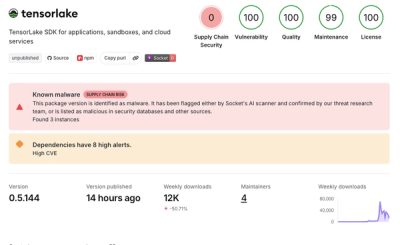
Tensorlake npm SDK version 0.5.144 was compromised in a ChainDrop / Shai-Hulud attack, delivering credential-stealing malware.