
Product
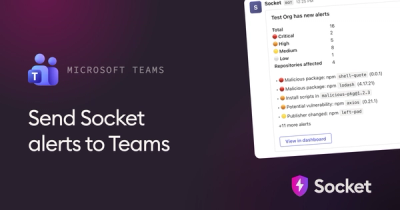
Microsoft Teams Notifications Are Now Available in Socket
Socket can now send alerts and supply chain attack notifications to Microsoft Teams, with filters that route the right updates to each channel.
By Jeppe Hasseriis - Sep 01, 2026
@nativescript/vite
Advanced tools

Vite integration for NativeScript apps.


Documentation · Environment Setup · Contribute · Community
npm i @nativescript/vite -D
init)To bootstrap an existing NativeScript app for Vite, run from your app root:
npx nativescript-vite init
This will:
vite.config.mts using the detected project flavor (Angular, Vue, React, Solid, TypeScript, or JavaScript) and the corresponding helper subpath from @nativescript/vite.@valor/nativescript-websockets..ns-vite-build to .gitignore if it is not already present.After running init, you have two ways to work with Vite:
ns debug ios
ns debug android
ns debug ios --no-hmr
ns debug android --no-hmr
adb reverseFor Android HMR the CLI automatically runs adb reverse tcp:<port> tcp:<port>
for the session's dev-server port (using the SDK-resolved adb, scoped to the
deploy target, after the device is ready) so the device reaches the dev server
through the ADB tunnel at 127.0.0.1:<port>. Relevant opt-outs:
NS_HMR_NO_ADB_REVERSE=1 — skip the tunnel and use 10.0.2.2.NS_HMR_PREFER_LAN_HOST=1 — physical device over Wi-Fi; emit the host's LAN IP.NS_HMR_HOST=<host[:port]> — point the device at an explicit origin (CI / tunnels).The CLI picks the dev-server settings for each session on its own:
NS_HMR_PORT (default 5173),
the same way vite moves off a busy port. Whatever it picks is baked into
the device URLs, bound by the dev server and (on Android) tunnelled with
adb reverse, so all three always agree..ns-vite-build/<platform>, so iOS and Android
builds never overwrite each other's output.Both can still be pinned explicitly:
| Environment variable | Purpose | Default |
|---|---|---|
NS_HMR_PORT | Preferred Vite dev-server port; the CLI moves to the next free port when it is taken | 5173 |
NS_HMR_STRICT_PORT | Fail instead of moving when NS_HMR_PORT is taken (Vite's strictPort) — for tunnels / CI that forward a fixed port | unset |
NS_VITE_DIST_DIR | Project-relative staging directory used for Vite output before the NativeScript CLI copies it into the platform app | .ns-vite-build/<platform> |
The environment settings only need to be visible to the ns process — the CLI
propagates them (and the values it picks) to the dev server it spawns.
Start both; nothing to configure:
# Terminal 1
ns debug ios       # dev server on 5173

# Terminal 2
ns debug android   # 5173 is busy → dev server on 5174
Each session gets its own port and staging directory. Older CLIs that don't pick ports need them set by hand per terminal:
# Terminal 1: iOS
NS_HMR_PORT=5173 NS_VITE_DIST_DIR=.ns-vite-build/ios ns debug ios

# Terminal 2: Android
NS_HMR_PORT=5174 NS_VITE_DIST_DIR=.ns-vite-build/android ns debug android
The inline environment syntax above is for POSIX shells; use the equivalent assignment on Windows.
vite serve yourselfThe dev server is just vite serve -- --env.<platform> --env.hmr. You can run
it standalone for diagnostics, but do not run it alongside ns run/ns debug
for the same platform — both would try to bind the same port. CLI-managed is the
supported default.
vite.config.mts (the .mts extension keeps the config ESM without setting "type": "module" in the app's package.json, avoiding Vite's configLoader: 'native' warning):import { defineConfig, mergeConfig, UserConfig } from 'vite';
import { typescriptConfig } from '@nativescript/vite/typescript';
export default defineConfig(({ mode }): UserConfig => {
return mergeConfig(typescriptConfig({ mode }), {});
});
Framework-specific configs should be imported from their matching subpaths to avoid loading unrelated framework tooling:
import { angularConfig } from '@nativescript/vite/angular';
import { reactConfig } from '@nativescript/vite/react';
import { solidConfig } from '@nativescript/vite/solid';
import { vueConfig } from '@nativescript/vite/vue';
nativescript.config.ts:import { NativeScriptConfig } from '@nativescript/core';
export default {
// add these:
bundler: 'vite',
bundlerConfigPath: 'vite.config.mts',
} as NativeScriptConfig;
Check out the NativeScript Vite documentation for more configuration options and features.
FAQs
Vite for NativeScript
We found that @nativescript/vite demonstrated a healthy version release cadence and project activity because the last version was released less than a year ago. It has 2 open source maintainers collaborating on the project.
Product
Socket can now send alerts and supply chain attack notifications to Microsoft Teams, with filters that route the right updates to each channel.

Security News
pnpm 12 rewrites the package manager in Rust, cutting install times by up to 90% while preserving pnpm 11 workflows and lockfiles.
Security News
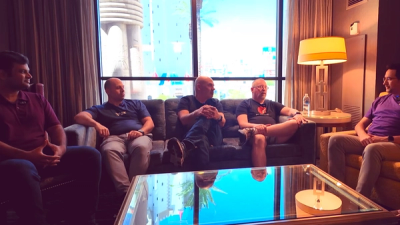
Socket CTO Ahmad Nassri joins AppSec leaders at Black Hat to discuss active malware, package manager risks, and software supply chain defense.