Context
Up-to-date docs for AI agents — local, instant, plug and play.



AI agents are trained on outdated docs. When libraries release new versions, your AI doesn't know — and confidently gives you wrong answers.
import { Experimental_Agent as Agent, stepCountIs } from 'ai';
import { ToolLoopAgent } from 'ai';
The fix isn't better prompting. It's giving your AI the right docs.
How It Works
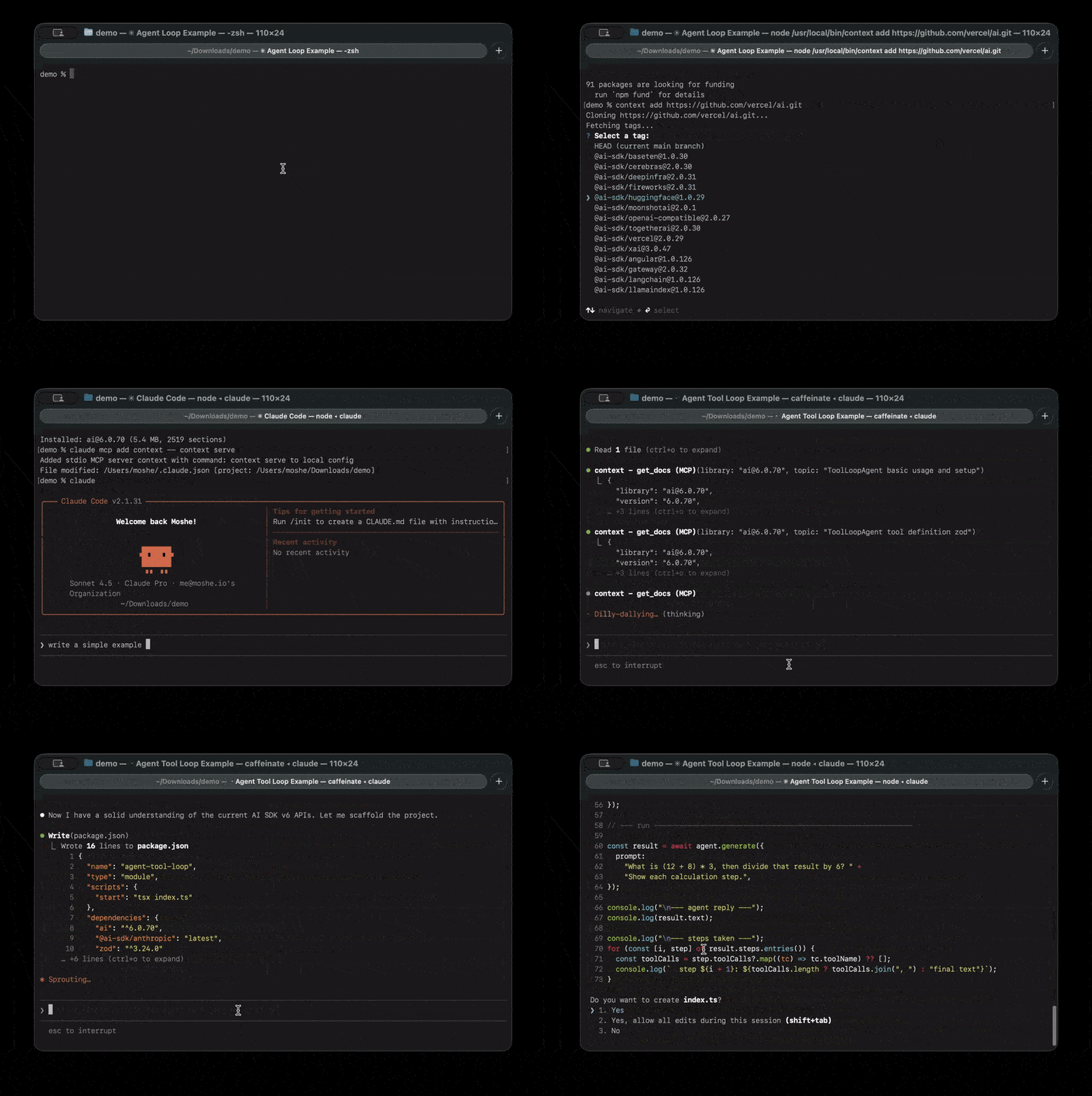
Context is an MCP server backed by a community-driven package registry with 100+ popular libraries already built and ready to use. When your AI agent needs documentation, it searches the registry, downloads the right package, and queries it locally — all automatically.
Install once. Configure once. Then just ask your AI.
:rocket: Quick Start
1. Install
npm install -g @neuledge/context
2. Connect to your AI agent
Context works with any MCP-compatible agent. Pick yours:
Claude Code
claude mcp add context -- context serve
Claude Desktop
Add to your config file:
- Linux:
~/.config/claude/claude_desktop_config.json
- macOS:
~/Library/Application Support/Claude/claude_desktop_config.json
- Windows:
%APPDATA%\Claude\claude_desktop_config.json
{
  "mcpServers": {
    "context": {
      "command": "context",
      "args": ["serve"]
    }
  }
}
Restart Claude Desktop to apply changes.
Cursor
Add to ~/.cursor/mcp.json (global) or .cursor/mcp.json (project-specific):
{
  "mcpServers": {
    "context": {
      "command": "context",
      "args": ["serve"]
    }
  }
}
Or use Settings > Developer > Edit Config to add the server through the UI.
OpenAI Codex
Either use the CLI
codex mcp add context -- context serve
Or add to ~/.codex/config.toml (global) or .codex/config.toml (project-specific):
[mcp_servers.context]
command = "context"
args = ["serve"]
Restart OpenAI Codex to apply changes.
VS Code (GitHub Copilot)
Requires VS Code 1.102+ with GitHub Copilot
Add to .vscode/mcp.json in your workspace:
{
  "servers": {
    "context": {
      "type": "stdio",
      "command": "context",
      "args": ["serve"]
    }
  }
}
Click the Start button that appears in the file, then use Agent mode in Copilot Chat.
Windsurf
Add to ~/.codeium/windsurf/mcp_config.json:
- Windows:
%USERPROFILE%\.codeium\windsurf\mcp_config.json
{
  "mcpServers": {
    "context": {
      "command": "context",
      "args": ["serve"]
    }
  }
}
Or access via Windsurf Settings > Cascade > MCP Servers.
Zed
Add to your Zed settings.json (press cmd+, or ctrl+, twice):
{
  "context_servers": {
    "context": {
      "command": {
        "path": "context",
        "args": ["serve"]
      }
    }
  }
}
Check the Agent Panel settings to verify the server shows a green indicator.
Goose
Run goose configure and select Command-line Extension, or add directly to ~/.config/goose/config.yaml:
extensions:
  context:
    type: stdio
    command: context
    args:
      - serve
    timeout: 300
OpenCode
Add to ~/.config/opencode/opencode.json:
{
  "mcp": {
    "context": {
      "command": ["context", "serve"],
      "enabled": true,
      "type": "local"
    }
  }
}
3. Ask your AI anything
That's it. Just ask:
"How do I create middleware in Next.js?"
Your agent searches the community registry, downloads the docs, and answers with accurate, version-specific information. Everything happens automatically — no manual context install needed for registry packages.
The registry is what makes Context plug and play. It's a growing collection of 100+ pre-built documentation packages maintained by the community. Think of it like a package manager, but for AI-ready docs.
Popular packages available today:
| Frameworks | Next.js, Nuxt, Astro, SvelteKit, Remix, Hono |
| React ecosystem | React, React Router, TanStack Query, Zustand, Redux Toolkit |
| Databases & ORMs | Prisma, Drizzle, Mongoose, TypeORM |
| Styling | Tailwind CSS, shadcn/ui, Styled Components |
| Testing | Vitest, Playwright, Jest, Testing Library |
| APIs & Auth | tRPC, GraphQL, NextAuth.js, Passport |
| AI & LLMs | LangChain, AI SDK, OpenAI, Anthropic SDK |
Browse the full registry →
Anyone can contribute. If a library you use isn't listed, submit a PR to add it — your contribution helps every Context user.
Why Local?
Context runs entirely on your machine. Docs are downloaded once and stored as compact SQLite databases in ~/.context/packages/. After that, everything is local.
- Fast — Local SQLite queries return in under 10ms
- Offline — Works on flights, in coffee shops, anywhere
- Private — Your queries never leave your machine
- Free — No subscriptions, no rate limits, no usage caps
- Reliable — No outages, no API changes, no service shutdowns
Beyond the Registry
The registry covers popular open-source libraries, but Context also works with any documentation source. Use context add to build packages from private repos, internal libraries, websites with llms.txt, or anything not yet in the registry.
context add https://github.com/your-company/design-system
context add ./my-project
context add https://github.com/vercel/next.js/tree/v16.0.0
context add https://svelte.dev
Once built, share packages with your team — they're portable .db files that install instantly:
context add ./my-project --name my-lib --pkg-version 2.0 --save ./packages/
context add ./packages/my-lib@2.0.db
:whale: Docker
Run Context as a containerized HTTP server for multi-client or Kubernetes deployments:
docker build -t context:local -f packages/context/Dockerfile .
docker run --rm -p 8080:8080 context:local
The container starts Context with HTTP transport on port 8080, accessible at http://localhost:8080/mcp. The image uses a multi-stage build with node:22-bookworm-slim for native module compatibility.
:books: CLI Reference
context browse <package>
Search for packages available on the registry server.
context browse npm/next
context browse react
context install <registry/name> [version]
Download and install a pre-built package from the registry server.
context install npm/next
context install npm/next 15.0.4
context install pip/django
context add <source>
Build and install a documentation package from source. Use this for libraries not in the registry, or for private/internal docs. The source type is auto-detected.
From git repository:
Works with GitHub, GitLab, Bitbucket, Codeberg, or any git URL:
context add https://github.com/vercel/next.js
context add https://gitlab.com/org/repo
context add https://bitbucket.org/org/repo
context add https://github.com/vercel/next.js/tree/v16.0.0
context add git@github.com:user/repo.git
context add ssh://git@github.com/user/repo.git
context add https://github.com/vercel/next.js --path packages/docs --name nextjs
From local directory:
Build a package from documentation in a local folder:
context add ./my-project
context add /path/to/repo --path docs
context add ./my-lib --name my-library --pkg-version 1.0.0
--pkg-version <version> | Custom version label |
--path <path> | Path to docs folder in repo/directory |
--name <name> | Custom package name |
--save <path> | Save a copy of the package to the specified path |
Saving packages for sharing:
context add https://github.com/vercel/next.js --save ./packages/
context add ./my-docs --save ./my-package.db
From website (llms.txt):
Many websites publish an llms.txt file with AI-ready documentation. Context auto-detects and fetches it. When the site only provides llms.txt (an index of links rather than the inlined llms-full.txt), Context follows each link and fetches the linked document:
context add https://svelte.dev
context add https://mui.com/material-ui
context add https://svelte.dev/docs/svelte/llms.txt
context add https://react-aria.adobe.com --name react-aria
From an arbitrary URL (blog posts, articles, raw Markdown):
If no llms.txt is found, Context falls back to fetching the page directly. HTML pages are run through a readability extractor (defuddle) so subscribe CTAs, navigation, and comment widgets don't end up in the package:
context add https://overreacted.io/things-i-dont-know-as-of-2018/
context add https://raw.githubusercontent.com/neuledge/context/main/README.md --name context-readme
For subscriber-only content on platforms you have a paid account for, see context auth below.
From URL:
context add https://cdn.example.com/react@18.db
From local file:
context add ./nextjs@15.0.db
Finding the right documentation repository:
Many popular projects keep their documentation in a separate repository from their main codebase. If you see a warning about few sections found, the docs likely live elsewhere:
context add https://github.com/facebook/react
context add https://github.com/reactjs/react.dev
Common patterns for documentation repositories:
project-docs (e.g., prisma/docs)project.dev or project.io (e.g., reactjs/react.dev)project-website (e.g., expressjs/expressjs.com)
When the CLI detects few documentation sections, it will show a Google search link to help you find the correct repository.
context list
Show installed packages.
$ context list

Installed packages:

  nextjs@16.0              4.2 MB    847 sections
  react@18                 2.1 MB    423 sections

Total: 2 packages (6.3 MB)
context remove <name>
Remove a package.
context remove nextjs
context auth
Store per-platform cookies or headers so context add <url> can fetch subscriber-only content you have a legitimate account for (e.g., a paid Substack or Medium subscription). Credentials are stored in ~/.context/auth.json with 0600 permissions, and matched by domain (with one level of parent-domain fallback for subdomains).
context auth add substack.com --cookies "substack.sid=YOUR_SID"
context auth add medium.com --cookies "sid=..." --header "x-frontend: web"
context auth list
context auth remove substack.com
context serve
Start the MCP server (used by AI agents).
context serve
context serve --http
context serve --http 3000
context serve --http 3000 --host 0.0.0.0
context serve --libs react next@15.0.4
--http [port] | Start as HTTP server instead of stdio (default port: 8080) |
--host <host> | Host to bind to (default: 127.0.0.1) |
--libs <names...> | Restrict the session to a fixed set of installed libraries. Each entry is a name (react) or name@version (react@18.3.1). When set, search_packages and download_package are hidden so the session is locked to that list. Useful for per-project scoping when you have many packages installed globally. |
The HTTP transport uses the MCP Streamable HTTP protocol, enabling multiple clients on the local network to connect to a single server instance. The endpoint is available at http://<host>:<port>/mcp.
context query <library> <topic>
Query documentation directly from the command line. Useful for testing and debugging.
context query 'nextjs@16.0' 'middleware authentication'
:gear: Architecture
┌─────────────────────────────────────────────────────────┐
│                     Your Machine                        │
│                                                         │
│  ┌──────────┐    ┌──────────────────┐    ┌────────────┐ │
│  │    AI    │    │   Context MCP    │    │ ~/.context │ │
│  │  Agent   │───▶│     Server       │───▶│  /packages │ │
│  │          │    │                  │    └────────────┘ │
│  └──────────┘    └────────┬─────────┘         │         │
│                           │            ┌──────────┐     │
│                           │            │  SQLite  │     │
│                           │            │   FTS5   │     │
│                           │            └──────────┘     │
└───────────────────────────┼─────────────────────────────┘
                            │ (first use only)
                            ▼
                   ┌────────────────┐
                   │   Community    │
                   │   Registry     │
                   └────────────────┘
First time you ask about a library:
- The MCP server searches the community registry
- Downloads the pre-built documentation package (a SQLite
.db file)
- Stores it locally in
~/.context/packages/
Every time after:
- FTS5 full-text search finds relevant sections locally
- Smart filtering keeps results within token budget
- Your AI gets focused, accurate documentation in under 10ms
:question: FAQ
Can I use Context with non-JavaScript frameworks like Spring Boot, Django, or Rails?
Yes! Context is language-agnostic. It natively supports Markdown (.md, .mdx), AsciiDoc (.adoc), reStructuredText (.rst), and HTML — no conversion needed.
context add https://github.com/fastapi/fastapi --path docs/en/docs
context add https://github.com/django/django --path docs
context add https://github.com/spring-projects/spring-boot --path spring-boot-project/spring-boot-docs/src/docs
context add https://github.com/rust-lang/book --path src
Point Context at the docs folder with --path and it handles the rest.
Can I contribute package definitions for new ecosystems?
Yes! The registry/ directory has YAML definitions organized by package manager:
registry/npm/ — JavaScript/TypeScript (Next.js, React, Tailwind, etc.)registry/pip/ — Python (FastAPI, Flask, Django, Pydantic)registry/maven/ — Java (Spring Boot, JUnit, Micrometer)
To add a package, create a YAML file. Two source types are supported:
Git source — clone a repo at a version tag:
name: my-library
description: "Short description of the library"
repository: https://github.com/org/my-library
versions:
- min_version: "2.0.0"
source:
type: git
url: https://github.com/org/my-library
docs_path: docs
tag_pattern: "v{version}"
ZIP source — download HTML docs from a URL (supports {version} placeholder):
name: python
description: "Python programming language official documentation"
versions:
- versions: ["3.14", "3.13", "3.12"]
source:
type: zip
url: "https://docs.python.org/3/archives/python-{version}-docs-html.zip"
docs_path: "python-{version}-docs-html"
exclude_paths:
- "whatsnew/**"
- "changelog.html"
Version discovery is supported for npm, PyPI, and Maven Central. See existing definitions for examples.
:wrench: Development
pnpm install
pnpm build
pnpm test
pnpm lint
:page_facing_up: License
Apache-2.0