

Company News
AWS Security Hub Adds Socket for Supply Chain Security
Socket is now in the AWS Security Hub Extended plan. Adopt it through AWS, apply committed spend, and block malicious open source packages.
By Feross Aboukhadijeh - Aug 04, 2026
@neverinfamous/postgres-mcp
Advanced tools
PostgreSQL MCP server with connection pooling, tool filtering, and full extension support
Last Updated March 2, 2026
PostgreSQL MCP Server enabling AI assistants (AntiGravity, Claude, Cursor, etc.) to interact with PostgreSQL databases through the Model Context Protocol. Features Code Mode — a revolutionary approach that provides access to all 227 tools through a single, secure JavaScript sandbox, eliminating the massive token overhead of multi-step tool calls. Also includes schema introspection and migration tracking, smart tool filtering, deterministic error handling, connection pooling, HTTP/SSE Transport, OAuth 2.1 authentication, and extension support for citext, ltree, pgcrypto, pg_cron, pg_stat_kcache, pgvector, PostGIS, and HypoPG.
227 Specialized Tools · 20 Resources · 19 AI-Powered Prompts










Docker Hub • npm Package • MCP Registry • Wiki • Changelog
| Feature | Description |
|---|---|
| 227 Specialized Tools | The largest PostgreSQL tool collection for MCP — from core CRUD and native JSONB to pgvector, PostGIS, pg_cron, ltree, pgcrypto, introspection analysis, schema version tracking, and 8 extension ecosystems |
| 20 Observability Resources | Real-time schema, performance metrics, connection pool status, replication lag, vacuum stats, lock contention, and extension diagnostics |
| 19 AI-Powered Prompts | Guided workflows for query building, schema design, performance tuning, and extension setup |
| Code Mode | Massive Token Savings: Execute complex, multi-step operations inside a fast, secure JavaScript sandbox. Instead of spending thousands of tokens on back-and-forth tool calls, Code Mode exposes all 227 capabilities locally, reducing token overhead by up to 90% and supercharging AI agent reasoning. |
| OAuth 2.1 + Access Control | Enterprise-ready security with RFC 9728/8414 compliance, granular scopes (read, write, admin, full, db:*, table:*:*), and Keycloak integration |
| Smart Tool Filtering | 21 tool groups + 16 shortcuts let you stay within IDE limits while exposing exactly what you need |
| HTTP Streaming Transport | SSE-based streaming with /mcp, and /health endpoints for remote deployments |
| High-Performance Pooling | Built-in connection pooling with health checks for efficient, concurrent database access |
| 8 Extension Ecosystems | First-class support for pgvector, PostGIS, pg_cron, pg_partman, pg_stat_kcache, citext, ltree, and pgcrypto |
| Introspection & Migration Tracking | Simulate cascade impacts, generate safe DDL ordering, analyze constraint health, and track schema migrations with SHA-256 dedup — 12 agent-optimized tools that let AI assistants reason about schema changes before executing them |
| Deterministic Error Handling | Every tool returns structured {success, error} responses — no raw exceptions, no silent failures, no misleading messages. Agents get actionable context instead of cryptic PostgreSQL codes |
| Production-Ready Security | SQL injection protection, parameterized queries, input validation, sandboxed code execution, SSL certificate verification by default, and HTTP body size enforcement |
| Strict TypeScript | 100% type-safe codebase with 3176 tests and 93.58% coverage |
| MCP 2025-11-25 Compliant | Full protocol support with tool safety hints, resource priorities, and progress notifications |
docker pull writenotenow/postgres-mcp:latest
{
  "mcpServers": {
    "postgres-mcp": {
      "command": "docker",
      "args": [
        "run",
        "--rm",
        "-i",
        "-e",
        "POSTGRES_HOST",
        "-e",
        "POSTGRES_PORT",
        "-e",
        "POSTGRES_USER",
        "-e",
        "POSTGRES_PASSWORD",
        "-e",
        "POSTGRES_DATABASE",
        "writenotenow/postgres-mcp:latest",
        "--tool-filter",
        "starter"
      ],
      "env": {
        "POSTGRES_HOST": "host.docker.internal",
        "POSTGRES_PORT": "5432",
        "POSTGRES_USER": "your_username",
        "POSTGRES_PASSWORD": "your_password",
        "POSTGRES_DATABASE": "your_database"
      }
    }
  }
}
Note for Docker: Use
host.docker.internalto connect to PostgreSQL running on your host machine.
📖 Full Docker guide: DOCKER_README.md · Docker Hub
npm install -g @neverinfamous/postgres-mcp
postgres-mcp --transport stdio --postgres postgres://user:password@localhost:5432/database
git clone https://github.com/neverinfamous/postgres-mcp.git
cd postgres-mcp
npm install
npm run build
node dist/cli.js --transport stdio --postgres postgres://user:password@localhost:5432/database
Code Mode (pg_execute_code) dramatically reduces token usage (70–90%) and is included by default in all presets.
Code executes in a sandboxed VM context with multiple layers of security. All pg.* API calls execute against the database within the sandbox, providing:
require(), process, eval(), and filesystem accesspg.* (e.g., pg.core.readQuery(), pg.jsonb.extract(), pg.introspection.dependencyGraph())admin OAuth scope — execution is logged for auditIf you control your own setup, you can run with only Code Mode enabled — a single tool that provides access to all 227 tools' worth of capability through the pg.* API:
{
  "mcpServers": {
    "postgres-mcp": {
      "command": "node",
      "args": [
        "/path/to/postgres-mcp/dist/cli.js",
        "--transport",
        "stdio",
        "--tool-filter",
        "codemode"
      ],
      "env": {
        "POSTGRES_HOST": "localhost",
        "POSTGRES_PORT": "5432",
        "POSTGRES_USER": "your_user",
        "POSTGRES_PASSWORD": "your_password",
        "POSTGRES_DATABASE": "your_database"
      }
    }
  }
}
This exposes just pg_execute_code. The agent writes JavaScript against the typed pg.* SDK — composing queries, chaining operations across all 20 tool groups, and returning exactly the data it needs — in one execution. This mirrors the Code Mode pattern pioneered by Cloudflare for their entire API: fixed token cost regardless of how many capabilities exist.
[!TIP] Maximize Token Savings: Instruct your AI agent to prefer Code Mode over individual tool calls:
"When using postgres-mcp, prefer
pg_execute_code(Code Mode) for multi-step database operations to minimize token usage."For maximum savings, use
--tool-filter codemodeto run with Code Mode as your only tool. See the Code Mode wiki for full API documentation.
[!NOTE] AntiGravity Users: Server instructions are automatically sent to MCP clients during initialization. However, AntiGravity does not currently support MCP server instructions. For optimal Code Mode usage in AntiGravity, manually provide the contents of
src/constants/ServerInstructions.tsto the agent in your prompt or user rules.
If you don't have admin access or prefer individual tool calls, exclude codemode:
{
  "args": ["--tool-filter", "starter,-codemode"]
}
📖 Full documentation: docs/CODE_MODE.md
See From Source above for setup. After cloning:
npm run lint && npm run typecheck  # Run checks
npm run bench                      # Run performance benchmarks
node dist/cli.js info              # Test CLI
node dist/cli.js list-tools        # List available tools
Run npm run bench to execute the performance benchmark suite (9 files, 75+ scenarios) powered by Vitest Bench. Benchmarks cover schema parsing, handler dispatch, identifier sanitization, auth middleware, connection pooling, Code Mode, logging, and more. Use npm run bench:verbose for detailed table output.
{
  "mcpServers": {
    "postgres-mcp": {
      "command": "node",
      "args": [
        "C:/path/to/postgres-mcp/dist/cli.js",
        "--postgres",
        "postgres://user:password@localhost:5432/database",
        "--tool-filter",
        "starter"
      ]
    }
  }
}
[!TIP] The
startershortcut provides 59 tools including Code Mode for token-efficient operations. All presets include Code Mode by default. See Tool Filtering to customize.
{
  "mcpServers": {
    "postgres-mcp": {
      "command": "node",
      "args": [
        "C:/path/to/postgres-mcp/dist/cli.js",
        "--tool-filter",
        "starter"
      ],
      "env": {
        "POSTGRES_HOST": "localhost",
        "POSTGRES_PORT": "5432",
        "POSTGRES_USER": "your_user",
        "POSTGRES_PASSWORD": "your_password",
        "POSTGRES_DATABASE": "your_database"
      }
    }
  }
}
| Scenario | Host to Use | Example Connection String |
|---|---|---|
| PostgreSQL on host machine | localhost or host.docker.internal | postgres://user:pass@localhost:5432/db |
| PostgreSQL in Docker | Container name or network | postgres://user:pass@postgres-container:5432/db |
| Remote/Cloud PostgreSQL | Hostname or IP | postgres://user:pass@db.example.com:5432/db |
| Provider | Example Hostname |
|---|---|
| AWS RDS PostgreSQL | your-instance.xxxx.us-east-1.rds.amazonaws.com |
| Google Cloud SQL | project:region:instance (via Cloud SQL Proxy) |
| Azure PostgreSQL | your-server.postgres.database.azure.com |
| Supabase | db.xxxx.supabase.co |
| Neon | ep-xxx.us-east-1.aws.neon.tech |
[!IMPORTANT] AI IDEs like Cursor have tool limits. With 227 tools available, you MUST use tool filtering to stay within your IDE's limits. We recommend
starter(59 tools) as a starting point. Code Mode is included in all presets by default for 70-90% token savings on multi-step operations.
The --tool-filter argument accepts shortcuts, groups, or tool names — mix and match freely:
| Filter Pattern | Example | Tools | Description |
|---|---|---|---|
| Shortcut only | starter | 59 | Use a predefined bundle |
| Groups only | core,jsonb,transactions | 47 | Combine individual groups |
| Shortcut + Group | starter,+text | 72 | Extend a shortcut |
| Shortcut - Tool | starter,-pg_drop_table | 58 | Remove specific tools |
All shortcuts and tool groups include Code Mode (pg_execute_code) by default for token-efficient operations. To exclude it, add -codemode to your filter: --tool-filter cron,pgcrypto,-codemode
Tool counts include Code Mode (
pg_execute_code) which is included in all presets by default.
| Shortcut | Tools | Use Case | What's Included |
|---|---|---|---|
starter | 59 | 🌟 Recommended | Core, trans, JSONB, schema, codemode |
essential | 47 | Minimal footprint | Core, trans, JSONB, codemode |
dev-schema | 52 | Dev Schema & Migrations | Core, trans, schema, introspection, codemode |
dev-analytics | 42 | Dev Analytics | Core, trans, stats, partitioning, codemode |
ai-data | 60 | AI Data Analyst | Core, JSONB, text, trans, codemode |
ai-vector | 50 | AI/ML with pgvector | Core, vector, trans, part, codemode |
dba-monitor | 59 | DBA Monitoring | Core, monitoring, perf, trans, codemode |
dba-schema | 45 | DBA Schema & Migrations | Core, schema, introspection, codemode |
dba-infra | 46 | DBA Infrastructure | Core, admin, backup, partitioning, codemode |
dba-stats | 57 | DBA Stats | Core, admin, monitoring, trans, stats, codemode |
geo | 43 | Geospatial Workloads | Core, PostGIS, trans, codemode |
base-ops | 51 | Operations Block | Admin, monitoring, backup, part, stats, citext, codemode |
ext-ai | 26 | Extension: AI/Security | pgvector, pgcrypto, codemode |
ext-geo | 24 | Extension: Spatial | PostGIS, ltree, codemode |
ext-schedule | 19 | Extension: Scheduling | pg_cron, pg_partman, codemode |
ext-perf | 28 | Extension: Perf/Analysis | pg_stat_kcache, performance, codemode |
Tool counts include Code Mode (
pg_execute_code) which is added to all groups by default.
| Group | Tools | Description |
|---|---|---|
codemode | 1 | Code Mode (sandboxed code execution) |
core | 21 | Read/write queries, tables, indexes, convenience/drop tools |
transactions | 8 | BEGIN, COMMIT, ROLLBACK, savepoints |
jsonb | 20 | JSONB manipulation and queries |
text | 14 | Full-text search, fuzzy matching |
performance | 21 | EXPLAIN, query analysis, optimization |
admin | 11 | VACUUM, ANALYZE, REINDEX |
monitoring | 12 | Database sizes, connections, status |
backup | 10 | pg_dump, COPY, restore |
schema | 13 | Schemas, views, sequences, functions, triggers |
introspection | 13 | Dependency graphs, cascade simulation, migration tracking |
partitioning | 7 | Native partition management |
stats | 9 | Statistical analysis |
vector | 17 | pgvector (AI/ML similarity search) |
postgis | 16 | PostGIS (geospatial) |
cron | 9 | pg_cron (job scheduling) |
partman | 11 | pg_partman (auto-partitioning) |
kcache | 8 | pg_stat_kcache (OS-level stats) |
citext | 7 | citext (case-insensitive text) |
ltree | 9 | ltree (hierarchical data) |
pgcrypto | 10 | pgcrypto (encryption, UUIDs) |
Add one of these configurations to your IDE's MCP settings file:
Best for: General PostgreSQL database work - CRUD operations, JSONB, schema management.
{
  "mcpServers": {
    "postgres-mcp": {
      "command": "node",
      "args": [
        "/path/to/postgres-mcp/dist/cli.js",
        "--transport",
        "stdio",
        "--tool-filter",
        "starter"
      ],
      "env": {
        "POSTGRES_HOST": "localhost",
        "POSTGRES_PORT": "5432",
        "POSTGRES_USER": "your_username",
        "POSTGRES_PASSWORD": "your_password",
        "POSTGRES_DATABASE": "your_database"
      }
    }
  }
}
Best for: AI/ML workloads with semantic search and vector similarity.
⚠️ Prerequisites: Requires pgvector extension installed in your PostgreSQL database.
{
  "mcpServers": {
    "postgres-mcp-ai": {
      "command": "node",
      "args": [
        "/path/to/postgres-mcp/dist/cli.js",
        "--transport",
        "stdio",
        "--tool-filter",
        "ai-vector"
      ],
      "env": {
        "POSTGRES_HOST": "localhost",
        "POSTGRES_PORT": "5432",
        "POSTGRES_USER": "your_username",
        "POSTGRES_PASSWORD": "your_password",
        "POSTGRES_DATABASE": "your_database"
      }
    }
  }
}
Customization Notes:
/path/to/postgres-mcp/ with your actual installation pathyour_username, your_password, etc.) with your PostgreSQL credentialsC:/postgres-mcp/dist/cli.js) or escape backslashes (C:\\postgres-mcp\\dist\\cli.js)| Prefix | Target | Example | Effect |
|---|---|---|---|
| (none) | Shortcut | starter | Whitelist Mode: Enable ONLY this shortcut |
| (none) | Group | core | Whitelist Mode: Enable ONLY this group |
+ | Group | +vector | Add tools from this group to current set |
- | Group | -admin | Remove tools in this group from current set |
+ | Tool | +pg_explain | Add one specific tool |
- | Tool | -pg_drop_table | Remove one specific tool |
Legacy Syntax (still supported):
If you start with a negative filter (e.g., -base,-extensions), it assumes you want to start with all tools enabled and then subtract.
When using HTTP/SSE transport, oauth 2.1 authentication can protect your MCP endpoints.
CLI Options:
node dist/cli.js \
  --transport http \
  --port 3000 \
  --postgres "postgres://user:pass@localhost:5432/db" \
  --oauth-enabled \
  --oauth-issuer http://localhost:8080/realms/postgres-mcp \
  --oauth-audience postgres-mcp-client
Environment Variables (Required):
OAUTH_ENABLED=true
OAUTH_ISSUER=http://localhost:8080/realms/postgres-mcp
OAUTH_AUDIENCE=postgres-mcp-client
Environment Variables (Optional — auto-discovered from issuer):
OAUTH_JWKS_URI=http://localhost:8080/realms/postgres-mcp/protocol/openid-connect/certs
OAUTH_CLOCK_TOLERANCE=60
Access control is managed through OAuth scopes:
| Scope | Access Level |
|---|---|
read | Read-only queries (SELECT, EXPLAIN) |
write | Read + write operations |
admin | Full administrative access |
full | Grants all access |
db:{name} | Access to specific database |
schema:{name} | Access to specific schema |
table:{schema}:{table} | Access to specific table |
This implementation follows:
The server exposes metadata at /.well-known/oauth-protected-resource.
Note for Keycloak users: Add an Audience mapper to your client (Client → Client scopes → dedicated scope → Add mapper → Audience) to include the correct
audclaim in tokens.
[!NOTE] Per-tool scope enforcement: Scopes are enforced at the tool level — each tool group maps to a required scope (
read,write, oradmin). When OAuth is enabled, every tool invocation checks the calling token's scopes before execution. When OAuth is not configured, scope checks are skipped entirely.
| Variable | Default | Description |
|---|---|---|
MCP_HOST | localhost | Server bind host (0.0.0.0 for containers) |
METADATA_CACHE_TTL_MS | 30000 | Cache TTL for schema metadata (milliseconds) |
LOG_LEVEL | info | Log verbosity: debug, info, warning, error |
Tip: Lower
METADATA_CACHE_TTL_MSfor development (e.g.,5000), or increase it for production with stable schemas (e.g.,300000= 5 min).
Prompts provide step-by-step guidance for complex database tasks. Instead of figuring out which tools to use and in what order, simply invoke a prompt and follow its workflow — great for learning PostgreSQL best practices or automating repetitive DBA tasks.
This server includes 19 intelligent prompts for guided workflows:
| Prompt | Description | Required Groups | Shortcut |
|---|---|---|---|
pg_query_builder | Construct queries with CTEs and window functions | core | starter |
pg_schema_design | Design schemas with constraints and indexes | core | starter |
pg_performance_analysis | Analyze queries with EXPLAIN and optimization | core, performance | dba-monitor |
pg_migration | Generate migration scripts with rollback support | core | starter |
pg_tool_index | Lazy hydration - compact index of all tools | — | any |
pg_quick_query | Quick SQL query guidance for common operations | core | starter |
pg_quick_schema | Quick reference for exploring database schema | core | starter |
pg_database_health_check | Comprehensive database health assessment | core, performance, monitoring | dba-monitor |
pg_backup_strategy | Enterprise backup planning with RTO/RPO | core, monitoring, backup | dba-infra |
pg_index_tuning | Index analysis and optimization workflow | core, performance | dba-monitor |
pg_extension_setup | Extension installation and configuration guide | core | starter |
pg_setup_pgvector | Complete pgvector setup for semantic search | core, vector | ai-vector |
pg_setup_postgis | Complete PostGIS setup for geospatial operations | core, postgis | geo |
pg_setup_pgcron | Complete pg_cron setup for job scheduling | core | ext-schedule |
pg_setup_partman | Complete pg_partman setup for partition management | core, partman | ext-schedule |
pg_setup_kcache | Complete pg_stat_kcache setup for OS monitoring | core, kcache | ext-perf |
pg_setup_citext | Complete citext setup for case-insensitive text | core, citext | base-ops |
pg_setup_ltree | Complete ltree setup for hierarchical data | core, ltree | ext-geo |
pg_setup_pgcrypto | Complete pgcrypto setup for cryptographic funcs | core, pgcrypto | ext-ai |
Resources give you instant snapshots of database state without writing queries. Perfect for quickly checking schema, health, or performance metrics — the AI can read these to understand your database context before suggesting changes.
This server provides 20 resources for structured data access:
| Resource | URI | Description |
|---|---|---|
| Schema | postgres://schema | Full database schema |
| Tables | postgres://tables | Table listing with sizes |
| Settings | postgres://settings | PostgreSQL configuration |
| Statistics | postgres://stats | Database statistics with stale detection |
| Activity | postgres://activity | Current connections |
| Pool | postgres://pool | Connection pool status |
| Capabilities | postgres://capabilities | Server version, extensions, tool categories |
| Performance | postgres://performance | pg_stat_statements query metrics |
| Health | postgres://health | Comprehensive database health status |
| Extensions | postgres://extensions | Extension inventory with recommendations |
| Indexes | postgres://indexes | Index usage with unused detection |
| Replication | postgres://replication | Replication status and lag monitoring |
| Vacuum | postgres://vacuum | Vacuum stats and wraparound warnings |
| Locks | postgres://locks | Lock contention detection |
| Cron | postgres://cron | pg_cron job status and execution history |
| Partman | postgres://partman | pg_partman partition configuration and health |
| Kcache | postgres://kcache | pg_stat_kcache CPU/I/O metrics summary |
| Vector | postgres://vector | pgvector columns, indexes, and recommendations |
| PostGIS | postgres://postgis | PostGIS spatial columns and index status |
| Crypto | postgres://crypto | pgcrypto availability and security recommendations |
| Extension | Purpose | Tools |
|---|---|---|
pg_stat_statements | Query performance tracking | pg_stat_statements |
pg_trgm | Text similarity | pg_trigram_similarity |
fuzzystrmatch | Fuzzy matching | pg_fuzzy_match |
hypopg | Hypothetical indexes | pg_index_recommendations |
pgvector | Vector similarity search | 16 vector tools |
PostGIS | Geospatial operations | 15 postgis tools |
pg_cron | Job scheduling | 8 cron tools |
pg_partman | Automated partition management | 10 partman tools |
pg_stat_kcache | OS-level CPU/memory/I/O stats | 7 kcache tools |
citext | Case-insensitive text | 6 citext tools |
ltree | Hierarchical tree labels | 8 ltree tools |
pgcrypto | Hashing, encryption, UUIDs | 9 pgcrypto tools |
Extension tools gracefully handle cases where extensions are not installed. Extension tool counts include
create_extensionhelpers but exclude Code Mode; the Tool Groups table above adds +1 per group for Code Mode.
Contributions are welcome! Please read our Contributing Guidelines before submitting a pull request.
For security concerns, please see our Security Policy.
⚠️ Never commit credentials - Store secrets in environment variables
This project is licensed under the MIT License - see the LICENSE file for details.
Please read our Code of Conduct before participating in this project.
FAQs
PostgreSQL MCP server with connection pooling, tool filtering, and full extension support
The npm package @neverinfamous/postgres-mcp receives a total of 85 weekly downloads. As such, @neverinfamous/postgres-mcp popularity was classified as not popular.
We found that @neverinfamous/postgres-mcp demonstrated a healthy version release cadence and project activity because the last version was released less than a year ago. It has 1 open source maintainer collaborating on the project.
Did you know?

Socket for GitHub automatically highlights issues in each pull request and monitors the health of all your open source dependencies. Discover the contents of your packages and block harmful activity before you install or update your dependencies.
Company News
Socket is now in the AWS Security Hub Extended plan. Adopt it through AWS, apply committed spend, and block malicious open source packages.
Research
/Security News
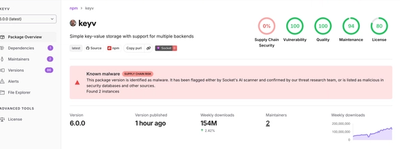
Popular npm packages keyv and cacheable compromised.

Security News
A misconfiguration gave three Anthropic models internet access, and one, believing it was in a simulation, shipped a credential-stealing package to PyPI.