Research
/Security News
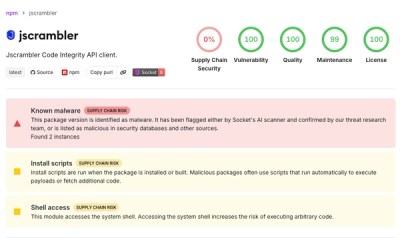
jscrambler npm Package Compromised in Supply Chain Attack
A compromised jscrambler npm release added a malicious preinstall hook that runs hidden native binaries on Linux, macOS, and Windows.
@next/mdx
Advanced tools
Use [MDX](https://github.com/mdx-js/mdx) with [Next.js](https://github.com/vercel/next.js)
For usage with the app directory see the section below.
npm install @next/mdx @mdx-js/loader
or
yarn add @next/mdx @mdx-js/loader
Create a next.config.js in your project
// next.config.js
const withMDX = require('@next/mdx')()
module.exports = withMDX()
Optionally you can provide MDX plugins:
// next.config.js
const withMDX = require('@next/mdx')({
options: {
remarkPlugins: [],
rehypePlugins: [],
},
})
module.exports = withMDX()
Optionally you can add your custom Next.js configuration as parameter
// next.config.js
const withMDX = require('@next/mdx')()
module.exports = withMDX({
webpack(config, options) {
return config
},
})
By default MDX will only match and compile MDX files with the .mdx extension.
However, it can also be optionally configured to handle markdown files with the .md extension, as shown below:
// next.config.js
const withMDX = require('@next/mdx')({
extension: /\.(md|mdx)$/,
})
module.exports = withMDX()
In addition, MDX can be customized with compiler options, see the mdx documentation for details on supported options.
Define the pageExtensions option to have Next.js handle .md and .mdx files in the pages directory as pages:
// next.config.js
const withMDX = require('@next/mdx')({
extension: /\.mdx?$/,
})
module.exports = withMDX({
pageExtensions: ['js', 'jsx', 'ts', 'tsx', 'md', 'mdx'],
})
Follow this guide from the MDX docs.
For usage with the app directory see below.
npm install @next/mdx
or
yarn add @next/mdx
Create an mdx-components.js file at the root of your project with the following contents:
// Allows customizing built-in components, e.g. to add styling.
const components = {
// h1: ({ children }) => <h1 style={{ fontSize: "100px" }}>{children}</h1>,
}
export function useMDXComponents() {
return components
}
Create a next.config.js in your project
// next.config.js
const withMDX = require('@next/mdx')({
// Optionally provide remark and rehype plugins
options: {
// If you use remark-gfm, you'll need to use next.config.mjs
// as the package is ESM only
// https://github.com/remarkjs/remark-gfm#install
remarkPlugins: [],
rehypePlugins: [],
},
})
/** @type {import('next').NextConfig} */
const nextConfig = {
// Configure pageExtensions to include md and mdx
pageExtensions: ['ts', 'tsx', 'js', 'jsx', 'md', 'mdx'],
// Optionally, add any other Next.js config below
reactStrictMode: true,
}
// Merge MDX config with Next.js config
module.exports = withMDX(nextConfig)
Follow this guide from the MDX docs.

FAQs
Use [MDX](https://github.com/mdx-js/mdx) with [Next.js](https://github.com/vercel/next.js)
The npm package @next/mdx receives a total of 713,447 weekly downloads. As such, @next/mdx popularity was classified as popular.
We found that @next/mdx demonstrated a healthy version release cadence and project activity because the last version was released less than a year ago. It has 2 open source maintainers collaborating on the project.
Did you know?

Socket for GitHub automatically highlights issues in each pull request and monitors the health of all your open source dependencies. Discover the contents of your packages and block harmful activity before you install or update your dependencies.

Research
/Security News
A compromised jscrambler npm release added a malicious preinstall hook that runs hidden native binaries on Linux, macOS, and Windows.

Research
/Security News
A malicious .NET package is typosquatting the Braintree SDK to steal live payment card data, merchant API keys, and host secrets from production apps.

Security News
/Research
Compromised Injective SDK npm version 1.20.21 exfiltrates wallet private keys and mnemonics through fake telemetry functionality.