Research
/Security News
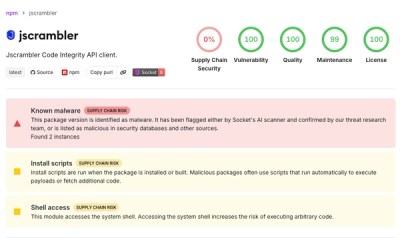
jscrambler npm Package Compromised in Supply Chain Attack
A compromised jscrambler npm release added a malicious preinstall hook that runs hidden native binaries on Linux, macOS, and Windows.
@nextengage/sdk
Advanced tools
Official TypeScript SDK for the NextEngage marketing platform (contacts, events, segments, campaigns).
Official TypeScript SDK for the NextEngage marketing platform.
pnpm add @nextengage/sdk
import { NextEngage } from "@nextengage/sdk";
// apiKey falls back to the NEXTENGAGE_API_KEY env var, so this works with no args:
const ne = new NextEngage();
// …or pass it explicitly (and optionally override the endpoint for local dev):
// const ne = new NextEngage({
// apiKey: "ne_...",
// baseUrl: "http://localhost:3001",
// });
// Upsert a contact (by email) — accepted for async persistence (see below)
await ne.contacts.upsert({
email: "ada@example.com",
attributes: { country: "IN", plan: "pro" },
});
// Track a behavioral event (feeds dynamic segments)
await ne.contacts.track({ email: "ada@example.com", name: "purchased", properties: { amount: 49 } });
// Bulk import
await ne.contacts.bulkImport([
{ email: "a@x.com" },
{ email: "b@x.com", attributes: { vip: true } },
]);
// Create + send a campaign
const tpl = await ne.templates.create({ name: "Promo", subject: "Hi {{ email }}", body: "<p>Sale!</p>" });
const campaign = await ne.campaigns.create({ name: "Spring", templateId: tpl.id, fromEmail: "news@acme.com" });
await ne.campaigns.send(campaign.id);
The API key is scoped to a single project; the SDK resolves the project id
automatically from /me.
upsert / track)On the hosted API, contacts.upsert and contacts.track are accepted onto a
durable queue and persisted asynchronously — the request never waits on the
database, so it stays fast and resilient even under heavy load or a DB blip.
These calls resolve to { accepted: true } (HTTP 202) and do not return the
created contact or a contact id — the write happens a moment later. A
subsequent read (e.g. contacts.list) may briefly not reflect it yet (eventual
consistency).
import { NextEngage, isAccepted } from "@nextengage/sdk";
const result = await ne.contacts.upsert({ email: "ada@example.com" });
if (isAccepted(result)) {
// Hosted API: queued for async persistence — no entity returned.
} else {
// Self-hosted with no ingest queue: persisted synchronously, `result` is the Contact.
console.log(result.id);
}
A self-hosted instance without an ingest queue persists synchronously and returns the entity (
Contact/{ ok, contactId }) instead — which is why those methods return a union.bulkImportis always synchronous.
Failed requests throw NextEngageError with status and parsed body.
FAQs
Official TypeScript SDK for the NextEngage marketing platform (contacts, events, segments, campaigns).
The npm package @nextengage/sdk receives a total of 36 weekly downloads. As such, @nextengage/sdk popularity was classified as not popular.
We found that @nextengage/sdk demonstrated a healthy version release cadence and project activity because the last version was released less than a year ago. It has 1 open source maintainer collaborating on the project.
Did you know?

Socket for GitHub automatically highlights issues in each pull request and monitors the health of all your open source dependencies. Discover the contents of your packages and block harmful activity before you install or update your dependencies.

Research
/Security News
A compromised jscrambler npm release added a malicious preinstall hook that runs hidden native binaries on Linux, macOS, and Windows.

Research
/Security News
A malicious .NET package is typosquatting the Braintree SDK to steal live payment card data, merchant API keys, and host secrets from production apps.

Security News
/Research
Compromised Injective SDK npm version 1.20.21 exfiltrates wallet private keys and mnemonics through fake telemetry functionality.