
Research
/Security News
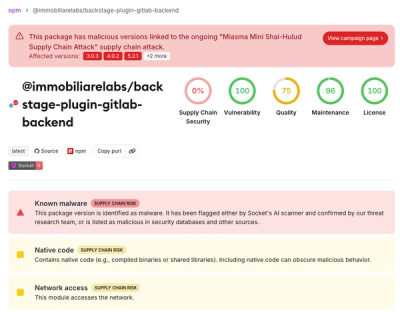
Miasma Mini Shai-Hulud Hits ImmobiliareLabs npm Packages
Miasma Mini Shai-Hulud hits @immobiliarelabs Backstage plugins, targeting GitLab and LDAP auth packages on npm.
By Socket Research Team - Jun 26, 2026
@nodevu/core
Advanced tools
The core, online-only utility of nodevu.
const nodevu = require('@nodevu/core')
async function getData() {
const data = await nodevu() // returns a lot of data!
}
The data returned by this module follows a pretty specific structure. Here's a detailing of that structure:
v17. Every value is an Object with the following properties:
releases (Object) - an Object that is filled with all releases under the release line:
v17.6.0. Every value is an Object with the following properties:
semver (Object) - a small object that gives semver information:
raw (String) - the whole, raw version.major (String) - the semver major number.minor (String) - the semver minor number.patch (String) - the semver patch number.line (String) - the "name" of the release line.dependencies (Object) - the bundled dependencies in this version of Node.js:
npm (String) - version of the bundled npm.v8 (String) - version of the bundled v8.uv (String) - version of the bundled libuv.zlib (String) - version of the bundled zlib.openssl (String) - version of the bundled openssl.files (Object) - an Object that provides context on the files available for the given release:
available (Array) - the available files, as listed by the official dist file. Every entry will be a String.links (Object) - an object of the different potential links:
aix (Array) - all AIX links (AIX is an IBM platform) links:
id (String) - the initial identifier from available that was passed in.files (Array) - an array of associated filenames for the ID.architecture (String) - the name of the architecture for the files in files.headers (Array) - all links to headers for the build:
id (String) - the initial identifier from available that was passed in.files (Array) - an array of associated filenames for the ID.architecture (String) - the name of the architecture for the files in files.linux (Array) - all the links to Linux distributions for the build:
id (String) - the initial identifier from available that was passed in.files (Array) - an array of associated filenames for the ID.architecture (String) - the name of the architecture for the files in files.macos (Array):
id (String) - the initial identifier from available that was passed in.files (Array) - an array of associated filenames for the ID.architecture (String) - the name of the architecture for the files in files.source (Array):
id (String) - the initial identifier from available that was passed in.files (Array) - an array of associated filenames for the ID.architecture (String) - the name of the architecture for the files in files.windows (Array):
id (String) - the initial identifier from available that was passed in.files (Array) - An array of associated filenames for the ID.architecture (String) - The name of the architecture for the files in files.lts (Object):
isLts(Boolean) - true if the release is an LTS release, false if it's not.security (Object):
isSecurity (Boolean) - true if the release is a security release, false if it's not.support (Object) - An Object to provide information about the project's support of the given release line, including dates, status, LTS codename, and LTS version info:
codename (String) - Only present if applicable to the given release. A string of the LTS release line's codename.lts (Object) - Only present if applicable to the given release. An object that provides LTS versioning information.
newest (String) - The newest release in the release line that is LTS. Usually, this will be the latest release in the line.oldest (String) - Only present if applicable to the given release. The oldest (first) release in the release line that was flagged as LTS.phases (Object) - Start dates for each phase of a release line's lifecycle:
start (String) - The start date of the release line (releases in this phase are current). Example: 2021-04-20.lts (String) - Only present if the release line is an LTS release. The start date of the LTS lifecycle (releases in this phase are lts). Example: 2021-10-26.maintenance (String) - Only present if the release line is an LTS release. The start date of the maintenance phase of the lifecycle. Example: 2022-10-18.end (String) - the date the release line is no longer supported. Example: 2024-04-30.security (Object):
all (Array) - an array of all security releases in the release line.newest (String) - the newest (most recent) security release. Example: 17.3.1.You can find an example of the output here. It's big. Like, really big. GitHub will struggle to render it. It's probably worth viewing raw or curl'ing the raw output.
FAQs
nodevu core API: comprehensive node.js version tooling
The npm package @nodevu/core receives a total of 136 weekly downloads. As such, @nodevu/core popularity was classified as not popular.
We found that @nodevu/core demonstrated a not healthy version release cadence and project activity because the last version was released a year ago. It has 1 open source maintainer collaborating on the project.
Did you know?

Socket for GitHub automatically highlights issues in each pull request and monitors the health of all your open source dependencies. Discover the contents of your packages and block harmful activity before you install or update your dependencies.
Research
/Security News
Miasma Mini Shai-Hulud hits @immobiliarelabs Backstage plugins, targeting GitLab and LDAP auth packages on npm.

Security News
Rolldown paused Rust React Compiler integration after a 5MB binary size increase raised concerns about shipping React-specific code to all Vite users.

Security News
/Research
Mini Shai-Hulud expands into the Go ecosystem after hitting LeoPlatform npm packages and targeting GitHub Actions workflows.