
Product
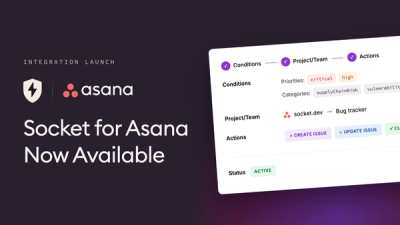
Socket for Asana Is Now Available
Create and manage Asana tasks directly from Socket alerts, with manual task creation, automated ticketing rules, and two-way sync.
By Jeppe Hasseriis - Aug 25, 2026
@notiflyio/js
Advanced tools
The @notiflyio/js package provides a JavaScript SDK for building custom inbox notification experiences.
The package provides a low-level API for interacting with the Notifly platform In-App notifications.
Note: the SDK's exported class is named
Novu— Notifly is a fork of Novu and keeps upstream code identifiers for easy upgrades.
Install @notiflyio/js npm package in your app
npm install @notiflyio/js
Add the below code in your application
import { Novu } from '@notiflyio/js';

const novu = new Novu({
  applicationIdentifier: 'YOUR_NOTIFLY_APPLICATION_IDENTIFIER',
  subscriber: 'YOUR_INTERNAL_SUBSCRIBER_ID',
});

const { data: notifications, error } = await novu.notifications.list();
|| Info: you can find the applicationIdentifier in the Notifly dashboard under the API keys page.
When HMAC encryption is enabled in your Notifly environment, you need to provide both subscriberHash and optionally contextHash to secure your requests.
Generate a subscriber hash on your backend:
import { createHmac } from 'crypto';

const subscriberHash = createHmac('sha256', process.env.NOTIFLY_SECRET_KEY)
  .update(subscriberId)
  .digest('hex');
Pass it to the Novu instance:
const novu = new Novu({
  applicationIdentifier: 'YOUR_NOTIFLY_APPLICATION_IDENTIFIER',
  subscriber: 'SUBSCRIBER_ID',
  subscriberHash: 'SUBSCRIBER_HASH_VALUE',
});
If you're using the context option to pass additional data, generate a context hash on your backend:
import { createHmac } from 'crypto';
import { canonicalize } from '@tufjs/canonical-json';

const context = { tenant: 'acme', app: 'dashboard' };
const contextHash = createHmac('sha256', process.env.NOTIFLY_SECRET_KEY)
  .update(canonicalize(context))
  .digest('hex');
Pass both context and contextHash to the Novu instance:
const novu = new Novu({
  applicationIdentifier: 'YOUR_NOTIFLY_APPLICATION_IDENTIFIER',
  subscriber: 'SUBSCRIBER_ID',
  subscriberHash: 'SUBSCRIBER_HASH_VALUE',
  context: { tenant: 'acme', app: 'dashboard' },
  contextHash: 'CONTEXT_HASH_VALUE',
});
Note: When HMAC encryption is enabled and
contextis provided, thecontextHashis required. The hash is order-independent, so{a:1, b:2}produces the same hash as{b:2, a:1}.
You can provide custom socket configuration options using the socketOptions parameter. These options will be merged with the default socket configuration when initializing the WebSocket connection.
By default, the socket type is determined automatically based on the socketUrl. You can explicitly set the socket type using the socketType option:
'cloud' — uses PartySocket'self-hosted' — uses socket.io (the default for custom/self-hosted URLs, including Notifly's ws service)This is useful when proxying the websocket service through your own domain where the URL no longer matches the expected pattern:
const novu = new Novu({
  applicationIdentifier: 'YOUR_NOTIFLY_APPLICATION_IDENTIFIER',
  subscriber: 'YOUR_INTERNAL_SUBSCRIBER_ID',
  socketUrl: 'wss://your-proxy.example.com/notifly-socket',
  socketOptions: {
    socketType: 'self-hosted',
  },
});
When using socket.io (socketType: 'self-hosted' or a custom URL), you can pass any socket.io-client options:
const novu = new Novu({
  applicationIdentifier: 'YOUR_NOTIFLY_APPLICATION_IDENTIFIER',
  subscriber: 'YOUR_INTERNAL_SUBSCRIBER_ID',
  socketOptions: {
    reconnectionDelay: 5000,
    timeout: 20000,
    path: '/my-custom-path',
    // ... other socket.io-client options
  },
});
FAQs
Notifly JavaScript SDK for
The npm package @notiflyio/js receives a total of 645 weekly downloads. As such, @notiflyio/js popularity was classified as not popular.
We found that @notiflyio/js demonstrated a healthy version release cadence and project activity because the last version was released less than a year ago. It has 1 open source maintainer collaborating on the project.
Product
Create and manage Asana tasks directly from Socket alerts, with manual task creation, automated ticketing rules, and two-way sync.

Security News
Open VSX has removed three extension IDs from its malicious-extension list as the legitimate publishers they impersonated move to claim the names for themselves.

Product
Socket’s PHP and Composer support is now in Beta for all customers, with PHP reachability analysis generally available.