
Product
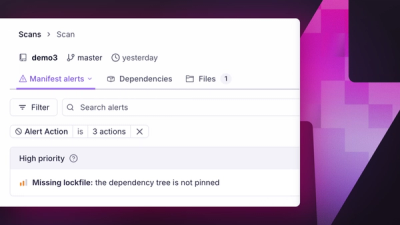
Introducing Manifest Alerts
Socket now detects supply chain risks in project manifests, starting with missing lockfiles that can make dependency installs non-reproducible.
By André Staltz, Trevor Norris - Jun 16, 2026
@octokit/app
Advanced tools
GitHub App toolset for Node.js


|
Browsers |
|
|---|---|
|
Node |
Install with |
[!IMPORTANT] As we use conditional exports, you will need to adapt your
tsconfig.jsonby setting"moduleResolution": "node16", "module": "node16".See the TypeScript docs on package.json "exports".
See this helpful guide on transitioning to ESM from @sindresorhus
const app = new App({
  appId: 123,
  privateKey: "-----BEGIN PRIVATE KEY-----\n...",
  oauth: {
    clientId: "0123",
    clientSecret: "0123secret",
  },
  webhooks: {
    secret: "secret",
  },
});

const { data } = await app.octokit.request("/app");
console.log("authenticated as %s", data.name);
for await (const { installation } of app.eachInstallation.iterator()) {
  for await (const { octokit, repository } of app.eachRepository.iterator({
    installationId: installation.id,
  })) {
    await octokit.request("POST /repos/{owner}/{repo}/dispatches", {
      owner: repository.owner.login,
      repo: repository.name,
      event_type: "my_event",
    });
  }
}

app.webhooks.on("issues.opened", async ({ octokit, payload }) => {
  await octokit.request(
    "POST /repos/{owner}/{repo}/issues/{issue_number}/comments",
    {
      owner: payload.repository.owner.login,
      repo: payload.repository.name,
      issue_number: payload.issue.number,
      body: "Hello World!",
    },
  );
});

app.oauth.on("token", async ({ token, octokit }) => {
  const { data } = await octokit.request("GET /user");
  console.log(`Token retrieved for ${data.login}`);
});

require("http").createServer(createNodeMiddleware(app)).listen(3000);
// can now receive requests at /api/github/*
App.defaults(options)Create a new App with custom defaults for the constructor options
const MyApp = App.defaults({
  Octokit: MyOctokit,
});
const app = new MyApp({ clientId, clientSecret });
// app.octokit is now an instance of MyOctokit
| name | type | description |
|---|---|---|
appId
|
number
| Required. Find the App ID on the app’s about page in settings. |
privateKey
|
string
|
Required. Content of the *.pem file you downloaded from the app’s about page. You can generate a new private key if needed.
|
Octokit
|
Constructor
|
You can pass in your own Octokit constructor with custom defaults and plugins. Note that For usage with enterprise, set Defaults to |
log
|
object
|
Used for internal logging. Defaults to console.
|
webhooks.secret
|
string
| Required. Secret as configured in the GitHub App's settings. |
webhooks.transform
|
function
| Only relevant for `app.webhooks.on`. Transform emitted event before calling handlers. Can be asynchronous. |
oauth.clientId
|
number
| Find the OAuth Client ID on the app’s about page in settings. |
oauth.clientSecret
|
number
| Find the OAuth Client Secret on the app’s about page in settings. |
oauth.allowSignup
|
boolean
|
Sets the default value for app.oauth.getAuthorizationUrl(options).
|
app.octokitOctokit instance. Uses the Octokit constructor option if passed.
app.logSee https://github.com/octokit/core.js#logging. Customize using the log constructor option.
app.getInstallationOctokitconst octokit = await app.getInstallationOctokit(123);
app.eachInstallationfor await (const { octokit, installation } of app.eachInstallation.iterator()) { /* ... */ }
await app.eachInstallation(({ octokit, installation }) => /* ... */)
app.eachRepositoryfor await (const { octokit, repository } of app.eachRepository.iterator()) { /* ... */ }
await app.eachRepository(({ octokit, repository }) => /* ... */)
Optionally pass installation ID to iterate through all repositories in one installation
for await (const { octokit, repository } of app.eachRepository.iterator({ installationId })) { /* ... */ }
await app.eachRepository({ installationId }, ({ octokit, repository }) => /* ... */)
app.getInstallationUrlconst installationUrl = await app.getInstallationUrl();
return res.redirect(installationUrl);
Optionally pass the ID of a GitHub organization or user to request installation on that specific target.
If the user will be sent to a redirect URL after installation (such as if you request user authorization during installation), you can also supply a state string that will be included in the query of the post-install redirect.
const installationUrl = await app.getInstallationUrl({ state, target_id });
return res.redirect(installationUrl);
app.webhooksapp.oauthAn @octokit/oauth-app instance
A middleware is a method or set of methods to handle requests for common environments.
By default, all middlewares expose the following routes
| Route | Route Description |
|---|---|
POST /api/github/webhooks | Endpoint to receive GitHub Webhook Event requests |
GET /api/github/oauth/login | Redirects to GitHub's authorization endpoint. Accepts optional ?state query parameter. |
GET /api/github/oauth/callback | The client's redirect endpoint. This is where the token event gets triggered |
POST /api/github/oauth/token | Exchange an authorization code for an OAuth Access token. If successful, the token event gets triggered. |
GET /api/github/oauth/token | Check if token is valid. Must authenticate using token in Authorization header. Uses GitHub's POST /applications/{client_id}/token endpoint |
PATCH /api/github/oauth/token | Resets a token (invalidates current one, returns new token). Must authenticate using token in Authorization header. Uses GitHub's PATCH /applications/{client_id}/token endpoint. |
DELETE /api/github/oauth/token | Invalidates current token, basically the equivalent of a logout. Must authenticate using token in Authorization header. |
DELETE /api/github/oauth/grant | Revokes the user's grant, basically the equivalent of an uninstall. must authenticate using token in Authorization header. |
createNodeMiddleware(app, options)Middleware for Node's built in http server or express.
const { App, createNodeMiddleware } = require("@octokit/app");

const app = new App({
  appId: 123,
  privateKey: "-----BEGIN PRIVATE KEY-----\n...",
  oauth: {
    clientId: "0123",
    clientSecret: "0123secret",
  },
  webhooks: {
    secret: "secret",
  },
});

const middleware = createNodeMiddleware(app);
require("http")
  .createServer(async (req, res) => {
    // `middleware` returns `false` when `req` is unhandled (beyond `/api/github`)
    if (await middleware(req, res)) return;
    res.writeHead(404);
    res.end();
  })
  .listen(3000);
// can now receive user authorization callbacks at /api/github/*
The middleware returned from createNodeMiddleware can also serve as an
Express.js middleware directly.
| name | type | description |
|---|---|---|
app
|
App instance
| Required. |
options.pathPrefix
|
string
|
All exposed paths will be prefixed with the provided prefix. Defaults to |
log
object
|
Used for internal logging. Defaults to |
See CONTRIBUTING.md
Probot is a framework for building GitHub Apps to automate and improve your workflow. It provides higher-level abstractions and a more opinionated structure compared to @octokit/app, making it easier to get started with building GitHub Apps.
github-app is a lightweight library for creating GitHub App tokens. It focuses on simplicity and minimalism, providing only the essential features needed for authentication, unlike @octokit/app which offers a more comprehensive set of tools.
FAQs
GitHub Apps toolset for Node.js
The npm package @octokit/app receives a total of 3,205,767 weekly downloads. As such, @octokit/app popularity was classified as popular.
We found that @octokit/app demonstrated a healthy version release cadence and project activity because the last version was released less than a year ago. It has 1 open source maintainer collaborating on the project.
Did you know?

Socket for GitHub automatically highlights issues in each pull request and monitors the health of all your open source dependencies. Discover the contents of your packages and block harmful activity before you install or update your dependencies.
Product
Socket now detects supply chain risks in project manifests, starting with missing lockfiles that can make dependency installs non-reproducible.

Research
/Security News
The trojanized extensions use TinyGo-compiled WebAssembly and Solana transaction memos to resolve command-and-control infrastructure.

Security News
Anthropic says the directive cited national security concerns over a narrow jailbreak, but offered no specific technical details.