
Research
/Security News
Popular npm Packages in the keyv and Cacheable Namespaces Compromised in Active Supply Chain Attack
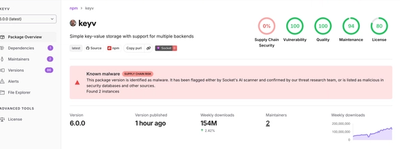
Popular npm packages keyv and cacheable compromised.
By Socket Research Team - Aug 04, 2026
@openagenda/mcp
Advanced tools
OpenAgenda v3 MCP server — code-mode tools over the v3 API, with a pluggable sandbox executor
An MCP server exposing the OpenAgenda v3 API to LLM
clients via the code-mode pattern: two tools — search_docs (find the right
operation) and execute (run code against the API) — instead of one tool per
endpoint. execute runs arbitrary caller code against the v3 surface (reads
and write/admin/moderation), so the sandbox egress boundary, per-caller OAuth
scoping and human-gated destructive tools are what bound what it can do.
⚠️ Deployed as the hosted, multi-tenant server (
https://mcp.openagenda.com, OAuth-enforced). The hosted policy layer (µVM boundary, OAuth, rate-limit, audit, maintenance kill) is in place. See Hébergé / multi-tenant for the caveats that still apply before relying on the write surface.
The hosted server is the recommended way to use this MCP: no install, OAuth
with your OpenAgenda account (the first connection opens a browser consent),
per-caller scoping and rate limits. The endpoint is
https://mcp.openagenda.com/mcp (Streamable HTTP).
Claude Code
claude mcp add --transport http openagenda https://mcp.openagenda.com/mcp
Then /mcp to authenticate.
Claude Desktop / claude.ai — Settings → Connectors → Add custom
connector → paste https://mcp.openagenda.com/mcp.
Cursor — add to ~/.cursor/mcp.json (or the project's .cursor/mcp.json):
{
  "mcpServers": {
    "openagenda": { "url": "https://mcp.openagenda.com/mcp" }
  }
}
VS Code
code --add-mcp '{"name":"openagenda","type":"http","url":"https://mcp.openagenda.com/mcp"}'
Anything else — the server is a standard OAuth-protected MCP resource
(RFC 9728 discovery at
https://mcp.openagenda.com/.well-known/oauth-protected-resource/mcp); any
client supporting remote MCP + OAuth works.
Prefer running it yourself? npx -y @openagenda/mcp speaks MCP over stdio
with an API key — see Quickstart (local).
This server is for agents exploring and prototyping against OpenAgenda. To
ship a site or tool, use the same operations as a typed SDK on npm,
@openagenda/api-client —
it is the very SDK the execute sandbox bundles, so code that an agent prototypes
here runs unchanged in your app. The only delta from an execute body is the
one-time client setup:
npm install @openagenda/api-client
import { OpenAgenda, client } from '@openagenda/api-client';

client.setConfig({ baseUrl: 'https://api.openagenda.com/v3', auth: 'oa_pk_…' });
const oa = new OpenAgenda();

const { data, error } = await oa.agendas.events.list({
  path: { agendaUid },
  query: { relative: ['upcoming'] },
});
Use a read-only publishable key (oa_pk_…, safe in browsers) for reads, a secret
key (oa_sk_…, server-only) for writes. The schemas zod validators are exported
from the package too. search_docs (and Scalar at the API docs) is the operation
reference; the calls it shows are the SDK's.
openapi.yaml ─▶ (docs index) ─▶ search_docs ┐
                                             ├─▶ MCP server (stdio) ─▶ SandboxExecutor ─▶ runtime
client writes JS ───────────────▶ execute ──┘                          (pluggable)
One narrow interface, SandboxExecutor, selected by
config. ~95 % of the server is shared; only the adapter that runs the code
differs — so the same codebase ships a broadly-compatible local mode and a
hard multi-tenant boundary, without duplication.
Engine (OA_EXECUTOR) | Runtime isolation | Owns egress? | Use |
|---|---|---|---|
node | permission sandbox (fs/subprocess/workers denied) + caps | ❌ no host-scoped net permission | local default (zero-install) |
deno | deny-by-default perms + wall-clock kill + heap cap | ✅ scoped --allow-net | local hardening (scoped egress) |
microsandbox | hardware-isolated micro-VM (own kernel) | ✅ (the µVM) | hosted / multi-tenant |
The engine is one axis; who owns network egress (OA_CODE_EGRESS_AUTHORITY)
is the other. srt is not an engine — it is the reference wrapper. Both
axes, the validity matrix and the fail-closed rules are in Execution
model below.
Two orthogonal axes:
node · deno ·
microsandbox.executor — the engine enforces it (deno --allow-net=<host>; the µVM).wrapper — an outer isolation layer owns it. srt is one
implementation — Docker --network, gVisor or a custom proxy are others.none — nobody enforces egress. Trusted-only.srt is a wrapper, not an engine. It jails a process and its whole
descendant tree (namespaces + seccomp + an egress proxy), so a bare engine
launched under it inherits the boundary. That is why it lives on the egress
axis, not the engine axis — srt -- node server.js, chosen by whoever
deploys, independently of the engine.
The MCP server itself always runs on Node.js (you launch it with
node).OA_EXECUTORcontrols only the runtime theexecutetool uses for submitted code — soOA_EXECUTOR=denodoes not mean you launch the server with deno.
OA_CODE_EGRESS_AUTHORITY governs the executed code only. The
orchestrator's own egress is a separate scope: you may run the whole MCP
process under srt as defense-in-depth while the code runs in microsandbox. That
is not microsandbox + wrapper — there the wrapper bounds our process
(allowlisting only the microsandbox control endpoint), not the code's µVM. The
code-egress matrix below is about scope 1; scope 2 is a pure deployment choice.
| engine + authority | verdict |
|---|---|
deno + executor | ✅ deno scopes --allow-net=<apiHost> — self-contained |
node + wrapper | ✅ the wrapper owns egress; node honors its proxy (NODE_USE_ENV_PROXY=1) |
deno + wrapper | ✅ deno runs permissive — it must not also scope --allow-net, or it blocks the wrapper's proxy (macOS) |
microsandbox + executor | ✅ the µVM owns its egress |
node + executor | ❌ refused by policy — Node's permission model cannot scope egress (Node 24 has no network permission; Node 25's --allow-net is all-or-nothing, not host-scoped). Use a wrapper or microsandbox for a real boundary. |
node + none | ⚠️ the local default (zero-install). The engine still self-applies Node's permission sandbox (--permission, Node ≥ 24: fs/subprocess/workers denied) unless OA_LOCAL_NO_SANDBOX=1 — but egress is NOT bounded; bannered at boot. |
other + none | ⚠️ accepted only with OA_MCP_MODE=local + an explicit OA_LOCAL_NO_SANDBOX=1 ack — never a silent default |
microsandbox + wrapper | ❌ unsupported — srt's seccomp denies the KVM/device primitives a µVM needs, and it is redundant (the µVM is already the hard boundary) |
hosted + anything else | ❌ fail-closed — hosted requires microsandbox + executor |
With wrapper, the boundary is a promise the deployer makes — the app
cannot prove srt is configured correctly. So rather than trust it, the app makes
a bad config loud and drift-proof:
openagenda-mcp print-egress-policy
(--format=srt|json, plus a policySha256 fingerprint).authority=wrapper: "this process does not
enforce egress itself; the wrapper must allow exactly <apiHost>."node + none (zero install, Node ≥ 24). The engine
runs the code under Node's permission sandbox (--permission): no
filesystem, subprocess, workers or addons. What it does not bound is
egress — a prompt-injected script can still send your API key anywhere (it
can no longer read local files). Bannered at boot.OA_EXECUTOR=deno (+ executor, the
default). One install adds the scoped egress boundary
(--allow-net=<apiHost>): the key physically cannot leave for another host.OA_LOCAL_NO_SANDBOX=1. Disables the permission
sandbox too — no fs/network boundary at all. Trusted, explicitly
acknowledged use only.node + wrapper, run under srt (below). Adds
OS-level fs/proc isolation and wrapper-owned egress.microsandbox + executor for the code; and,
independently, the orchestrator under srt (allowlisting only the microsandbox
control endpoint). Two layers, two scopes — never microsandbox-under-srt.This model governs the network boundary only. Resource caps (timeout, heap) stay the engine's + orchestrator's job; rate-limit, concurrency and audit stay the orchestrator's — all independent of the axes above.
srt (the wrapper authority)Emit the exact policy — don't hand-write it, so it can't drift from
OA_BASE_URL (and so it doesn't fall into the read footgun below):
openagenda-mcp print-egress-policy --format=srt > srt-settings.json
That file is a complete srt settings object:
{
  "network": { "allowedDomains": ["api.openagenda.com"], "deniedDomains": [] },
  "filesystem": {
    "denyRead": ["~"],
    "allowRead": [".", "/home/you/.nvm/versions/node/vXX"],
    "allowWrite": [],
    "denyWrite": []
  }
}
Three boundaries, and the read one is not optional:
denyRead would leave ~/.ssh, .env, cloud creds, etc. readable — and
code-mode returns the executed value to the caller, so
return readFileSync('~/.ssh/id_rsa') exfiltrates via the result channel,
bypassing the network allowlist entirely. So the emitted policy denies the
home dir and re-allows only the workspace (.) and the runtime install root
(system paths like /usr stay readable).The
allowReadruntime path is machine-specific (your node/deno install location) — regenerate the policy on each host. If you run the deno engine under srt, also re-allow deno's cache dir (DENO_DIR, default~/.cache/deno), which lives under the denied home.
Then launch the MCP under srt with that policy:
OA_EXECUTOR=node OA_CODE_EGRESS_AUTHORITY=wrapper \
  srt --settings srt-settings.json -- node public/mcp/src/index.js
srt jails the process and the engine it spawns, so it is the single
authority for both egress and reads; node honors srt's proxy via
NODE_USE_ENV_PROXY=1 (set by the engine). The same wrapping hardens the
orchestrator in a hosted deployment — there the allowlist is the microsandbox
control endpoint instead.
Prereqs: Node ≥ 24 — that's it. The default engine is node itself under its
permission sandbox (no fs/subprocess; network not bounded — see
Recommended deployments). Recommended hardening:
install deno and set OA_EXECUTOR=deno for a scoped
egress boundary. For the srt wrapper setup, see
Running under srt.
# From npm — no checkout needed:
# The API needs a credential (no anonymous read): any OpenAgenda API key for stdio (oa_pk_… shown; a least-privilege/read key is advised — it's baked into the sandboxed code). HTTP uses OAuth.
OA_API_KEY=oa_pk_xxx npx -y @openagenda/mcp         # speaks MCP over stdio (node engine)

# Or from a checkout:
yarn install
export OA_API_KEY=oa_pk_xxx
export OA_BASE_URL=https://dapi.openagenda.com/v3   # dev; defaults to production
node public/mcp/src/index.js
Register it with an MCP client (e.g. Claude Desktop / Claude Code):
{
  "mcpServers": {
    "openagenda": {
      "command": "npx",
      "args": ["-y", "@openagenda/mcp"],
      "env": { "OA_API_KEY": "oa_pk_xxx" }
    }
  }
}
(From a checkout, use "command": "node",
"args": ["/abs/path/to/public/mcp/src/index.js"] instead.)
Claude Desktop, one click — grab openagenda.mcpb from the
latest release and
double-click it (or drag it into Settings). Desktop prompts for your API key and
wires the stdio server above for you. The bundle is a thin launcher — it runs
npx @openagenda/mcp, so it always pulls the current published version; the
.mcpb itself only changes when its metadata does. (This is the API-key path;
for OAuth with no key, add the hosted remote by URL instead — see
Connect to the hosted server.) Build it
yourself with yarn pack:mcpb.
Then ask, e.g. "how many upcoming events per city in agenda X?" — the model
calls search_docs, writes a script using oa.agendas.events.facets(...), and execute
runs it in the sandbox.
The non-secret invocation knobs also exist as flags — each maps onto its env
var (the flag wins; --help shows the full list):
npx -y @openagenda/mcp --executor=deno --base-url=https://dapi.openagenda.com/v3
Secrets (OA_API_KEY, …) are env-only by design: argv is visible in
ps//proc, so no flag will ever carry a credential.
| Var | Default | Meaning |
|---|---|---|
OA_MCP_MODE | local | local | hosted (drives defaults + fail-closed gating) |
OA_EXECUTOR | node (local) / microsandbox (hosted) | engine: node | deno | microsandbox (see Execution model; deno = the scoped-egress upgrade) |
OA_CODE_EGRESS_AUTHORITY | none (node) / executor (others) | who owns code egress: executor | wrapper | none |
OA_LOCAL_NO_SANDBOX | off | bare node: disables the permission sandbox too (NO boundary at all); also the egress=none ack for non-node engines |
OA_BASE_URL | https://api.openagenda.com/v3 | v3 base URL |
OA_API_KEY | none | any OpenAgenda API key (Bearer) — the stdio credential; a least-privilege/read key is advised (HTTP uses OAuth) |
OA_SANDBOX_TIMEOUT_MS | 5000 | hard wall-clock kill |
OA_SANDBOX_MEMORY_MB | 256 | V8 heap cap (node/deno) / hard µVM RAM cap (microsandbox — needs more headroom) |
OA_MAX_CONCURRENCY | 4 | max simultaneous execute runs — the host-RAM guardrail |
OA_EXEC_MAX_QUEUE | OA_MAX_CONCURRENCY × 10 | max execute calls waiting for a slot before a retryable "at capacity" error (default auto-scales with the cap) |
OA_EXEC_QUEUE_TIMEOUT_MS | 30000 | how long an over-cap execute waits for a free slot before a retryable "at capacity" error |
OA_RATE_LIMIT_PER_MIN | 60 | sustained execute calls/min per caller (OAuth sub); transport=http only — the per-token rate-limit |
OA_RATE_LIMIT_BURST | 20 | per-caller execute burst (token-bucket size) before a retryable "rate limit reached" error |
OA_MAX_CONCURRENCY_PER_CALLER | 2 | max simultaneous execute runs one caller may hold (OAuth sub); transport=http only — fairness cap so a single caller can't occupy every global slot. Raise it (≥ OA_MAX_CONCURRENCY + OA_EXEC_MAX_QUEUE) to effectively disable |
OA_INSIGHT_OPS_TOKEN | none | InsightOps log token — ships logs + audit there (prod). For stderr instead, set DEBUG=openagenda-mcp* |
OA_EXECUTE_DISABLED | off | 1 → refuse execute (maintenance/incident); search_docs stays served. Per-caller bans live at the AS, not here |
OA_MICROSANDBOX_IMAGE | node:24-alpine | OCI image for the µVM (microsandbox; official Node Alpine, node on PATH; pin a digest in prod — see config.js) |
OA_SANDBOX_RUNTIME | node | JS runtime INSIDE the µVM: node | llrt (microsandbox only; llrt ≈ −52 % RAM / ~3× warm — see docs/microsandbox.md) |
OA_LLRT_BIN | (unset) | host path to a static llrt binary, bind-mounted (optional; unset when the image bakes llrt on PATH, e.g. llrt.Dockerfile) |
OA_MICROSANDBOX_POOL_SIZE | 0 (off) | warm single-use µVM spares (microsandbox; throughput optim, holds RAM — see docs/microsandbox.md) |
OA_USE_SYSTEM_CA | off | dev only: trust the OS cert store (Node bundles its own) |
OA_EXTRA_CA_CERTS | none | dev only: path to an extra PEM CA bundle |
Dev TLS.
dapi.openagenda.comserves a private CA (O=OADEV), unknown to Node's bundled roots →UNABLE_TO_VERIFY_LEAF_SIGNATURE. SetOA_USE_SYSTEM_CA=1(the dev CA is in your system store) orOA_EXTRA_CA_CERTS=docker/devinstaller/ssl/certs/ca.crt. Production (api.openagenda.com) needs neither — leave them off.
Where the logs go. Two independent, env-gated sinks (NODE_ENV plays no part). stderr: set
DEBUG=openagenda-mcp*(the standarddebuglever) — the way to watch logs in a terminal or dev/docker. InsightOps: setOA_INSIGHT_OPS_TOKEN(prod). With neither set, the server warns once at boot ("no log sink configured") and then stays quiet — so logs and the audit trail aren't discarded silently; fatals and boot safety banners always hit stderr directly. Both can be on; neither touches stdout (stdio-safe).
The precautions to take before this runs as a public server — i.e. when
anyone on the internet can submit code that executes on your infra. The
local setups (deno, or node under srt) are guardrails for bounded trust;
they are NOT a hard boundary against untrusted code. config.js fails
closed: OA_MCP_MODE=hosted requires OA_EXECUTOR=microsandbox with
OA_CODE_EGRESS_AUTHORITY=executor, and refuses everything else.
The microsandbox reference (measured latency/footprint, the SNI egress model, image rationale, pool sizing and lifetime invariant) lives in docs/microsandbox.md. The engine itself is implemented (boot, host-enforced egress, hard caps), validated on a real KVM host; the per-caller OAuth token, rate-limit, per-tool audit log and a maintenance kill (
OA_EXECUTE_DISABLED) are in place too. The server is now deployed in production (https://mcp.openagenda.com, OAuth-enforced against the prod AS). Run the µVM integration tests on a virtualization host withOA_MSB_IT=1 yarn workspace @openagenda/mcp test.
The egress allowlist is the exfiltration boundary — not the
oaclient. The executed code is untrusted and shares scope with theoaclient: it can read the baked-in key and callfetchdirectly — theoaclient is no boundary at all. What actually keeps the key from leaving is the sandbox's network egress allowlist (deno--allow-net, srtallowedDomains), scoped to the API host. Harden that; the client is not a security boundary.
Each item maps to a concrete threat:
--runtime=runsc
as a battle-tested fallback). One VM per call, destroyed after — never
reused across callers. A shared-kernel container or srt/deno is not
enough here.setTimeout inside the code — untrusted code ignores that).srt has no resource limits — another reason a wrapper like srt
can't be the hosted boundary.169.254.169.254, RFC1918 ranges and localhost. (The classic SSRF →
cloud-credential theft.)OA_MAX_CONCURRENCY, default 4 → a saturated burst queues then gets a
retryable busy, instead of spawning unbounded ~116 MiB µVMs and OOMing the
host). concurrencyLimit.js wraps the executor for every engine and
transport — bounds instantaneous load globally (identity-blind).callerConcurrency.js, keyed on the OAuth
sub; OA_MAX_CONCURRENCY_PER_CALLER, default 2, transport=http only) —
bounds how many runs one caller holds in the pipeline at once (running, or
waiting in the global queue), so a single caller can't occupy every global slot
and starve others (the global cap alone is identity-blind, and burst ≫ the cap
lets one caller grab them all). A caller already at its cap gets a retryable
busy. In-memory per instance.execute (rateLimiter.js, token bucket keyed
on the OAuth sub; OA_RATE_LIMIT_PER_MIN/OA_RATE_LIMIT_BURST,
transport=http only) — bounds sustained load per caller, so one caller
can't monopolise the shared budget over time. Over-rate calls get a retryable
"rate limit reached" result. In-memory per instance (effective limit scales
with replica count, like the concurrency caps).log.js) emits one
structured record per search_docs / execute call (caller sub + client app,
transport, outcome, duration, the code body capped at 8 KiB + its full sha256,
bytes_out, a non-reversible credential_fp — never the secret, never the
result payload) to InsightOps (OA_INSIGHT_OPS_TOKEN, prod) / stderr (DEBUG). The
kill is OA_EXECUTE_DISABLED (cut execute, keep search_docs); banning
a specific caller is the AS's job (grant revocation), not a local denylist.The sandbox is the isolation; it is not the whole policy. Egress allowlist, resource caps and the scoped-token model are yours to configure on top — they don't come for free with any engine.
Auth method, transport and tenancy are independent axes — don't conflate "hosted" with "OAuth":
oa_pk_… is just the
example, and a least-privilege/read key is advised since it's baked into the
sandboxed code). Fine for local use and for a server a structure hosts
for its own trusted callers behind its own perimeter (single-tenant, private).
A shared key is a legitimate operator choice there.execute swaps the caller's token for a short-lived aud=api token (RFC 8693)
so executed code runs as the consenting caller, never a shared ambient
secret. On slice-auth/better-auth. This is what the public + multi-tenant
case requires.The transport choice fixes the auth model rather than leaving a footgun:
transport=http fails closed without OAuth config (issuer, resource,
exchange secret), so a shared key can never be exposed over the network — there
is no shared-key-over-HTTP path to opt into. It also fails closed on unbounded
egress: because http is network-facing, the node-first default (egress=none)
is refused — a self-hosted http server must bound egress with OA_EXECUTOR=deno
(or microsandbox), run under a wrapper, or explicitly accept a trusted
single-tenant box with OA_LOCAL_NO_SANDBOX=1.
OA_API_KEYis the stdio credential — shared and ambient by nature. The server redacts it from any error text it returns, and it is meant for local / single-tenant use; the public multi-tenant surface uses per-caller OAuth above.
The v3 surface includes write/admin/moderation, and execute runs arbitrary
code — so it can mutate, and code-mode hides the dangerous call inside a
script: the audit log records the script (see Audit & forensics above) but
there is no per-action approval. execute is therefore annotated
non-read-only so clients keep gating it. The planned mitigation is a
hybrid: keep execute for reads/composition, and add a few explicit,
destructiveHint-annotated tools gated by human approval for the sensitive
operations (delete agenda, moderate/reject, remove member) — not built yet, so
execute is currently the only write path and leans on the OAuth scope grant +
the sandbox boundary.
search_docs + execute, not
a third describe_operation (which would add an LLM↔MCP round-trip per call) —
search_docs returns the signature, typed params, response shape and a runnable
example in one shot, with detail modulated by rank (top hits render in full,
the long tail compactly), so the payload stays bounded as the catalogue grows to
dozens of operations. This mirrors the Stainless "SDK Code Mode" shape.search_docs ranks with MiniSearch (lexical BM25), not embeddings. For a
tiny (dozens-of-ops), keyword-heavy catalogue queried in natural language,
lexical search is the right tool and the industry default (Anthropic ships
BM25 + regex for tool search out of the box; embeddings are their escape hatch
for hundreds-to-thousands of tools). MiniSearch is the only candidate that meets
every constraint with nothing to spare: pure ESM, zero deps, no native binary,
synchronous, deterministic BM25+, with fuzzy + prefix + field boost. Notes on
the alternatives weighed:
T | Promise<T> (async leaks into every call site), and it carries more churn.
Revisit only if funded multilingual semantic search becomes a requirement —
and even then via bring-your-own precomputed vectors, not tfjs-node.SYNONYMS map + fuzzy),
not a stemming one.> 6 chars). A blanket fuzzy distance turns
short words into false hits (show→how, events→event), surfacing the wrong
operation; prefix matching covers partial words, fuzzy is reserved for typos in
longer tokens.x-codeSamples in the OpenAPI contract (co-located with
each operation, also consumable by Scalar), with an auto-derived skeleton as
fallback — so a single source serves the MCP and future reference docs.The microsandbox engine (hosted µVM boundary) is implemented and verified
on a real KVM host; the hosted policy layer is now in place — a global
concurrency cap + bounded queue (concurrencyLimit.js), a per-caller
concurrency cap (callerConcurrency.js), a per-caller rate-limit
(rateLimiter.js), a per-tool audit log (log.js → InsightOps) and a
maintenance kill (OA_EXECUTE_DISABLED). See
docs/microsandbox.md.
The HTTP transport + OAuth 2.1 resource server are implemented and live
(local JWKS verification, audience binding, per-caller RFC 8693 token-exchange,
and transport=http fails closed without OAuth), wired to the production AS
(https://openagenda.com/api/auth) and deployed at https://mcp.openagenda.com.
The stdio transport still uses a shared OA_API_KEY (any key; least-privilege
advised; redacted from error text) — fine local / single-tenant, not for a public
shared-key deployment. See Auth above.
No email claim to enrich the audit caller yet (the OA uid claim is already
surfaced alongside sub). AS-side per-caller banning is in place: a
ban/remove revokes the user's OAuth grants and the token-exchange re-checks the
user is still active, so a banned caller stops minting aud=api tokens.
No per-action approval for mutations (the audit log records the whole
execute script, not each API call) — see Mutations & moderation.
Privacy/retention of the audit input is undecided: the audit log stores the
user's search_docs query and (capped) execute code in InsightOps — a public
deployment must disclose this and set retention. Not a code blocker.
No host resource telemetry from app code: CPU/RAM/KVM stay a node_exporter
scrape (e.g. alloy), deliberately not application code. The server DOES emit its
own OpenTelemetry — all three signals on one NodeSDK (telemetry.js), over
OTLP to that same host agent (Alloy), enabled in hosted mode when an OTLP
endpoint is set (off otherwise):
/proc — VmHWM (monotone) and utime+stime (cumulative), which capture even a
sub-150ms run, unlike the SDK's 1s sb.metrics() sample.mcp.tool/execute, …/search_docs)
with child spans for the slow steps (mcp.credential.exchange,
mcp.sandbox.run), so a slow execute is attributable to a stage, not just a
total. The execute span is the intended parent of the v3 API trace once its
context is propagated into the µVM's API calls (roadmap).@openagenda/logs records ALSO go out over OTLP
(otel: true), in addition to InsightOps — and a record emitted inside a
tool span is auto-correlated to that trace.So: metrics/traces/logs via OTel→Alloy (Mimir/Tempo/Loki), logs+audit also
to InsightOps (@openagenda/logs), host via node_exporter→Mimir. Kept separate
by role; logs deliberately fan out to both InsightOps and OTel.
Liveness: an unauthenticated GET /health returns { "status": "ok" } for
uptime checks (and a future LB / horizontal-scale probe). Deliberately cheap — it
touches no AS/token-exchange and spawns no sandbox, so a probe can't add load or
couple liveness to the AS's availability.
No per-call process isolation on the local engines (node/deno) — a runaway is killed via process-group SIGKILL + a 1 MiB output cap, not a VM boundary (the microsandbox engine does isolate per run).
Deployed at https://mcp.openagenda.com (OAuth-enforced, hosted policy layer in
place). The caveats above still apply before the write surface opens publicly:
per-action approval for mutations, audit privacy/retention, and the single-host SPOF.
FAQs
OpenAgenda v3 MCP server — code-mode tools over the v3 API, with a pluggable sandbox executor
We found that @openagenda/mcp demonstrated a healthy version release cadence and project activity because the last version was released less than a year ago. It has 2 open source maintainers collaborating on the project.
Did you know?

Socket for GitHub automatically highlights issues in each pull request and monitors the health of all your open source dependencies. Discover the contents of your packages and block harmful activity before you install or update your dependencies.
Research
/Security News
Popular npm packages keyv and cacheable compromised.

Security News
A misconfiguration gave three Anthropic models internet access, and one, believing it was in a simulation, shipped a credential-stealing package to PyPI.

Security News
/Company News
Socket has joined the new Composer and Packagist sponsorship program as a launch sponsor, supporting the team that keeps PHP's package ecosystem secure.