
Product
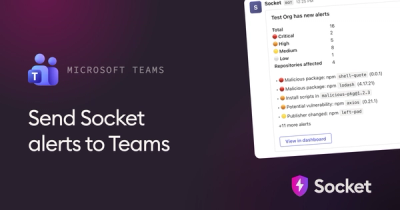
Microsoft Teams Notifications Are Now Available in Socket
Socket can now send alerts and supply chain attack notifications to Microsoft Teams, with filters that route the right updates to each channel.
By Jeppe Hasseriis - Sep 01, 2026
@opencode-ai/ai
Advanced tools
Schema-first AI primitives for opencode. Provider quirks live in adapters, not in calling code.
Schema-first AI primitives for opencode. Provider quirks live in adapters, not in calling code.
import { Effect, Layer } from "effect"
import { LLM, LLMClient } from "@opencode-ai/ai"
import { RequestExecutor } from "@opencode-ai/ai/route"
import { OpenAI } from "@opencode-ai/ai/providers"
const model = OpenAI.configure({ apiKey: process.env.OPENAI_API_KEY }).responses("gpt-4o-mini")
const request = LLM.request({
model,
system: "You are concise.",
prompt: "Say hello in one short sentence.",
generation: { maxTokens: 40 },
})
const program = Effect.gen(function* () {
const response = yield* LLMClient.generate(request)
console.log(response.text)
})
const llmLayer = LLMClient.layer.pipe(Layer.provide(RequestExecutor.fetchLayer))
await Effect.runPromise(program.pipe(Effect.provide(llmLayer)))
Run LLMClient.stream(request) instead of generate when you want incremental LLMEvents. The event stream is provider-neutral — same shape across OpenAI Chat, OpenAI Responses, Anthropic Messages, Gemini, Bedrock Converse, and any OpenAI-compatible deployment.
Use Image.generate with an image model for direct asset generation:
import { Image, ImageInput } from "@opencode-ai/ai"
import { OpenAI } from "@opencode-ai/ai/providers"

const program = Effect.gen(function* () {
  const response = yield* Image.generate({
    model: OpenAI.configure({ apiKey: process.env.OPENAI_API_KEY }).image("gpt-image-2"),
    prompt: "A robot tending a rooftop garden",
    options: {
      n: 2,
      size: "1024x1024",
      quality: "high", // inferred from the OpenAI image model
      outputFormat: "webp",
      future_option: true, // unknown native options pass through unchanged
    },
  })

  return response.images // GeneratedImage[] with owned bytes or a provider URL
})
Pass ordered image inputs to the same method for editing, composition, or image-conditioned generation:
const response =
  yield *
  Image.generate({
    model,
    prompt: "Combine these product photos into one studio scene",
    images: [
      ImageInput.bytes(firstBytes, "image/png"),
      ImageInput.url("https://example.com/second.webp"),
      ImageInput.file("file_123"),
    ],
    options,
    http,
  })
ImageInput.fileUri(uri, mediaType) represents provider file URIs such as Gemini Files. Raw strings are not
accepted as image inputs, avoiding ambiguity between base64, URLs, and provider IDs. Empty or omitted images
uses text-to-image generation; a non-empty array selects the provider's edit behavior without enforcing provider
image-count limits locally. images is the only common image-editing field. OpenAI uses multipart for byte/data-URL
edits and its JSON reference body for URL or file-ID edits. Its provider-specific options.mask accepts an
ImageInput for inpainting:
yield *
  Image.generate({
    model: OpenAI.configure({ apiKey }).image("gpt-image-2"),
    prompt,
    images: [ImageInput.bytes(sourceBytes, "image/png")],
    options: { mask: ImageInput.bytes(maskBytes, "image/png") },
  })
The OpenAI adapter extracts this helper value into the edit request's native mask field rather than passing the
tagged ImageInput object through as an ordinary option. On multipart requests, http.body can override option
fields but not structural model, prompt, image[], or mask fields, and the transport owns the multipart
Content-Type boundary. For JSON requests, http.body remains the final raw-native overlay. Gemini does not fetch
public HTTP URLs, and hosted Z.ai image generation does not accept image inputs. These cases fail with
InvalidRequest before network I/O.
Provider-native image options belong to each request. Raw http.body fields have final precedence over them:
const model = OpenAI.configure({ apiKey }).image("gpt-image-2")

yield *
  Image.generate({
    model,
    prompt,
    options: { quality: "medium" },
    http,
  })
xAI image models use the same request API with xAI-native controls:
yield *
  Image.generate({
    model: XAI.configure({ apiKey }).image("any-model-id"),
    prompt,
    options: {
      n: 2,
      aspectRatio: "16:9",
      resolution: "1k",
      responseFormat: "b64_json",
      future_option: true,
    },
    http,
  })
Google's current Gemini image models use the same direct API:
import { Google } from "@opencode-ai/ai/providers"

const googleProgram = Effect.gen(function* () {
  const response = yield* Image.generate({
    model: Google.configure({ apiKey }).image("any-model-id"),
    prompt: "A robot tending a rooftop garden",
    options: {
      aspectRatio: "16:9",
      imageSize: "2K",
      seed: 42,
      thinkingLevel: "HIGH",
      includeThoughts: true,
      futureOption: true,
    },
    http,
  })

  return response.images
})
Google image options are request-scoped and inferred from the selected model. Known fields autocomplete while
future string values and arbitrary native Gemini generationConfig fields remain available. Native fields override
their mapped aliases, and http.body is the final deep overlay. The selected model ID is sent to Gemini
generateContent without a local allowlist.
Z.ai image models infer open Z.ai-native options from the selected model:
yield *
  Image.generate({
    model: ZAI.configure({ apiKey }).image("any-model-id"),
    prompt,
    options: {
      quality: "hd",
      userID: "user-123",
      future_option: true,
    },
    http,
  })
Z.ai does not include trustworthy MIME metadata for output URLs, so generated images use
application/octet-stream. Output URLs expire after 30 days; download and persist them promptly if they must
remain available.
Conversational image generation remains part of the LLM interaction. OpenAI Responses exposes it through its hosted image tool:
const program = Effect.gen(function* () {
  const response = yield* LLM.generate(
    LLM.request({
      model: OpenAI.configure({ apiKey }).responses("gpt-5"),
      prompt: "Design a solarpunk rooftop garden, then show me.",
      tools: [OpenAI.imageGeneration({ quality: "high" })],
    }),
  )

  return response.message
})
The hosted result is represented as a provider-executed tool call and tool result. Its image is a file content item with a data URI, so retaining response.message preserves the generated image for continuation.
LLM.request({...}) — build a provider-neutral LLMRequest. Accepts ergonomic inputs (system: string, prompt: string) that normalize into the canonical Schema classes.LLM.generate / LLM.stream — re-exported from LLMClient for one-import use.Message.user(...) / Message.assistant(...) / Message.tool(...) — message constructors from the canonical schema model.LanguageModel.make(...) / ToolCallPart.make(...) / ToolResultPart.make(...) / ToolDefinition.make(...) — model and tool-related constructors from the canonical schema model.LLMEvent.is.* — typed guards (is.textDelta, is.toolCall, is.finish, …) for filtering streams.Image.generate({...}) — generate images through a provider-neutral image request and response model.ImageClient — Effect service and layer for image execution, parallel to LLMClient.Use the deterministic test client from @opencode-ai/ai/testing to script provider-neutral responses and inspect
the requests sent by code under test:
import { Effect } from "effect"
import { TestLLM } from "@opencode-ai/ai/testing"

const programWithTestClient = Effect.gen(function* () {
  const test = yield* TestLLM.Test
  yield* test.push(TestLLM.text("Hello from the test model", "text-1"))
  const result = yield* program
  console.log(yield* test.requests())
  return result
}).pipe(Effect.provide(TestLLM.testLayer()))
testLayer() provides the same object under LLMClient.Service and TestLLM.Test. Production consumes the
normal client; tests use the additional controls. Each layer build has fresh state.
test.push(...) queues one-shot responses in execution order. Each argument is one response.test.always(response) installs a repeatable fallback. The layer's fallback option sets its initial value.test.serve(request => response) installs a request-dependent fallback. always and serve replace each
other without changing queued replies; queued replies take precedence.test.requests() returns an array snapshot. transformRequest changes only the recorded observation;
serve receives the original canonical request.test.wait(count) waits for request arrivals, not output or completion, and supports concurrent waiters.test.gate() returns a scoped gate with countable started notifications and a release Effect. Release
unblocks all requests captured by that gate; closing its scope also releases it. Effect-aware test runners
already provide Scope.Constructing stream() or generate() does not record a request, invoke a responder, or consume a script.
Each execution does. An exhausted queue without a fallback defects immediately rather than waiting for a
future reply.
Generation responses remain canonical event arrays or arbitrary Stream<LLMEvent, AIError> values. The client consumes
supplied streams directly, preserving failure identity, finalizers, incomplete output, and post-finish tails;
it does not repair or truncate them.
For explicit compaction, script a CompactionResponse through push, always, or serve. Its replacement contains the next context window, including retained user messages. The client returns that result and usage directly, with the same lazy request recording and gates. Generation and compaction reject fixtures for the wrong operation instead of converting between response shapes.
The published legacy Service, layer, clientLayer, and module-level controls remain available as adapters
over the same implementation, including the legacy live requests array. New tests should use Test and
testLayer.
Compaction is opt-in. The package supports automatic compaction in OpenAI/Azure Responses and Anthropic Messages (including Claude on Vertex), and explicit compaction calls in OpenAI/Azure/xAI Responses. Model and deployment support still depends on the provider. Bedrock compaction is deferred to a separate follow-up.
This is different from prompt caching, server-side history storage, or truncation. Compaction returns provider-owned context that must be replayed to continue the conversation.
LLMClient.compact(request) is the caller-controlled operation for OpenAI, Azure, and xAI Responses. It performs exactly one HTTP call to /responses/compact, using the selected route's endpoint, credentials, query, and HTTP middleware. It returns a CompactionResponse with replacement: Message[] and optional usage, not a normal generation response.
Prefer this operation, where supported, when the application owns compaction policy and durable context updates.
const result = yield * LLMClient.compact(request)
const next = LLMRequest.update(request, {
  messages: result.replacement,
})
const response = yield * LLMClient.generate(next)
replacement replaces the complete input window. Do not append it to the original transcript or extract only the encrypted item: the provider may retain additional messages in its output. Retained user and assistant messages remain ordinary messages with typed text, media, or reasoning parts, in their original order. Provider-specific message IDs, status, and phase use providerMetadata, not a raw output array hidden in an assistant message. Unsupported returned item types fail explicitly.
The selected model carries explicit-compaction capability through request construction and updates. Calls using unsupported routes fail type checking. When the model is selected dynamically, narrow the request with LLMClient.canCompact(request) before calling LLMClient.compact; a model or route switch does not inherit the old capability. Runtime validation still rejects unsupported calls from untyped consumers. Capability describes the route's API, not whether every model or custom deployment supports the operation.
Generation-only body overlays such as stream and store are not sent to the compact endpoint. Supported compact controls such as service tier and prompt-cache settings preserve request defaults and HTTP-overlay precedence. Retained image and file detail settings survive serialization and replay.
The input must still fit the model's context window. Explicit compaction is not an overflow-recovery operation. Anthropic does not expose this operation in this package; its in-band compaction remains available below. Compatible routes do not inherit an explicit compact endpoint simply because they use a Responses protocol.
providerOptions.contextManagement lets the provider decide when to compact during an ordinary generate or stream call. This is an advanced option for callers that own persistence and recovery: persist the complete assistant message, including its checkpoint, before continuing. Enabling the option does not provide durable checkpoint storage, interruption recovery, or model-switch policy. Keep the prior context until a successful checkpoint has been persisted.
Inside an Effect.gen, enable OpenAI compaction with typed provider options:
import { LLM, LLMClient, LLMRequest, Message } from "@opencode-ai/ai"
import { OpenAI } from "@opencode-ai/ai/providers"

const request = LLM.request({
  model: OpenAI.configure({ apiKey }).responses("gpt-5.3-codex"),
  messages,
  providerOptions: {
    contextManagement: [{ type: "compaction", compactThreshold: 200_000 }],
  },
})
const response = yield * LLMClient.generate(request)
const next = LLMRequest.update(request, {
  messages: [...request.messages, response.message, Message.user("Continue")],
})
store: false remains the default. Keep the entire response.message, not just response.text. Compaction events become ordered CompactionParts alongside text and reasoning. The conversation contains everything needed to continue; there is no separate replay object or hidden provider transcript.
A compaction part has provider and exactly one representation: encrypted for Responses, or text for Anthropic. Responses also preserves the optional checkpoint id. These fields survive message serialization without becoming visible assistant text. Sending a checkpoint to another provider or an incompatible API fails rather than silently losing context.
import { CompactionPart, ProviderID } from "@opencode-ai/ai"

CompactionPart.make({ provider: ProviderID.make("openai"), id: "cmp_123", encrypted: "..." })
CompactionPart.make({ provider: ProviderID.make("anthropic"), text: "Summary of the conversation..." })
For Anthropic, use:
providerOptions: {
  contextManagement: {
    edits: [{
      type: "compact_20260112",
      trigger: { type: "input_tokens", value: 150_000 },
      pauseAfterCompaction: true,
      instructions: "Summarize the task and decisions. Do not call tools while summarizing.",
    }],
  },
}
compact-2026-01-12 to existing beta headers, including when replaying a checkpoint without enabling new compactions.response.finishReason.raw === "compaction". It occurs only if the threshold triggers compaction: pauseAfterCompaction does not mean "compact now". The caller explicitly issues the next request; the package never automatically resumes.content: null when summarization fails. This becomes a compaction part with text: null, which is not a successful replacement for prior history. The package never prunes history automatically.Usage totals include all reported Anthropic usage.iterations, including compaction. contextTokens separately reports the final message iteration's inclusive input size, when available. A compaction-only pause does not report a post-compaction context size. Raw iteration usage remains in providerMetadata.The AI package transports options and typed conversation parts. It does not schedule compaction, persist Session checkpoints, select history, switch providers, or replace Core's existing local compaction policy. Native compaction is not enabled for OpenCode Sessions by this feature; Session integration must persist these parts before enabling it. The AI SDK bridge rejects native compaction parts rather than dropping them. Provider-executed tool APIs and persistence changes are a separate follow-up.
Tests cover serialized round trips, real local HTTP plus a tool loop, WebSocket recovery, provider errors, malformed blocks, and usage accounting. Live provider tests are gated by RECORD=true and the relevant API keys:
# Run from packages/ai. Only records the selected new cassette group.
RECORD=true RECORDED_PREFIX=openai-compaction bun test test/provider/compaction.recorded.test.ts
RECORD=true RECORDED_PREFIX=xai-compaction bun test test/provider/compaction.recorded.test.ts
RECORD=true RECORDED_PREFIX=anthropic-compaction bun test test/provider/compaction.recorded.test.ts
Provider references: OpenAI, Azure, Anthropic, xAI.
Prompt caching is on by default. Every LLMRequest resolves to cache: "auto" unless the caller opts out with cache: "none". Each protocol translates CacheHints to its wire format (cache_control on Anthropic, cachePoint on Bedrock; OpenAI and Gemini do implicit caching server-side and don't need inline markers — auto is a no-op there).
"auto" places up to four breakpoints — the last tool definition, the first system part, the last system part when distinct, and the final message boundary. These expose successively larger reusable prefixes for tools, the base agent, project instructions, and the active conversation. The rolling final-message boundary advances on every request so recent conversation prefixes remain reusable during tool loops.
Tools precede every system and conversation block in the provider prefix, so tool definitions must remain byte-stable and deterministically ordered for downstream breakpoints to remain reusable.
Requests below a provider's minimum cacheable size simply do not produce a reusable cache entry.
LLM.request({
  model,
  system,
  prompt: "one-off question",
  cache: "none",
})
cache: {
  tools?: boolean,
  system?: boolean,
  messages?: "latest-user-message" | "latest-assistant" | { tail: number },
  ttlSeconds?: number,         // ≥ 3600 → 1h on Anthropic/Bedrock; else 5m
}
Inline CacheHint on any text / system / tool / tool-result part overrides automatic placement. The auto policy preserves manual hints, counts them against Anthropic and Bedrock's four-breakpoint limit, and only fills the remaining slots.
LLM.request({
  model,
  system: [
    { type: "text", text: "stable system prompt", cache: { type: "ephemeral" } },
  ],
  ...
})
| Protocol | cache: "auto" |
|---|---|
| Anthropic Messages | emits up to 4 cache_control markers (4-breakpoint cap enforced) |
| Bedrock Converse | emits up to 4 cachePoint blocks (4-breakpoint cap enforced) |
| OpenRouter | emits up to 4 cache_control markers |
| OpenAI Chat / Responses | no-op (implicit caching above 1024 tokens) |
| Gemini | no-op (implicit caching on 2.5+; explicit CachedContent is out-of-band) |
Normalized cache usage is read back into response.usage.cacheReadInputTokens and cacheWriteInputTokens across every provider.
Provider facades configure endpoint/auth/deployment details first, then expose model selectors that take only a model or deployment id. The selected model carries the executable route value used at runtime.
import { OpenAI, CloudflareAIGateway } from "@opencode-ai/ai/providers"

const openai = OpenAI.configure({ apiKey: process.env.OPENAI_API_KEY }).responses("gpt-4o-mini")
const gateway = CloudflareAIGateway.configure({
  accountId: process.env.CLOUDFLARE_ACCOUNT_ID,
  gatewayApiKey: process.env.CLOUDFLARE_API_TOKEN,
}).model("workers-ai/@cf/meta/llama-3.1-8b-instruct")
Included providers: OpenAI, Anthropic, Google (Gemini), Google Vertex Gemini and Anthropic, Amazon Bedrock, Azure OpenAI, Cloudflare AI Gateway, Cloudflare Workers AI, GitHub Copilot, OpenRouter, xAI, Z.ai, plus generic OpenAI-compatible Chat and Responses entrypoints and an Anthropic Messages-compatible entrypoint.
Native catalog integrations load provider behavior through package-like entrypoints. These are export paths from the same @opencode-ai/ai npm package, not independently published packages. Each entrypoint exports the same model(modelID, settings) contract, and settings contains serializable provider configuration plus common headers and body overlays.
import { model } from "@opencode-ai/ai/providers/openai/responses"

const selected = model("gpt-5", {
  apiKey: process.env.OPENAI_API_KEY,
  headers: { "x-application": "opencode" },
})
OpenAI Chat and OpenAI Responses are separate semantic entrypoints:
@opencode-ai/ai/providers/openai/chat@opencode-ai/ai/providers/openai/responses@opencode-ai/ai/providers/openai-compatible/responses@opencode-ai/ai/providers/anthropic-compatible@opencode-ai/ai/providers/google-vertex/gemini@opencode-ai/ai/providers/google-vertex/chat@opencode-ai/ai/providers/google-vertex/responses@opencode-ai/ai/providers/google-vertex/messagesOpenAI Responses has one semantic route and uses HTTP by default. Advanced callers may supply a per-call WebSocket channel executor through StreamOptions; transport policy does not change provider settings, model identity, or route identity. The provider-neutral Open Responses implementation owns the reusable WebSocket request and event contract, while each provider opts in with its own handshake and connection policy. Azure follows the same Chat/Responses split at providers/azure/chat and providers/azure/responses. Generic OpenAI-compatible Chat remains at providers/openai-compatible; the Responses adapter at providers/openai-compatible/responses uses the provider-neutral Open Responses protocol. OpenAI Responses extends that baseline with OpenAI tools, event variants, metadata, and defaults. Generic Anthropic Messages-compatible providers use providers/anthropic-compatible, which the named Anthropic provider composes. Google Gemini and Amazon Bedrock expose their single native API through their existing provider paths.
Vertex Gemini, Vertex Chat, Vertex Responses, and Vertex Messages are separate API entrypoints. All accept project, location, and an optional accessToken; when no explicit token or auth override is supplied they lazily use Google Application Default Credentials. Vertex Gemini instead selects express mode when apiKey or GOOGLE_VERTEX_API_KEY is present. Vertex Chat targets MaaS models through the OpenAI-compatible Chat Completions endpoint, while Vertex Responses targets Grok models and defaults store to false as required by Vertex. providers/google-vertex remains the default alias for providers/google-vertex/gemini.
Tuned Vertex Gemini deployments use model ids shaped like endpoints/1234567890 and require OAuth or ADC; Vertex express-mode API keys support publisher models only.
import { model } from "@opencode-ai/ai/providers/google-vertex/gemini"

model("gemini-3.5-flash", { project: "my-project", location: "global" })
import { model } from "@opencode-ai/ai/providers/google-vertex/chat"

model("deepseek-ai/deepseek-v3.2-maas", { project: "my-project", location: "global" })
import { model } from "@opencode-ai/ai/providers/google-vertex/responses"

model("xai/grok-4.20-reasoning", { project: "my-project", location: "global" })
import { model } from "@opencode-ai/ai/providers/google-vertex/messages"

model("claude-sonnet-4-6", { project: "my-project", location: "global" })
Provider facades such as OpenAI.configure(...).responses(...) remain the direct application API. Package-like entrypoints are the self-similar loading contract used when a catalog selects behavior by export path.
Other provider exports listed above remain direct facades until they explicitly implement the package-like contract. Exporting a provider facade does not implicitly make it a catalog-loadable provider package.
Request options in order of stability:
generation — portable knobs (maxTokens, temperature, topP, topK, penalties, seed, stop).promptCacheKey — stable cache affinity lowered by every protocol that supports it.providerOptions: { ... } — flat options inferred from the selected model (OpenAI store, Anthropic thinking, Gemini thinkingConfig, OpenRouter routing).http: { body, headers, query } — last-resort serializable overlays merged into the final HTTP request. Reach for this only when a stable typed path doesn't yet exist.Route/provider defaults are overridden by request-level values for each axis.
The selected model supplies the provider-specific option type, so per-request overrides stay flat while the canonical runtime request remains provider-neutral:
LLM.request({
  model,
  prompt,
  providerOptions: {
    reasoningEffort: "low",
  },
})
Adding a new model or deployment is usually 5-15 lines using Route.make({ protocol, endpoint, auth, framing, ... }). The route owns endpoint/auth/framing and the protocol owns body construction plus stream parsing. Transports are reusable IO templates that receive route endpoint/auth at compile time. Capability/catalog metadata lives outside this low-level package; unsupported request shapes fail during protocol lowering. See AGENTS.md for the architectural detail.
This package is built on Effect. Public methods return Effect or Stream; provide LLMClient.layer for LLM dispatch and ImageClient.layer for image dispatch, then import the provider/protocol modules for the routes you use. The example at example/tutorial.ts is a runnable walkthrough.
AGENTS.md — architecture, route construction, contributor guideexample/tutorial.ts — runnable end-to-end walkthroughtest/provider/*.test.ts — fixture-first protocol tests; *.recorded.test.ts files cover live cassettesFAQs
Bootstrap package for @opencode-ai/ai
The npm package @opencode-ai/ai receives a total of 73,301 weekly downloads. As such, @opencode-ai/ai popularity was classified as popular.
We found that @opencode-ai/ai demonstrated a healthy version release cadence and project activity because the last version was released less than a year ago. It has 2 open source maintainers collaborating on the project.
Product
Socket can now send alerts and supply chain attack notifications to Microsoft Teams, with filters that route the right updates to each channel.

Security News
pnpm 12 rewrites the package manager in Rust, cutting install times by up to 90% while preserving pnpm 11 workflows and lockfiles.
Security News
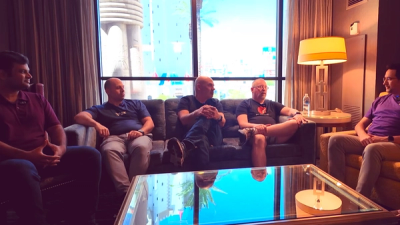
Socket CTO Ahmad Nassri joins AppSec leaders at Black Hat to discuss active malware, package manager risks, and software supply chain defense.