
Product
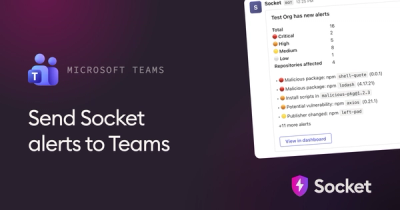
Microsoft Teams Notifications Are Now Available in Socket
Socket can now send alerts and supply chain attack notifications to Microsoft Teams, with filters that route the right updates to each channel.
By Jeppe Hasseriis - Sep 01, 2026
@opencode-ai/sdk
Advanced tools
In-process OpenCode host for Promise and Effect applications. The SDK executes Server's assembled HTTP router in memory, opening no listener and adding no network hop.
In-process OpenCode host for Promise and Effect applications. The SDK executes Server's assembled HTTP router in memory, opening no listener and adding no network hop.
import { OpenCode } from "@opencode-ai/sdk"
await using opencode = await OpenCode.create()
const session = await opencode.sessions.create({
location: { directory: "/workspace" },
})
Pass imported Promise plugins in plugins, or register one later with await opencode.plugin(plugin).
The Promise API uses the same values, errors, request options, and AsyncIterable streams as @opencode-ai/client.
Embedded hosts are silent by default. Set log to receive structured log entries:
await using opencode = await OpenCode.create({
  log: {
    level: "warn",
    emit: (entry) => console.error(entry.message, entry.attributes, entry.cause),
  },
})
close() and Symbol.asyncDispose release router resources, Location services, fibers, and scoped plugin registrations.
Use instances when Sessions in the same directory need different application plugins. The application selects a stable key from Session metadata; the SDK constructs and caches an instance for that key and the Session's current Location.
import { OpenCode } from "@opencode-ai/sdk"
import { threads } from "./threads"
import { slackPlugin } from "./slack-plugin"

await using opencode = await OpenCode.create({
  database: { path: "./sessions.db" },
  instances: {
    key(session) {
      const threadID = session.metadata?.threadID
      if (typeof threadID !== "string") throw new Error("Session has no thread ID")
      return threadID
    },
    configure: async (threadID) => ({
      plugins: [slackPlugin(await threads.get(threadID))],
    }),
  },
})

const session = await opencode.sessions.create({
  location: { directory: "/workspace" },
  metadata: { threadID: "thread-42" },
})
await opencode.sessions.prompt({ sessionID: session.id, text: "Review the changes" })
threads and slackPlugin are application-owned modules. key is synchronous and should only select identity, not initialize plugins. configure returns plugin definitions; their setup receives the selected instance's ctx.location.
configure runs on a cache miss, not on each prompt. Loaded instances live until the host closes; change the application key or restart the host to reconstruct their birth configuration. Plugin transforms and reloads remain available within that lifetime.plugins entry (the host plugin keeps the ID), prevents capability acquisition, without falling back to another instance. A subsequent request can retry a failed construction.instances preserves default Location sharing. Host-wide plugins remain separate from Session-selected configuration; retain host-wide catalog policy when locationless generation needs it.The selector is installed before automatic recovery starts. Its callbacks must be able to load application data without depending on the returned opencode handle or a later registration call. Functions are reconstructed, not serialized.
Use a persistent database.path to recover Sessions after restart; the default database is in memory. Workerd uses its injected Durable Object storage. After restart, the next capability-dependent operation or recovery drain rebuilds the selected instance from saved Session metadata and application data.
Promise plugin resources should be acquired in setup and released by its cleanup function. Effect configuration can acquire resources in its supplied instance Scope; capture application services before creating the SDK host.
Use the Workerd entrypoint inside a Cloudflare Durable Object. Hold one host for the lifetime of the object instance rather than creating one per request.
import { OpenCodeWorkerd } from "@opencode-ai/sdk/workerd"
import myPlugin from "./my-plugin"

export class OpenCodeDO {
  private readonly opencode: Promise<OpenCodeWorkerd.Interface>

  constructor(state: DurableObjectState) {
    this.opencode = state.blockConcurrencyWhile(() =>
      OpenCodeWorkerd.create({
        storage: state.storage,
        config: { default_agent: "build" },
        plugins: [myPlugin],
      }),
    )
  }

  async fetch() {
    const opencode = await this.opencode
    return Response.json(await opencode.health.get())
  }
}
blockConcurrencyWhile keeps every Durable Object event out until the host is ready and resets the object if initialization fails. The retained Promise gives request handlers direct access to the same host after startup. Configuration is a typed JavaScript object, and plugins are imported values bundled with the Worker.
The Effect-native API remains available from @opencode-ai/sdk/effect:
import { OpenCode } from "@opencode-ai/sdk/effect"

const opencode = yield * OpenCode.create()
const session = yield * opencode.sessions.get({ sessionID })
The Effect Workerd entrypoint is @opencode-ai/sdk/workerd/effect.
Effect configuration uses the same keys and lifetime rules, with canonical Session.Info values and an Effect-returning factory:
import { OpenCode } from "@opencode-ai/sdk/effect"
import { Effect, Schema } from "effect"
import { threads } from "./threads-effect"
import { slackPlugin } from "./slack-plugin-effect"

const threadMetadata = Schema.decodeUnknownSync(Schema.Struct({ threadID: Schema.String }))
const opencode =
  yield *
  OpenCode.create({
    database: { path: "./sessions.db" },
    instances: {
      key: (session) => threadMetadata(session.metadata).threadID,
      configure: (threadID) => threads.get(threadID).pipe(Effect.map((thread) => ({ plugins: [slackPlugin(thread)] }))),
    },
  })
Both Workerd entrypoints also accept instances. The public OpenCode.InstanceOptions and OpenCode.InstanceConfiguration types describe the corresponding Promise or Effect callbacks.
FAQs
Unknown package
The npm package @opencode-ai/sdk receives a total of 10,822,801 weekly downloads. As such, @opencode-ai/sdk popularity was classified as popular.
We found that @opencode-ai/sdk demonstrated a healthy version release cadence and project activity because the last version was released less than a year ago. It has 2 open source maintainers collaborating on the project.
Product
Socket can now send alerts and supply chain attack notifications to Microsoft Teams, with filters that route the right updates to each channel.

Security News
pnpm 12 rewrites the package manager in Rust, cutting install times by up to 90% while preserving pnpm 11 workflows and lockfiles.
Security News
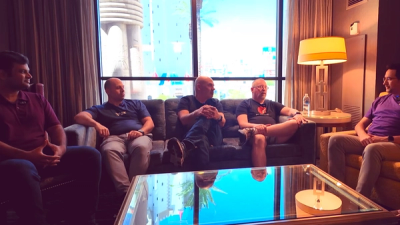
Socket CTO Ahmad Nassri joins AppSec leaders at Black Hat to discuss active malware, package manager risks, and software supply chain defense.