A light-weight meta-prompting, context engineering, and spec-driven development system for Claude Code, OpenCode, Antigravity CLI, Kimi CLI, Kilo, Codex, Copilot, Cursor, Windsurf, and more.
What is GSD Core
GSD Core is a context-engineering and spec-driven development framework that drives AI coding agents (Claude Code, Codex, Antigravity CLI, Kimi CLI, Copilot, Cursor, and more) through a disciplined phase loop. It solves context rot — the quality degradation that accumulates as an AI fills its context window — by running all heavy research, planning, and execution work in fresh-context subagents while keeping your main session lean.
How it works
Each milestone repeats the same five-step loop, one phase at a time:
Discuss — capture implementation decisions before anything is planned
Plan — research, decompose, and verify the plan fits a fresh context window
Execute — run plans in parallel waves; each executor starts with a clean 200k-token context
Verify — walk through what was built; diagnose and fix before declaring done
Ship — create the PR, archive the phase, repeat for the next one
Quickstart
npx @opengsd/gsd-core@latest
The installer prompts for your runtime (Claude Code, OpenCode, Antigravity CLI, Kimi CLI, Kilo, Codex, Copilot, Cursor, Windsurf, and more) and whether to install globally or locally. The installer is required for cross-runtime compatibility — do not copy files from agents/ or commands/ directly.
Most AI-coding setups fail at scale because context bloat silently degrades output quality, there is no shared memory between sessions, and nothing verifies that code actually works. GSD Core solves all three: heavy work runs in fresh subagents, structured artifacts like STATE.md and CONTEXT.md survive session boundaries, and the verify step walks through what was built and generates fix plans before a phase is declared done. See docs/explanation/context-engineering.md for the full reasoning.
GSD Core is a meta-prompting, context engineering, and spec-driven development system for AI coding agents.
The npm package @opengsd/gsd-core receives a total of 3,907 weekly downloads. As such, @opengsd/gsd-core popularity was classified as popular.
We found that @opengsd/gsd-core demonstrated a healthy version release cadence and project activity because the last version was released less than a year ago.It has 3 open source maintainers collaborating on the project.
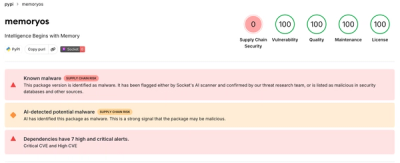
The compromise affects MemTensor's MemOS, an open source memory framework for large language models (LLMs) and AI agents. Both npm package @memtensor/memos-cloud-openclaw-plugin and the PyPI package MemoryOS are compromised. They drop cross-platform Go binaries that exfiltrate developer secrets.