OpenNext takes the Next.js build output and converts it into packages that can be deployed across a variety of environments. Natively OpenNext has support for AWS Lambda, and classic Node.js Server.
Features
OpenNext aims to support all Next.js 15 features. Some features are work in progress. If you are running into any problems make sure to check the docs first before you open a new issue or visit our Discord to let us know!
For personalisation you need to create a file open-next.config.ts at the same place as your next.config.js, and export a default object that satisfies the OpenNextConfig interface. It is possible to not have an open-next.config.ts file, the default configuration will then be applied automatically.
Debug mode
OpenNext can be executed in debug mode by setting the environment variable OPEN_NEXT_DEBUG=true before your build.
This will output A LOT of additional logs to the console. This also disable minifying in esbuild, and add source maps to the output. This can result in code that might be up to 2-3X larger than the production build. Do not enable this in production.
You can read more about the configuration in the docs
Preleases
Besides the standard npm releases we also automatically publish prerelease packages on branch pushes (using pkg.pr.new):
https://pkg.pr.new/@opennextjs/aws@main:
Updated with every push to the main branch, this prerelease contains the most up to date yet (reasonably) stable version of the package.
https://pkg.pr.new/@opennextjs/aws@experimental
Updated with every push to the experimental branch, this prerelease contains the latest experimental version of the package (containing features that we want to test/experiment on before committing to).
Which you can simply install directly with your package manager of choice, for example:
npm i https://pkg.pr.new/@opennextjs/aws@main
Contribute
To run OpenNext locally:
Clone this repository.
Build open-next:
cd packages/open-next
pnpm build
Run open-next in watch mode:
pnpm dev
Now, you can make changes in open-next and build your Next.js app to test the changes.
cd path/to/my/nextjs/app
path/to/opennextjs-aws/packages/open-next/dist/index.js build
There is also a way to run OpenNext locally. You can read a guide about it here. Its mostly used for development/debugging purposes.
OpenNext provide you with a warmer function that can be used to reduce cold start.
On Lambda, there are multiple scenarios where a lambda will trigger a cold start even if you have some warmed instance. For example if you have more requests than warm instances you'll get a cold start. Also NextJs lazy load the routes, so even if you hit a warm instance, this specific route might not have been loaded yet.
Acknowledgements
We are grateful for the projects that inspired OpenNext and the amazing tools and libraries developed by the community:
nextjs-lambda by Jan for serving as inspiration for packaging Next.js's standalone output to Lambda.
CDK NextJS by JetBridge for its contribution to the deployment architecture of a Next.js application on AWS.
serverless-http by Doug Moscrop for developing an excellent library for transforming AWS Lambda events and responses.
The npm package @opennextjs/aws receives a total of 817,969 weekly downloads. As such, @opennextjs/aws popularity was classified as popular.
We found that @opennextjs/aws demonstrated a healthy version release cadence and project activity because the last version was released less than a year ago.It has 1 open source maintainer collaborating on the project.
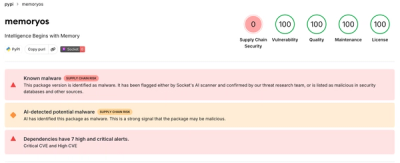
The compromise affects MemTensor's MemOS, an open source memory framework for large language models (LLMs) and AI agents. Both npm package @memtensor/memos-cloud-openclaw-plugin and the PyPI package MemoryOS are compromised. They drop cross-platform Go binaries that exfiltrate developer secrets.