


Security News
arXiv Is Rate Limiting Authors Following a Flood of AI Slop Submissions
arXiv now limits authors to two submissions a month as AI slop overwhelms moderators, delays good papers, and sparks debate over applying the limit to everyone.
@orpc/standard-server-fetch
Advanced tools
oRPC is a powerful combination of RPC and OpenAPI, makes it easy to build APIs that are end-to-end type-safe and adhere to OpenAPI standards
You can find the full documentation here.
@orpc/standard-server-fetchFetch API server adapter for oRPC.
If you find oRPC valuable and would like to support its development, you can do so here: GitHub Sponsors.
ScreenshotOne.com |
ζδΈγγ |
LN Markets |
Reece McDonald | nk | supastarter | Dexter Miguel | herrfugbaum | Ryota Murakami |
David Cramer | Valerii Petryniak | Valerii Strilets | Kyle Mistele | christ12938 | Ryan Soderberg |
shota | Ellis Driscoll |
David Walsh | Robbe Vaes | Aidan Sunbury | soonoo | Kevin Porten | Denis | Christopher Kapic |
Tom Ballinger | Sam | Titoine | Igor Makowski | hanayashiki | Lev Dubinets | Kelly Peilin Chan |
Alex | Andrey Gubanov |
Distributed under the MIT License. See LICENSE for more information.
FAQs
Unknown package
The npm package @orpc/standard-server-fetch receives a total of 877,039 weekly downloads. As such, @orpc/standard-server-fetch popularity was classified as popular.
We found that @orpc/standard-server-fetch demonstrated a healthy version release cadence and project activity because the last version was released less than a year ago.Β It has 1 open source maintainer collaborating on the project.

Security News
arXiv now limits authors to two submissions a month as AI slop overwhelms moderators, delays good papers, and sparks debate over applying the limit to everyone.

Research
/Security News
A new GhostAction wave hits hundreds of GitHub repos, expanding CI/CD secret theft to cloud and AI credentials in source code and git history.

Research
/Security News
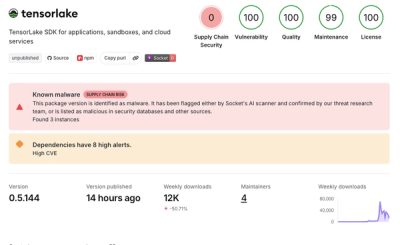
Tensorlake npm SDK version 0.5.144 was compromised in a ChainDrop / Shai-Hulud attack, delivering credential-stealing malware.