@particlr/runtime

Plays .prt particle effects in PixiJS v8 (and PixiJS v7, via a separate
subpath — see below). Design effects visually in the
particlr editor, export a .prt file, play it
back with this package. The editor previews through this exact runtime, and
playback is deterministic (same document + seed ⇒ same frames) — so what you
tune is what you ship.
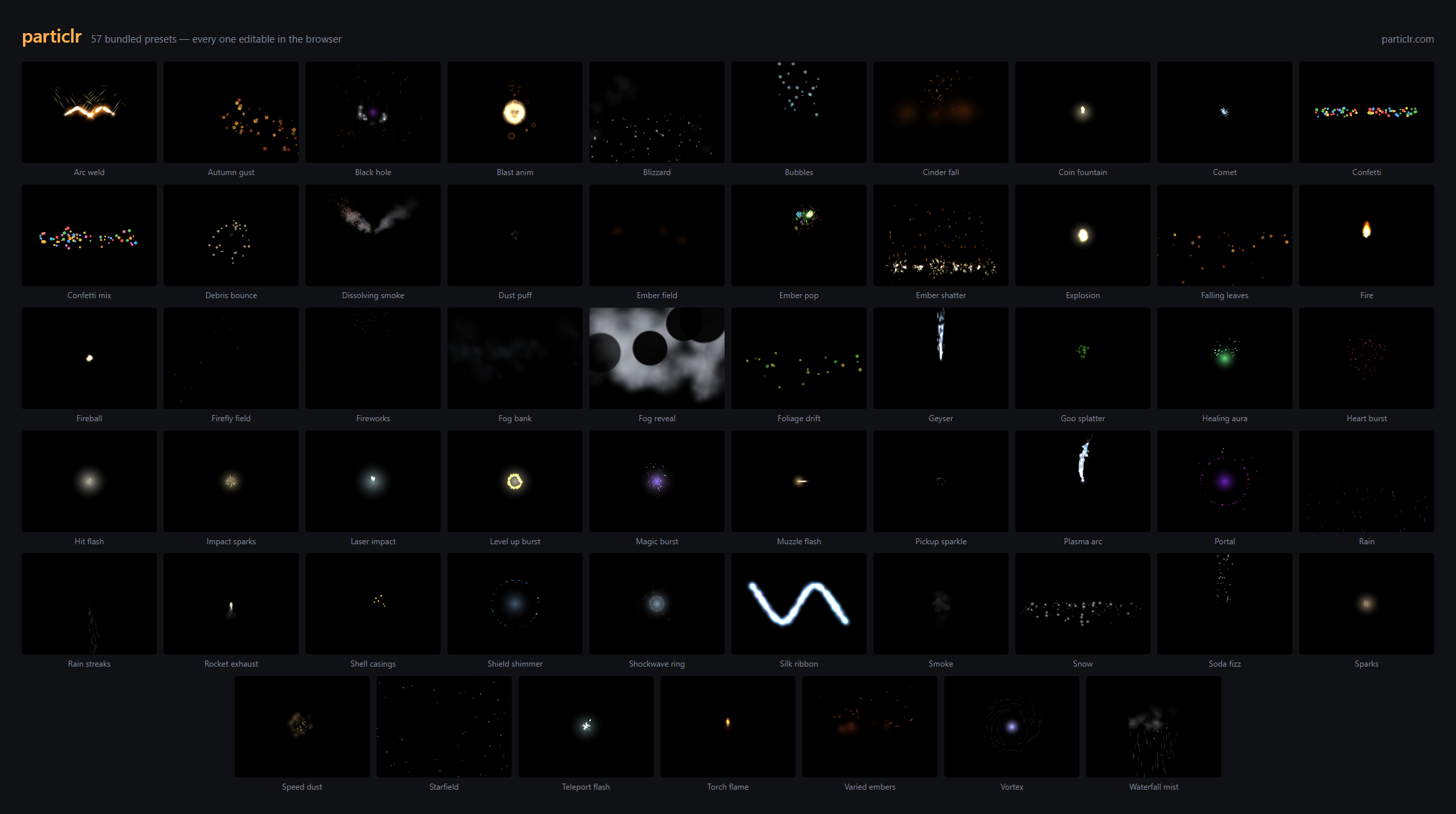
The editor ships 57 CC0 presets — every frame above was rendered by this
package. Open any of them at particlr.com, tune it,
export, and play it back here.
Install
npm install @particlr/runtime pixi.js
Use
import { Application } from "pixi.js";
import { parseParticle, Effect } from "@particlr/runtime";
import { PixiParticleRenderer } from "@particlr/runtime/pixi";
const app = new Application();
await app.init({ width: 800, height: 600 });
document.body.appendChild(app.canvas);
const doc = parseParticle(await (await fetch("boom.prt")).text()).doc!;
const fx = new Effect(doc, { seed: 1337 });
const view = new PixiParticleRenderer(fx);
view.container.position.set(400, 300);
app.stage.addChild(view.container);
app.ticker.add((t) => {
fx.step(t.deltaMS / 1000);
view.sync();
});
That's the whole integration. Live example:
particlr.com/sample.
Pixi v7
Games still on PixiJS v7 (the v7 → v8 migration is a large lift) can consume the
same .prt effects without migrating. The v7 adapter lives on its own subpath —
one subpath per major: ./pixi is the v8 adapter, ./pixi7 is the v7
adapter. The pixi.js peer range is ">=7.2.0 <9", and the v7 adapter is
developed and golden-tested against pixi.js 7.4.3.
The only differences from the v8 snippet above are the v7 Application idiom
(the constructor is synchronous — no await app.init() — and the canvas is
app.view, typed as ICanvas, hence the cast) and the import path:
import { Application } from "pixi.js";
import { parseParticle, Effect } from "@particlr/runtime";
import { PixiParticleRenderer } from "@particlr/runtime/pixi7";
const app = new Application({ width: 800, height: 600 });
document.body.appendChild(app.view as HTMLCanvasElement);
const doc = parseParticle(await (await fetch("boom.prt")).text()).doc!;
const fx = new Effect(doc, { seed: 1337 });
const view = new PixiParticleRenderer(fx);
view.container.position.set(400, 300);
app.stage.addChild(view.container);
app.ticker.add(() => {
fx.step(app.ticker.deltaMS / 1000);
view.sync();
});
The public API is identical to ./pixi — migrating between majors is a one-line
import change. The v7 adapter is at full feature parity: flipbooks, trails
(including connect ribbons), sub-emitter rendering (driven by the shared core),
and dissolve (via a forked v7 particle pipeline). The one hard limit is the
renderer: v7 has no WebGPU, so the v7 adapter is WebGL only.
Performance note, measured honestly: v7's ParticleContainer renders full
Sprite objects where v8 renders lightweight Particle structs, so the v7
adapter costs more CPU per frame by construction — in our benchmarks (~500
live particles, high churn, real Chromium) the v7 adapter spends ~1.3 ms per
frame where v8 spends ~0.1 ms. Both are far under a 60 fps budget; at typical
2D-game particle counts this is not a limiting factor, but if you are pushing
tens of thousands of particles, v8 is the faster target.
Builtin textures without Pixi
The five builtin textures (circle-soft, circle-hard, square, spark,
smoke) are generated as pure-math straight-alpha RGBA pixel buffers — no
canvas, no GPU, no pixi.js. They are the same bytes every adapter uploads.
If you are writing a renderer for another engine and only need those buffers,
import them from the ./textures subpath, which pulls in zero Pixi code:
import { generateBuiltinTexture, type TextureData } from "@particlr/runtime/textures";
const tex: TextureData = generateBuiltinTexture("circle-soft");
This entry needs no pixi.js peer and runs in bare Node. The ./pixi and
./pixi7 adapters continue to re-export generateBuiltinTexture for existing
consumers, so nothing changes for Pixi users.
Going further
Effect also has a movable emitter for trails (setEmitterPosition),
playback control (timeScale, onDone), a host-driven attractor
(setAttractor), and per-instance parameters (setParam, setColorParam) —
one boom.prt, many weapons. The full API is documented in the shipped
TypeScript types, and the .prt format's reference is the bundled JSON
Schema: import schema from "@particlr/runtime/particle.schema.json".
License
MIT. See LICENSE.