

Company News
AWS Security Hub Adds Socket for Supply Chain Security
Socket is now in the AWS Security Hub Extended plan. Adopt it through AWS, apply committed spend, and block malicious open source packages.
By Feross Aboukhadijeh - Aug 04, 2026
@picoberry/mcp-server
Advanced tools
PicoBerry MCP server — generate game-ready 3D models, images, and animations from any MCP client. Several 3D and image engines behind one API (query list_models for the live set); a thin wrapper over the PicoBerry /v1 API.

Generate game-ready 3D models, images, and animations from any MCP client —
Claude Code, Cursor, Claude Desktop, Cline — with no HTTP glue. A thin wrapper
over the PicoBerry /v1 API, so you get PicoBerry's
multi-engine pipeline directly inside your agent. Several 3D and image engines
sit behind one API; call list_models for the live set and each engine's cost.
There's no separate subscription for the MCP or the API. Generation spends the same prepaid PicoBerry credits as the web app, per engine, at rates you can read with
list_modelsbefore you spend anything. (Using the API does require a completed purchase — see Get an API key.)
No install needed — run it with npx:
// Claude Code:  .mcp.json   ·   Claude Desktop:  claude_desktop_config.json
{
  "mcpServers": {
    "picoberry": {
      "command": "npx",
      "args": ["-y", "@picoberry/mcp-server"],
      "env": {
        "PICOBERRY_API_KEY": "pb_live_xxxxxxxxxxxxxxxx"
      }
    }
  }
}
Cursor uses the same shape in ~/.cursor/mcp.json.
Sign in at https://picoberry.ai, open the API Keys tab in your dashboard, and hit Create key. The key is shown once — copy it immediately and treat it like a password.
API access needs a completed purchase: a subscription or a one-off credit pack. A purchase entitles you permanently — you don't need a current subscription. (An active paid subscription works too, of course.)
| Var | Required | Default | Notes |
|---|---|---|---|
PICOBERRY_API_KEY | ✅ | — | pb_live_... |
PICOBERRY_API_BASE | — | https://api.picoberry.ai | leave unset unless you were given a different host |
| Tool | What it does |
|---|---|
list_models | Engines + credit cost for a category (3d / image / remesh / texture / animate). Call before generating — don't hardcode engines. |
list_animation_presets | Animation preset ids (engine-specific), with optional substring filter. |
get_credits | Current credit balance + plan. |
generate_image | Text → image (+ optional reference image URLs). |
generate_3d_from_text | Text → 3D model (GLB). |
generate_3d_from_image | Image → 3D model. Single: image_url or local image_path. Multi-view (2–4 views, higher fidelity): image_urls or image_paths, ordered [front, left, back, right] — tripo*/meshy6/hunyuan-3.x only. |
remesh | Retopologize an existing 3D asset → new asset. |
texture | Re-texture (PBR) an existing 3D asset → new asset. |
animate | Auto-rig + animate an existing 3D character → new asset. |
get_asset | Status + result URLs for one asset. |
wait_for_asset | Poll until an asset finishes (or times out), then return it. |
list_my_assets | Browse your generated assets. |
download_asset | Export a completed 3D asset (glb / fbx / obj) → signed URL. |
Generation is asynchronous:
generate_3d_from_text({ prompt }) → returns an asset { id }.wait_for_asset({ asset_id: id }) → polls until taskStatus === 2 (succeeded).files.model (GLB) or files.image (PNG).taskStatus: 0 pending · 1 processing · 2 succeeded · 3 failed. Result
URLs are signed and short-lived — download promptly. Errors come back with an
actionable message (e.g. an unknown engine returns the list of valid names).
"Make a low-poly treasure chest, retopo it to 3k tris, and give me a Unity FBX."
list_models(category="3d")                         → pick an engine
generate_3d_from_text(prompt="low-poly treasure chest, game ready")  → { id: A }
wait_for_asset(asset_id=A)                          → taskStatus 2
remesh(asset_id=A, polycount=3000)                  → { id: B }
wait_for_asset(asset_id=B)
download_asset(asset_id=B, format="fbx", texture_preset="unity")  → signed URL
Run this next to blender-mcp and the
agent can generate with PicoBerry, then import into Blender in one flow:
{
  "mcpServers": {
    "picoberry": { "command": "npx", "args": ["-y", "@picoberry/mcp-server"], "env": { "PICOBERRY_API_KEY": "pb_live_..." } },
    "blender":   { "command": "uvx", "args": ["blender-mcp"] }
  }
}
npm install
npm run build      # tsc → dist/
PICOBERRY_API_KEY=pb_live_... npm start
Run Actions → Publish → Run workflow (or push a v* tag). It publishes to
npm and then to the official MCP registry, in that order — the registry
validates by fetching the package's npm metadata and matching its mcpName
against server.json's name, so npm has to land first. A guard step checks
every invariant (name/version agreement, namespace casing, version not already
on npm) before anything is published, because npm versions are immutable and a
failed half-publish burns the number.
Bump version in both package.json and server.json (version and
packages[0].version) — the guard fails the run if they disagree.
One-time setup — no secrets. Both publishes authenticate over the workflow's
GitHub OIDC token (id-token: write). There is nothing to store or rotate.
The only step is telling npm to trust this workflow. On npmjs.com go to @picoberry/mcp-server → Settings → Trusted publishing → GitHub Actions and enter:
| Field | Value |
|---|---|
| Organization or user | UModeler |
| Repository | picoberry-mcp |
| Workflow filename | publish.yml |
| Environment name | (leave empty) |
| Allowed actions | npm publish |
The workflow filename must match exactly — it is part of what npm verifies.
The MCP registry needs no setup at all: mcp-publisher exchanges the Actions
OIDC token, and the registry grants io.github.<repository_owner>/* from the
token's repository_owner claim. That covers io.github.UModeler/picoberry-mcp
and avoids the interactive browser login (which additionally requires org Owner).
Trusted Publishing needs npm >= 11.5.1, so the workflow runs on Node 24 (npm 11.x). Node 22 still bundles npm 10.9 and would fail — the
node-versionpin is load-bearing. A guard step fails the run early if the runner ever ships an older npm.
The namespace is compared byte-exactly —
io.github.UModeler/..., matching the GitHub org's login. A lowercasedio.github.umodeler/...is rejected 403.
After publishing, claim the Glama listing
— unclaimed servers get limited discoverability, and awesome-mcp-servers gates
its PRs on a Glama badge in CI.
MIT
FAQs
PicoBerry MCP server — generate game-ready 3D models, images, and animations from any MCP client. Several 3D and image engines behind one API (query list_models for the live set); a thin wrapper over the PicoBerry /v1 API.
The npm package @picoberry/mcp-server receives a total of 68 weekly downloads. As such, @picoberry/mcp-server popularity was classified as not popular.
We found that @picoberry/mcp-server demonstrated a healthy version release cadence and project activity because the last version was released less than a year ago. It has 1 open source maintainer collaborating on the project.
Did you know?

Socket for GitHub automatically highlights issues in each pull request and monitors the health of all your open source dependencies. Discover the contents of your packages and block harmful activity before you install or update your dependencies.
Company News
Socket is now in the AWS Security Hub Extended plan. Adopt it through AWS, apply committed spend, and block malicious open source packages.
Research
/Security News
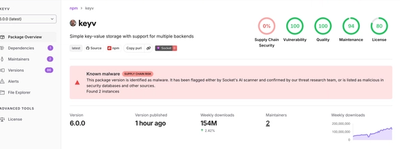
Popular npm packages keyv and cacheable compromised.

Security News
A misconfiguration gave three Anthropic models internet access, and one, believing it was in a simulation, shipped a credential-stealing package to PyPI.